Land Safely with Suraksha Marine
Premier OPITO Training for Offshore Excellence
Join the Suraksha Marine Legacy

Complete the form below to register for your preferred OPITO training course or request additional details. Our team will get back to you within 24 hours.
Suraksha Marine
Pioneering Offshore Safety and Excellence in Global Standards Training
At Suraksha Marine, we are more than just a training provider—We are your partners in safety! Dedicated to empowering offshore professionals with the skills and certifications, the need is to thrive in the high-stakes world of the oil and gas industry.
As an OPITO-approved training organization, our journey is rooted in a relentless commitment to safety, innovation, and global excellence. Below, explore how Suraksha Marine sets the standard for offshore training and our inspiring story of becoming a trusted name in the industry.

1. Helicopter Safety Training
(HUET, CA-EBS)
Master Helicopter Escape and Breathing System Skills
Industries Served:
-
Oil & Gas Exploration & Production (offshore rigs, FPSOs, drilling platforms)
-
Offshore Wind & Renewable Energy (floating turbines, substations)
-
Maritime Shipping & Logistics (helicopter-serviced vessels)
-
Offshore Construction & Infrastructure (project sites with helideck access)
-
Subsea Operations (cable installation, ROV support vessels)
-
Emergency Services & SAR Operations
The Critical Need:
Helicopter transport remains the primary lifeline for offshore operations, with over 2.3 million passengers traveling to offshore installations annually in global waters. However, helicopter ditching incidents present one of the most severe survival challenges in offshore environments. Without proper training, survival rates drop to just 58%—but with OPITO-approved HUET and CA-EBS training, survival rates reach 100% in controlled scenarios
Our Comprehensive Course Portfolio:
What Sets Suraksha Marine Apart:
-
State-of-the-Art Simulators:
180-degree inversion HUET pools with variable lighting and cold-water conditions replicating North Sea environments -
CA-EBS Excellence:
India's first and only training center approved for advanced Compressed Air Emergency Breathing System training -
Real-World Scenarios:
Training includes equipment malfunctions, debris, and fuel-contaminated water drills based on actual incident analysis -
Proven Results:
Our training methodology directly addresses the survival techniques that saved 14 of 18 lives in the 2013 Sumburgh helicopter crash
Course
HUET with CA-EBS - 1 Day
HUET with EBS - 1 Day
Tropical HUET- 1 Day
Key Industries
Oil & gas, wind energy, maritime
International offshore operations
Gulf of Mexico, Southeast Asia operations
Certification
OPITO Standard 5295 (4-year validity)
OPITO certified (4-year validity)

2. Emergency Response
(BOSIET, FOET, OERTM)
Prepare for Crises with Hands-On Simulations
Industries Served:
-
Oil & Gas Upstream Operations (drilling rigs, production platforms, FPSOs)
-
Offshore Wind & Renewable Energy (installation and maintenance crews)
-
Maritime Transport & Logistics (cargo vessels, supply boats, heavy-lift operations)
-
Offshore Construction & Infrastructure (jacket installation, subsea construction)
-
Emergency Services & Response Teams (coast guard, offshore rescue operations)
-
Marine Insurance & Risk Management (loss adjusters, surveyors, safety consultants)
The Emergency Response Imperative:
Major offshore incidents—from the Piper Alpha disaster (167 fatalities) to Mumbai High North (22 fatalities)—demonstrate that the difference between catastrophe and controlled response lies in comprehensive emergency training. Modern offshore operations demand teams capable of immediate, coordinated response to fires, gas leaks, medical emergencies, and platform abandonment scenarios.
Our OPITO-Approved Emergency Response Portfolio:
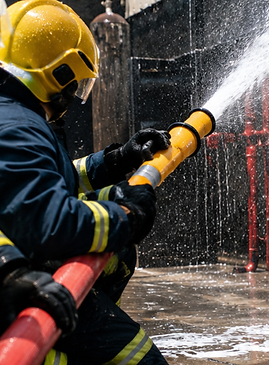
BOSIET
(Basic Offshore Safety Induction and Emergency Training):
-
Safety Induction:
Offshore hazards identification, risk management systems, regulatory compliance -
Helicopter Safety & Escape:
Pre-flight procedures, emergency protocols, underwater escape techniques -
Sea Survival & First Aid:
Personal survival equipment, hypothermia prevention, basic medical response -
Firefighting & Self-Rescue:
Portable equipment operation, smoke-filled environment escape, emergency evacuation
OERTM (Offshore Emergency Response Team Member):
-
Fire Response Leadership:
Advanced firefighting systems, foam operations, breathing apparatus control -
Search & Rescue:
Missing personnel location, casualty handling, coordinated team operations -
Incident Command:
Emergency briefings, communication protocols, post-incident debriefing -
Technical Operations:
Fixed fire system operation, hazmat response, multi-platform coordination
Course
BOSIET with CA-EBS - 3 days
FOET (refresher) - 1 day
OERTM Initial - 4-5 days
OERTM Further - 2-3 days
Tropical BOSIET - 3 days
Key Industries
Oil & Gas Exploration & Production,
Offshore Wind & Renewable Energy,
Offshore Mining,
Offshore Construction & Infrastructure,
Maritime Shipping & Logistics
Renewables
Wind Energy
FPUs/FPSOs
Construction
Subsea Services
Aquaculture
Certification
OPITO 4-year validity
OPITO 2-year validity
3. Gas Safety (Basic H2S)
Learn to Detect and Respond to Hydrogen Sulfide Hazards
Industries Served:
-
Oil & Gas Exploration & Production (drilling rigs, wellheads, processing facilities)
-
Offshore Mining & Dredging (subsea extraction, mineral processing)
-
Petrochemical & Refining Operations (floating refineries, process platforms)
-
Wastewater Treatment & Municipal Services (offshore treatment facilities)
-
Geothermal Energy Operations (thermal extraction platforms)
-
Marine Construction (pipeline installation, subsea infrastructure)
The Hidden Killer:
Hydrogen sulfide (H2S) is one of offshore operations' most lethal hazards—colorless, flammable, and capable of causing immediate unconsciousness at concentrations above 500 ppm. A single breath at 1000+ ppm can be fatal.
Historical incidents demonstrate that proper H2S training is not optional but essential for anyone working in environments where hydrocarbon extraction, processing, or transportation occurs.
Critical H2S Facts:
-
Detection Threshold: 0.13 ppm (rotten egg smell)
-
Occupational Limits: 10 ppm (8-hour exposure), 15 ppm (short-term exposure)
-
Immediate Danger: 100+ ppm causes respiratory system paralysis
-
Fatality Risk: 500+ ppm causes immediate collapse and death
Our Comprehensive H2S Training Program:
H2S Properties & Hazards:
-
Formation processes and common occurrence locations
-
Chemical characteristics and concentration measurements (ppm)
-
Physiological effects from mild irritation to fatal exposure
-
Environmental factors affecting H2S dispersion and accumulation
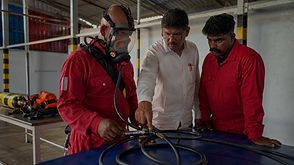
Detection & Monitoring Systems:
-
Personal H2S detectors: pre-use checks and operation procedures
-
Fixed installation monitoring systems and alarm interpretation
-
Calibration requirements and maintenance protocols
-
Integration with platform emergency shutdown systems
Personal Protective Equipment:
-
Emergency breathing apparatus (EBA) selection and sizing
-
Self-contained breathing apparatus (SCBA) for rescue operations
-
Cascade breathing system connections and disconnection procedures
-
PPE integration for comprehensive protection protocols
Emergency Response Procedures:
-
Immediate response to H2S alarms and detection
-
Evacuation routes and assembly point procedures
-
Rescue team coordination and victim recovery
-
Communication protocols during gas emergencies
Course
BASIC H2S
Theoretical Foundation
Equipment Training
Emergency Response
Key Industries
Oil & Gas Exploration & Production,
Offshore Wind & Renewable Energy,
Offshore Mining,
Offshore Construction & Infrastructure,
Maritime Shipping & Logistics
Renewables
Wind Energy
FPUs/FPSOs
Construction
Subsea Services
Aquaculture
Certification
OPITO 4-year validity
OPITO 2-year validity

4. Boat Safety (TSbB)
Ensure Safe Transfers with Expert-Led Training
Industries Served:
-
Maritime Shipping & Logistics (cargo vessels, container ships, tankers)
-
Offshore Wind & Renewable Energy (crew transfer vessels, maintenance boats)
-
Oil & Gas Operations (supply boats, standby vessels, anchor handlers)
-
Offshore Construction (heavy-lift barges, construction support vessels)
-
Aquaculture & Marine Farming (fish farm service boats, transport vessels)
-
Port Operations & Pilotage (harbor boats, pilot transfers, marine services)
The Critical Boat Transfer Challenge:
When helicopters are grounded due to weather conditions—as occurred during the Mumbai High North disaster when 35-knot winds and 5-meter swells made aerial evacuation impossible—boat transfers become the primary means of offshore access. However, boat-to-platform transfers present unique risks: vessel collision, personnel falls overboard, and equipment entanglement. The Travel Safely by Boat (TSbB) program addresses these specific hazards with comprehensive training designed for real-world conditions
OPITO TSbB Training Portfolio:
Comprehensive Training Modules:
Boat Travel & Transfer Safety:
-
Pre-Transfer Briefings: Weather assessment, sea state evaluation, transfer risk analysis
-
Embarkation/Disembarkation: Safe boarding procedures, personnel accountability, equipment handling
-
Swing Rope Transfers: Proper technique, luggage transfer methods, hazard identification and control
-
Personal Flotation Devices: Correct donning procedures, inspection requirements, emergency deployment
Emergency Response Procedures:
-
Man Overboard (MOB): Immediate response actions, recovery procedures, communication protocols
-
Boat Emergencies: Engine failure, collision scenarios, fire response, emergency evacuation
-
Life Raft Operations: Deployment procedures, boarding techniques, in-water survival
-
Sea Survival Skills: Hypothermia prevention, group survival tactics, rescue signaling
Course
TSbB Initial Training
TSbB Further Training
TSbB Supplementary Training
Key Industries
Oil & Gas Exploration & Production
Offshore Wind & Renewable Energy
Offshore Construction & Infrastructure
Maritime Shipping & Logistics
Aquaculture & Marine Farming
Subsea Telecommunications & Cables
Marine Construction
Logistics & Marine Transport
Aquaculture & Blue-Economy Operations
Offshore Wind (basket transfer to turbines/platforms)
Certification
OPITO 4-year validity
OPITO 2-year validity
.png)
Business Value for Organizations:
Insurance Benefits: Companies with CA-EBS trained personnel report 10-15% reductions in aviation insurance premiums
Regulatory Compliance: Meet OPITO, IMO, and client-specific safety requirements across all major offshore jurisdictions
Operational Continuity: Reduced incident rates mean fewer disruptions and evacuations
Global Workforce Mobility: OPITO certification enables seamless deployment across international projects
Training Methodology:
Our progressive approach combines theoretical understanding with intensive practical application:
-
Classroom Foundation: Helicopter safety protocols, emergency procedures, and CA-EBS system familiarity
-
Dry-Land Simulation: Repeated practice in helicopter mockups until movements become instinctive
-
Shallow Water Training: Controlled submersion exercises building confidence and technique
-
Live Water Deployment: Full-scale dunker pool scenarios with realistic emergency conditions
Contact for Corporate Training Solutions:
Customized helicopter safety training for your entire offshore workforce. Our flexible delivery options include on-site training, group discounts, and integrated certification tracking systems.
Performance Indicators That Matter

100% first-attempt certification success through optimized preparation

35% improvement in emergency response times measured in post-training assessments

40% reduction in time-to-competence via blended learning integration

Zero major training incidents across 500,000+ annual training hours

50% reduction in training-related mobilization delays through coordinated program delivery

30% reduction in offshore safety incidents among companies using integrated training programs

How Suraksha Marine Ensures Offshore Safety
Suraksha Marine’s journey began with Capt. S. K. Sinha, a maritime pioneer whose career and vision redefined safety training standards. Starting as a seafarer in 1983 after training at T.S. Rajendra, Mumbai, Capt. Sinha sailed with global giants like the Shipping Corporation of India and Teekay Corporation, later taking on critical safety roles on offshore oil and gas platforms. He was also a qualified Extra Master, awarded by M.O.S.T., Govt. of India, in 1987. It is the highest qualification in marine industry, a pre-requisite for appointment as Nautical Advisor to Govt. of India.