


OPITO Product 9014
Basic H₂S Training
Essential H₂S hazard-awareness and emergency-response training for personnel who are, or may be, required to work in an environment that could become contaminated by hydrogen sulphide gas.
Develop the basic knowledge and practical competence required to understand H₂S hazards, recognise alarms, use personal detection equipment, don escape breathing apparatus and respond correctly during an H₂S emergency.
4
1
H₂S
2 Year
Guided learning hours
Mandatory units
Detection & Escape Equipment
Validity

Validity
2 years
Product Type
OPITO Approved Course
Trainers
OPITO Certified and years of experience
Category
Oil and Gas / Basic Emergency Response
Understand the Hazard Before You Need to Respond

01 — Know the Hazard
Understand the characteristics of H₂S and the potential effects associated with exposure.

02 — Trust the Detection Process
Learn the function and use of relevant detection equipment and the information it provides.

03 — Understand Your Escape Equipment
Develop familiarity with respiratory protection and escape equipment used when personnel may be exposed to H₂S.

04 — Respond With a Sequence
Bring detection, protection and emergency actions together into a clear and practical response.

The Product is specifically intended for personnel who may work in an environment that could become contaminated by H₂S gas.

Course Objectives
Three connected areas of H₂S competence.
Learners are expected to be able to:
Understand H₂S
Explain the properties, characteristics and hazards associated with hydrogen sulphide.
Understand Detection & Respiratory Protection
Understand the purpose and use of personal detection equipment and respiratory-protection systems.
Respond to an H₂S Emergency
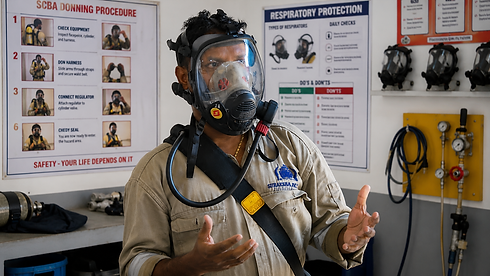
Practise the appropriate emergency response, including personal detection, escape breathing apparatus and cascade-system procedures.
IS 9014 Right For you?
H₂S awareness and emergency-response training for personnel working in potentially contaminated environments.
Product 9014 is designed for personnel who are, or could be, working in an environment that may become contaminated by hydrogen sulphide gas.
It is relevant to personnel who may need to:recognise an H₂S hazard, respond to an H₂S alarm, use personal H₂S detection equipment, don escape breathing apparatus, connect to a cascade breathing system, and take the correct immediate actions during an H₂S emergency.
There are no prerequisites for Basic H2S Training.
Before booking, confirm your requirement with your employer, operator or mobilisation team.

CHECK

ACTIVATE

MONITOR

RESPOND

Understand H₂S, how it behaves and how exposure levels are measured before moving into emergency response.
1 Mandatory Units
01 — OIS-91
Basic H2S Training
4 hours
Understand the offshore environment, its hazards and the systems used to control risk.
Product 9014 contains one mandatory unit — OIS-91 Basic H2S Training. Successful completion requires learners to achieve both the knowledge and practical outcomes defined within that unit.
OIS-91 is structured around two main competence areas:
H₂S Hazards, Emergency Response Actions and Apparatus and Safe Use of Essential PPE During H₂S Hazards and Emergencies.
Why Basic H2S Training?
H₂S can become life-threatening before a worker has time to improvise.
Hydrogen sulphide is a hazardous gas that may be encountered in oil and gas operations. Because exposure can have serious physiological effects, personnel working in areas where H₂S may be present need to understand the gas, recognise how it is detected and know how to respond when an alarm is activated.
Product 9014 is designed to give learners the basic knowledge and practical emergency-response skills needed to recognise H₂S hazards and use the relevant protective and escape equipment correctly.
Understand what the gas is before learning how to escape it.
Learners develop an understanding of how H₂S is formed, where it may be encountered, its common names and its physical properties and characteristics.
The training also introduces the terminology used to describe H₂S concentration, including parts per million (ppm) and occupational or workplace exposure limits. Learners develop a basic understanding of how H₂S concentrations are measured and how exposure limits are used in the workplace.
Physiological Effects of H₂S
Exposure affects the body—and individual response can vary.
Learners develop awareness of the physiological effects of H₂S exposure and the factors that may influence individual susceptibility.
This knowledge supports the core emergency principle that H₂S exposure should not be treated casually or assessed by instinct alone. Personnel must rely on detection equipment, alarms and approved emergency-response procedures

01
Know the properties and hazards of H₂S.
Understand

02
Use personal detection equipment correctly.
DETECT

03
Take the correct action when an alarm activates.
RESPOND

04
Don and activate the required escape breathing apparatus.
PROTECT

05
Move away from the contaminated area in accordance with emergency procedures.
ESCAPE

06
Use the pressurised cascade system where required.
CONNECT
What the Learner Will Practise
Knowledge must be understood. Practical actions must be demonstrated.
For a compact practical-training section:
-
Personal H₂S detector pre-use checks
-
Operation of personal detection equipment
-
Response to an H₂S alarm
-
Mask EBA donning and operation within 30 seconds
-
Hood EBA donning and operation within 30 seconds
-
Connection to a pressurised cascade system
-
Disconnection from a pressurised cascade system
Demonstrate the exit action before adding the full inversion sequence.

Competence For A Safer Tomorrow
Theory builds knowledge. Practice builds confidence.
.png)

Recognise the alarm. Protect your breathing. Follow the escape procedure.
Detect the hazard before it becomes an emergency.
Learners understand how H₂S is detected using onsite and personal detection equipment.
The training explains the purpose of personal gas detectors and then moves into practical use. Learners carry out pre-use checks and operation of H₂S personal detection equipment, ensuring they understand how the device is used before relying on it in a hazardous environment.
Responding to an H₂S Alarm
An alarm requires immediate, deliberate action.
Learners understand the actions that must be taken when an H₂S alarm activates.
The practical element requires learners to respond to an alarm as part of the emergency-response sequence. The emphasis is not simply on hearing the warning—it is on transitioning immediately into the correct protective and escape actions.
.png)
UNDERSTAND
.png)
PERFORM
.png)
OBSERVE
.png)
DEMONSTRATE
.png)
PRACTISE
Medical Screening
Learners must be capable of participating fully.
Although Product 9014 has no training prerequisite, practical activities may include physically demanding or potentially stressful elements.
Before participating in practical exercises, learners are required to complete an appropriate medical-screening form provided by the OPITO-approved Centre.
Learners and/or sponsoring companies are responsible for declaring medical conditions that may affect safe participation. Where fitness is uncertain, the Centre should direct the learner to an appropriate medical professional familiar with the training requirements.
Validity
2-Year OPITO Certificate Validity
The OPITO Basic H2S Training certificate is valid for two years.
The Product also notes that some employers may require revalidation more frequently than OPITO's two-year period.
Where a previous certificate expires within three months before course enrolment, the new certificate date should normally correspond with the previous certificate's expiry date unless stated otherwise by the Duty Holder, Asset Owner or Operator.
Why Train with Suraksha Marine?
Move beyond hazard awareness into equipment familiarity.
-
H₂S Hazard Understanding: Build a clear understanding of gas properties, exposure hazards and workplace response.
-
Personal Detection Equipment: Practice the pre-use checks and operation of personal H₂S detectors.
-
Escape Breathing Apparatus: Develop hands-on familiarity with both mask and hood EBA systems.
-
Time-Critical Donning: Practise the specified EBA donning and operating actions within the Product's 30-second requirement.
-
Cascade-System Familiarisation: Practise connection and disconnection from a pressurised cascade breathing system.
-
Structured Assessment: Move from knowledge and demonstration into directly observed practical performance.
Know the Hazard Before the Alarm Sounds
H₂S emergency response depends on recognising the hazard, trusting the detection system, protecting the airway and carrying out the required escape sequence without delay. Product 9014 develops that foundation through a combination of H₂S knowledge, detection-equipment familiarisation, escape breathing apparatus and practical emergency-response exercises.
Detect. Protect. Escape.
Train the system.
Practice the sequence.
Demonstrate competence.
Corporate workforce mobilisation?


