


OPITO Product 4550
Offshore Emergency Response Team Member Further Training
(OERTM Further)
Advanced practical refresher training for existing Offshore Emergency Response Team Members who need to revalidate their OPITO OERTM certification and maintain competence in complex fire and non-fire emergency scenarios.
OPITO Product 4550 is a specialist emergency-response programme for personnel already serving as Offshore Emergency Response Team Members. The course provides an onshore environment in which OERTMs can practise emergency-response activities that cannot reasonably be reproduced during routine offshore drills, including live-fire response, breathing-apparatus operations, multi-level firefighting, casualty recovery, confined-space incidents, chemical emergencies and restricted-access rescue.
1 DAY
1
2 Year
12.5 Guided learning hours
Mandatory units
Validity

Validity
2 years
Product Type
OPITO Approved Course
Trainers
OPITO Certified and years of experience
Category
Oil and Gas / Basic Emergency Response
Build Response Confidence Before the Incident Escalates

01 — Read the Emergency Environment
Recognise the hazards, changing conditions and immediate priorities within an offshore emergency-response scenario before committing personnel or equipment.

02 — Work as Part of the Response Team
Reinforce clear communication, role discipline and coordinated action with the Emergency Response Team Leader and other team members throughout the incident.

03 — Apply the Right Response Equipment
Refresh the safe and effective use of breathing apparatus, portable and mobile firefighting equipment, foam systems and casualty-recovery equipment appropriate to the emergency.

04 — Control, Rescue and Recover
Bring firefighting, search, rescue, casualty handling and team coordination together into a structured practical response under realistic simulated conditions.
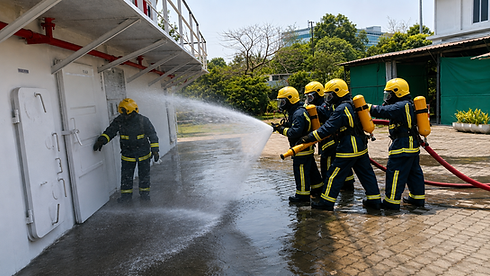
The Product specifies 12.5 Guided Learning Hours delivered over consecutive days, with an approximate balance of 10% theory and 90% practical training.

OERTM Competence Extends Beyond the Training Centre
Product 4550 is not the entire competence system for an Offshore Emergency Response Team Member.
The specification places responsibility on the installation, MODU or vessel Duty Holder to ensure that appointed OERTMs have sufficient training and experience to perform the role competently and safely.
This includes: workplace training, workplace competence assessment, and, where required, additional specialist training such as confined-space or working-at-height training.
Practical Training Environment:
The training supports team-based emergency scenarios rather than isolated demonstrations.
The training environment includes facilities for:
-
Hose deployment
-
Hydrant and branch operation
-
Portable-monitor use
-
Class A, B and C fire scenarios
-
Pressure-fed hydrocarbon fires
-
Foam firefighting
-
Breathing-apparatus operations
-
Multi-level firefighting
-
Confined-space response
-
Restricted-access casualty recovery
-
Protection of simulated pressure-vessel systems.
IS 4550 Right For you?
Designed for experienced Offshore Emergency Response Team Members who need to maintain practical response competence.
Product 4550 is suitable if you are already working as an Offshore Emergency Response Team Member and need further training to refresh, practise and demonstrate emergency-response skills that cannot always be fully exercised during routine offshore drills.
Product 4550 may be right for you if you:
-
Already hold the required OERTM competence and need to refresh practical emergency-response capability.
-
Participate in offshore drills but require exposure to more complex simulated fire and non-fire incidents.
-
Need to maintain competence in firefighting, breathing apparatus, search, casualty recovery and team response.
-
Work under an OERTL and need to reinforce communication, coordination and incident-control discipline.
-
Require further practical training in multi-level, smoke-affected, restricted-access or hazardous response environments.
-
Need to demonstrate continued readiness before your emergency-response competence is required during a real incident.
OERTM Further Training is not initial training. It is intended to maintain and refresh the capability of personnel already operating within the offshore emergency-response role.
It should also be considered part of a wider competence system that includes workplace drills, installation-specific familiarisation, competence assessment and any specialist training required by the Duty Holder.
There are no prerequisites for OERTM Training.
Before booking, confirm your requirement with your employer, operator or mobilisation team.


ENTER

SEARCH

LOCATE

ASSESS

RECOVER
One Mandatory Unit
What Does OERTM Further Training Develop?
The programme gives existing team members the opportunity to practise and maintain the skills required when responding to offshore emergencies as part of an Emergency Response Team.
The training develops practical performance across:
-
Fire attack
-
Hose deployment
-
Foam application
-
Breathing apparatus
-
PPE selection
-
Team communication
-
Incident-area entry
-
Search and rescue
-
Casualty assessment
-
Casualty recovery
-
Chemical response
-
Confined-space incidents
-
Restricted-access rescue
-
Post-incident debriefing.

01
OIS-15
12 H 50 M
Further Practical Exercises for the OERTM
Build Response Confidence Before the Incident Escalates
Learners refresh the practical skills required to operate effectively as part of an Offshore Emergency Response Team, including incident briefing, communication with the OERTL, breathing apparatus, firefighting equipment, hose management and entry into changing emergency environments.
Training then brings these skills together through realistic fire and non-fire scenarios involving search, casualty recovery, chemical incidents, confined spaces and restricted-access emergencies. The focus is on coordinated team response, correct equipment selection and maintaining control as the incident develops.
Why OERTM Further Training?
Emergency-response competence must be maintained, not assumed.
Offshore Emergency Response Team Members may participate regularly in drills and exercises on their installation. Those activities are essential for maintaining familiarity with the asset, emergency organisation, equipment and local response arrangements.
However, some emergency situations cannot be safely or realistically reproduced offshore. OERTM Further Training provides experienced Emergency Response Team Members with the opportunity to refresh, practise and demonstrate emergency-response skills in realistic scenarios that go beyond what can normally be achieved during workplace drills.
The purpose is not to repeat initial training. It is to maintain the practical capability to respond when an offshore incident becomes complex, conditions deteriorate and several emergency-response activities must be managed together.
Three-Level Emergency Structure
At least one practical structure must contain a minimum of:
3 LEVELS with both open and enclosed spaces on each level.
The structure allows realistic operations under conditions involving: smoke logging, heat, cosmetic or real smoke, fire, stairs, fixed ladders, and walkways.
This creates the physical conditions required to develop controlled team movement, breathing-apparatus operations, hose management, communication, search and casualty recovery across multiple levels.
Multi-Level Fire Scenarios
This gives the team exposure to differing fire behaviours, fuel conditions and firefighting strategies.
The training structure supports representative internal and external fire scenarios so learners can practice selecting equipment, managing hose lines and applying appropriate firefighting tactics under changing conditions.
The structure must be capable of supporting representative fires including:
Internally
-
Class A contained fires
-
Class B contained-spill fires
-
Class B pressure-fed fires
Externally
-
Class B pressure-fed fires
-
Class B contained-spill fires
-
Class B flowing fires and
-
Class C gas fires.
Firewater System
Realistic firefighting requires a reliable water supply.
The training centre must provide a firewater reservoir with sufficient capacity to complete the required exercises and a pumping system capable of supplying the practical fire areas at full training capacity.
The system must also include:
-
Backup firewater capability,
-
Fuel shutoff controls in the event of firewater failure and
-
Low-pressure alarm or equivalent firewater-pressure monitoring.
This is another indication that OERTM Further is a specialist emergency-response Product rather than general fire awareness training.

01
Understand the incident, hazards, team roles and immediate response objective before deployment.
RECEIVE THE BRIEF

02
Choose the firefighting, rescue, communication and protection equipment appropriate to the emergency.
SELECT THE EQUIPMENT

03
Fit and check the required emergency-response PPE and breathing apparatus before entering the incident area.
DON PPE & BA

04
Move into the response area under clear communication and coordinated direction from the OERTL.
DEPLOY AS A TEAM

05
Apply the appropriate firefighting, isolation, protection or hazard-control actions as conditions develop.
CONTROL THE INCIDENT

06
Locate casualties, assess the situation and carry out controlled search, rescue and recovery actions.
SEARCH & RECOVER

06
Confirm that immediate hazards are controlled and leave the incident area in a safe, managed condition.
SECURE THE AREA

06
Review actions, communication, equipment use and lessons from the scenario to strengthen future performance.
DEBRIEF THE RESPONSE
Why OERTM Further Training Matters
Offshore emergency-response personnel may participate regularly in drills, but some high-risk scenarios cannot be fully reproduced offshore.
OERTM Further Training gives experienced Emergency Response Team Members the opportunity to refresh, practise and demonstrate the practical skills required for complex fire and non-fire incidents. The focus is on maintaining response capability, reinforcing team coordination and confirming that critical actions can still be performed effectively under realistic simulated conditions.
What Learners Must Demonstrate
-
Selecting correct firefighting media and equipment
-
Breathing-apparatus control-board procedures
-
Selection and donning of emergency-response PPE
-
Working-duration BA operation and wearer checks
-
Participation in an incident brief
-
Selection and use of portable firefighting equipment
-
Foam equipment operation and flushing
-
Fire extinguishment and securing the area
-
Effective communication with the OERTL and response team
-
Safe entry and operation within the incident area
-
Correct search-and-rescue procedures
-
Initial casualty assessment and recovery
-
Participation in post-incident debriefing and restoration of operational readiness.
The training progression refreshes individual response skills first, then brings them together through integrated scenarios where firefighting, breathing apparatus, communication, search, rescue and area control must function as one coordinated emergency response.

Competence For A Safer Tomorrow
Theory builds knowledge. Practice builds confidence.


REFRESH THE SKILLS. REHEARSE THE INCIDENT. MAINTAIN THE RESPONSE CAPABILITY.
Why Team Size Matters
Training as a team creates demands that cannot be reproduced through individual practical exercises alone.
OERTM competence is inherently collaborative. A realistic incident requires learners to operate within a team structure where individuals must: receive the brief, assume assigned roles, deploy equipment, communicate, maintain hose lines, search, recover casualties and report to the Team Leader.
Practise What Offshore Drills Cannot Fully Reproduce
Offshore emergency-response teams routinely participate in drills and exercises.
But not every incident can be recreated safely or realistically on an operating installation. High-pressure hydrocarbon fire, live-fire attack, full-duration breathing-apparatus operations, casualty recovery through restricted access, multi-level hose deployment, chemical incidents and realistic confined-space response all require a controlled training environment.
The purpose is not to recreate initial OERTM training. It is to place existing team members back into complex practical emergency situations so that critical response skills remain active, coordinated and observable.

REFRESH

RESCUE

BRIEF

SECURE

EQUIP

DEBRIEF
Medical Screening
Practical OERTM training can be physically demanding and stressful.
Learners must be capable of participating fully.
Before practical exercises, they must either: possess a valid current offshore medical certificate, possess an operator-approved medical certificate or complete an appropriate medical-screening form through the OPITO-approved centre.
Learners and sponsoring organisations are responsible for declaring conditions that could adversely affect participation. Where doubt exists, the centre must direct the learner to an appropriate medical professional familiar with the training.
Validity
2-Year OPITO Certificate Validity
The OPITO OERTM Further Training certificate is valid for two years.
The Product also notes that some employers may require revalidation more frequently than OPITO's two-year period.
Where the previous certificate expiry falls within three months prior to enrolment, the new certification date should normally correspond with the previous expiry date unless otherwise directed by the Duty Holder, Asset Owner or Operator.
Why Train with Suraksha Marine?
Move beyond individual skills into coordinated emergency response.
-
Incident Response Discipline: Build confidence in receiving the emergency brief, understanding hazards, clarifying team roles and preparing for deployment.
-
Firefighting & Hazard Control: Practise the selection and use of hoses, hydrants, monitors, foam systems and portable extinguishers across representative offshore emergency scenarios.
-
Breathing Apparatus & PPE: Refresh the correct identification, donning, checking and operational use of working-duration breathing apparatus and emergency-response PPE.
-
Search & Casualty Recovery: Develop practical competence in search, casualty assessment and recovery within smoke-affected, enclosed, multi-level and restricted-access environments.
-
Fire & Non-Fire Scenarios: Train across realistic incidents including hydrocarbon fires, gas or liquid releases, chemical incidents, confined spaces and restricted-access emergencies.
-
Team Communication & Coordination: Reinforce clear communication with the OERTL and other team members while maintaining awareness of changing hazards, casualties and response priorities.
-
Scenario-Based Assessment: Bring equipment use, firefighting, search, rescue, communication and area control together within integrated practical emergency-response scenarios.
-
Post-Incident Debrief: Review team actions, communication, equipment use and response decisions to strengthen future emergency performance.
Practise What Offshore Drills Cannot Fully Reproduce.
Return to complex offshore emergency-response scenarios and demonstrate continued capability across firefighting, breathing apparatus, team communication, search, casualty recovery, chemical response and restricted-access incidents.
Refresh the Response. Rebuild the Team Rhythm. Demonstrate the Competence.
Real Equipment.
Controlled Simulation.
Demonstrated Competence.
Corporate workforce mobilisation?
Frequently Asked Questions (FAQ)


