


Case Study
The BBLT Platform Cellar Deck Fire, Angola, 20 May 2025
Fire Safety, Maintenance Shutdown Risk, and Why Training Is the Last Barrier
Case Study Analysis by Suraksha Marine
Case Study
1. The Fire That Started While the Platform Was Supposed to Be Quiet
Offshore workers learn early that production operations carry risk. Live hydrocarbons. High-pressure systems. Rotating machinery. Gas compression. Well interventions. Lifting operations. Simultaneous activities across a complex, isolated structure surrounded by open sea. The hazard list is long and well-known.
What the offshore industry is sometimes slower to teach — and what the Benguela Belize Lobito Tomboco platform fire of 2025 demonstrates with devastating clarity — is this:
A platform does not become a safe place simply because production has been shut down.
On 20 May 2025, at approximately 03:10 local time, a fire broke out on the cellar deck of the BBLT deepwater platform, operated by Cabinda Gulf Oil Company (CABGOC), a Chevron subsidiary, in Angola's Block 14 concession. The platform was 60 miles off the Cabinda coast, in approximately 1,300 feet of water. It had been in a planned production shutdown since 1 May 2025 — 20 days into a scheduled annual maintenance programme.
The fire was contained. CABGOC confirmed that onsite personnel responded immediately and extinguished the blaze. Emergency protocols were activated, all injured personnel were brought ashore, and the ANPG and relevant authorities were notified.
The human cost, however, was severe.
Seventeen workers were injured — four seriously. Two were evacuated to specialist hospital facilities in South Africa. One worker was initially reported missing. A body was later located in the water near the platform. Over the following eight days, the death toll climbed. The first fatality was confirmed on 24 May. A second worker died on 27 May. A third fatality — associated with the body recovered from the sea — brought the total confirmed deaths to three.
Three families. Seventeen injuries. A platform that was, by every production metric, in its quietest period of the year.
For offshore safety trainers, this incident carries an urgent message to every worker in every region — India, Angola, the North Sea, the Gulf of Mexico, the Middle East, Southeast Asia, and beyond: the risk profile of a shutdown is not the same as the risk profile of production. In some ways, it is more dangerous. And the only reliable protection is trained, prepared, alert people.
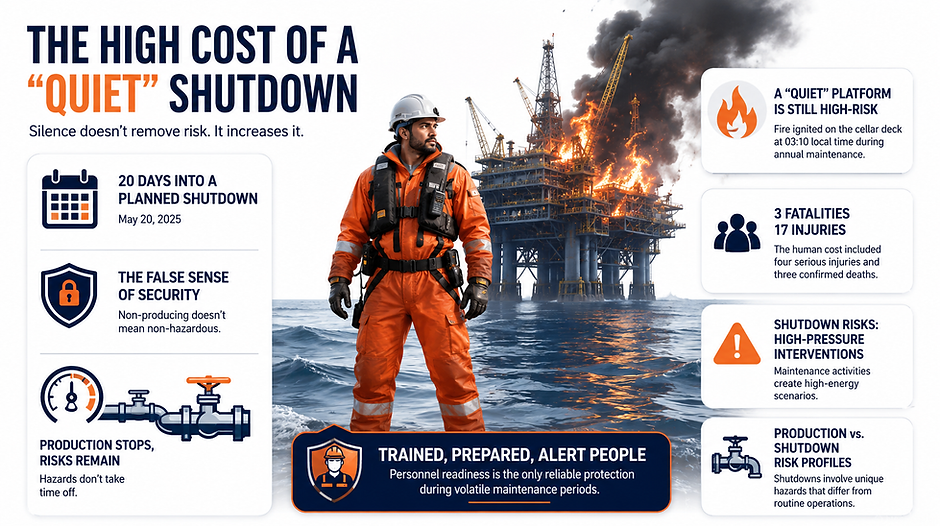
Incident snapshot:
On 20 May 2025, a fire broke out around 03:10 on the cellar or basement deck of Chevron subsidiary CABGOC’s Benguela Belize Lobito Tomboco platform offshore Angola. The platform was in a planned maintenance shutdown, which changed the risk profile from normal production to multi-contractor maintenance activity.
Human impact:
Public reporting recorded 17 injured initially, with later updates confirming three fatalities.
Core learning theme:
Shutdown risk, cellar deck fire, night-shift emergency readiness, contractor coordination, SIMOPS, fire response, medical evacuation, muster accountability and investigation learning.
Suraksha Marine training fit:
BOSIET, FOET, OERTM, Further OERTM, Firefighting and Self-Rescue, Emergency First Aid, medevac coordination, muster discipline and shutdown safety training.
2. Block 14, Deep Water, and the Architecture of a Complex Maintenance Shutdown
2.1 The BBLT Project — A Major Deepwater Hub
The Benguela Belize Lobito Tomboco development is one of Angola's most significant deepwater oil projects. Located in the Lower Congo Basin's Block 14, approximately 97 kilometres (60 miles) off the coast of the Cabinda exclave, BBLT sits in waters roughly 396 metres (1,300 feet) deep and has been described as a central production and drilling hub with reported capacity of approximately 200,000–220,000 barrels per day.
The facility is a compliant tower platform — a tall, slender structure engineered to flex laterally under wave loading and environmental forces, allowing it to stand in water depths where conventional fixed-leg structures would be impractical. From an engineering perspective, it represents a sophisticated deepwater production solution.
From a safety perspective, it represents a multi-deck, high-complexity industrial environment where a fire — in any section, at any level, at any time — demands a fast, trained, coordinated response.

2.2 The Cellar Deck — Understanding the Fire's Location
Public reporting consistently identifies the fire's location as the cellar deck or basement deck of the BBLT platform. This detail matters enormously for training purposes.
Cellar decks and lower production decks are among the most complex spaces on an offshore installation.
They typically contain:
-
Dense concentrations of piping, risers, valves, and flanges
-
Production equipment, separators, pumps, and chemical injection systems
-
Hydrocarbon drain systems and low-point collection areas
-
Structural members that create congestion and visual obstruction
-
Limited natural ventilation compared to open upper decks
-
Multiple access routes that can be compromised by scaffold, hoses, or cables
-
Emergency drainage systems that must be managed carefully
During a maintenance shutdown, the cellar deck becomes even more complex. Equipment is opened. Blinds and spades are installed and removed. Flanges are broken. Systems are drained — or partially drained. Work fronts multiply. Temporary equipment fills spaces. Access changes with scaffold builds. Gas tests must be repeated as conditions change with every new work activity.
This is the environment in which the fire at 03:10 on 20 May 2025 occurred.
2.3 The Maintenance Shutdown Context — 20 Days In
Production at BBLT had been shut down since 1 May 2025 for scheduled annual maintenance. At the time of the fire, the platform had been in shutdown mode for 20 days.
Maintenance shutdowns are among the most demanding periods in the lifecycle of an offshore installation. They are not a pause in activity — they are an intensification of a different kind of activity.

During a planned major maintenance shutdown:
-
Equipment is in various states of opening, inspection, repair, and reinstatement
-
More workers may be present than during normal operations — including contractors unfamiliar with the specific installation
-
Systems exist in intermediate states — partially isolated, partially drained, partially recommissioned
-
Work permits multiply to cover dozens of simultaneous tasks
-
The normal routine of the platform is disrupted, making assumptions about what is isolated, what is active, and what is safe more dangerous
-
Hot work may be occurring near areas that were recently live with hydrocarbons
-
Gas detection systems may be locally inhibited or impaired to allow planned work
A shutdown is not a quiet time. It is a different kind of loud.
The Hour — 03:10 and the Biology of Night Work
The fire erupted at 03:10. This single detail should prompt every trainer to pause and consider what it means in the context of human performance.
At 03:10:
-
Workers on night shift are deep into the biological low point of the human circadian rhythm
-
Workers who were asleep may have been abruptly awakened by alarms into immediate emergency roles
-
Cognitive function, reaction time, and situational awareness are measurably lower than at any daytime hour
-
Supervision arrangements may have reduced staffing at key coordination points
-
Contractors may be less familiar with changed access routes introduced during the maintenance period
The offshore industry cannot control when emergencies occur. It can only train people to respond effectively at any hour. That training — not optimism about timing — is the only reliable answer to a 03:10 fire alarm.
3. The Workforce Inside the Emergency — Roles That Changed in Seconds
On a major deepwater platform like BBLT during a scheduled maintenance shutdown, the workforce is not homogeneous. It is a temporary community of permanent crew, specialist maintenance contractors, inspection teams, scaffolders, welders, instrument technicians, riggers, catering staff, medics, emergency response personnel, helideck operators, and offshore management — all sharing a structure that was, until 03:10 on 20 May 2025, a controlled workplace.
At 03:10, every role transformed.
Maintenance technician Evacuee / first responder
Process operator Emergency shutdown support
Control room operator Communication and coordination lifeline
Platform medic Multi-casualty triage leader
ERT team member BA entry firefighter / casualty extractor
Helideck operator Medevac preparation and coordination
Supervisor Decision-maker under uncertainty
Contractor welder Evacuee needing to know the muster route
OIM / emergency commander Incident commander managing fire, casualties, missing person, and authorities simultaneously
The 17 Injured and 3 Who Did Not Come Home
Public reporting confirmed 17 injuries on 20 May 2025, four of them serious. Two of the seriously injured were evacuated to specialist hospital facilities in South Africa for treatment.
One worker was initially unaccounted for — a missing-person search was activated. In the days that followed:
-
24 May 2025 — The first fatality was confirmed
-
27 May 2025 — A second worker died from injuries at hospital, raising the toll to three
-
A body found in the water near the platform was associated with the missing worker, representing a fourth tragedy as part of the confirmed casualty total
Behind these numbers are individuals. People who boarded their crew-change transport and flew offshore to complete routine maintenance work. People who had families expecting them home. People who had almost certainly completed basic offshore safety training.
This case study is written with respect for each of them. The purpose is not dramatic retelling. The purpose is to ensure that every offshore worker who reads this arrives on their next installation fully prepared to respond to what happened at BBLT — with their training already embedded, their emergency sequence already practiced, and their judgment already sharpened.
The Contractor Interface
A maintenance shutdown's workforce typically includes a high proportion of contractors. Contractors bring specialist skills — welding, scaffolding, instrument calibration, mechanical overhaul — but they may bring limited familiarity with the specific platform.
They may not know:
-
Where all muster stations are
-
Which access routes have changed due to scaffold builds
-
Which gas detectors are currently inhibited for maintenance
-
What the platform-specific alarm signals mean
-
Who to report a safety concern to
-
Which work fronts are active nearby
This is not a failing of contractors. It is a responsibility of platform management. Every contractor who steps onto a platform during a shutdown must receive practical emergency familiarisation before work begins — not a paper induction, not a video in a shore-based facility, but a physical walkthrough of the specific routes, alarms, and muster arrangements that will matter if the alarm sounds.
4. Timeline of Events
4.1 The Chronology — From Planned Shutdown to Unplanned Emergency
Before 1 May – 19 May 2025
Before 1 May 2025, the BBLT platform was operating in normal production mode. Live hydrocarbon systems, routine operating procedures, established safety barriers and standard platform risk controls were in place. In normal production, the risk profile is serious but generally familiar: systems are live, operating envelopes are defined, routines are established and the workforce understands the day-to-day controls.
On 1 May 2025, production was shut down for planned annual maintenance. This marked a major change in operating mode. A shutdown is not simply “less production.” It is a different safety environment. Equipment may be opened, isolated, drained, inspected, repaired or reassembled. Temporary equipment may be introduced. Contractors and specialist teams may work across several areas. Permit-to-work activity increases. Simultaneous operations become more complex.
From 1–19 May, the maintenance programme continued across an estimated 20-day window. This period likely involved multi-contractor, multi-discipline work fronts. For training purposes, this is the first major lesson: shutdowns are sustained high-complexity risk windows. The platform may be out of normal production, but risk does not disappear. It changes shape.

This image shows the BBLT platform during a planned annual shutdown, with production systems quiet and maintenance activity spread across multiple deck levels. Crews, supervisors, scaffolding teams, and contractors are shown working within a controlled permit-to-work environment where coordination is essential.
This phase represents the risk profile of shutdown work. When many teams, temporary equipment, isolations, hot work, inspections, and simultaneous activities come together, the platform may appear orderly, but the margin for error depends on planning, communication, supervision, and strict control of work.

This image captures the early-morning moment when fire breaks out on the lower cellar or basement deck of the BBLT facility. Flames, smoke, alarms, and rapid worker reaction create a serious offshore emergency atmosphere without sensationalising the incident.
This phase shows how quickly a maintenance-period hazard can become a life-threatening event. The fire occurred while the facility was undergoing scheduled shutdown activities, reminding offshore teams that shutdown periods require the same level of vigilance as live production operations.
4.2 Phase Two: Fire Ignition During the Lowest Human-Performance Window
20 May 2025, Around 03:10
At approximately 03:10 on 20 May 2025, a fire ignited on the cellar or basement deck of the BBLT platform. The timing is significant. Early morning hours are often a biological low point for human alertness. Fatigue, reduced reaction speed, lower staffing density in some areas, night-shift workload and reduced visibility can all affect emergency response.
The location also matters. A cellar or basement deck can be a challenging emergency environment. Such areas may contain process equipment, pipework, risers, structural congestion, restricted access routes and limited visibility during smoke or fire. Emergency teams may face heat, smoke, access difficulties, communication challenges and casualty extraction problems.
This phase shows why emergency readiness must be constant. A platform cannot be highly prepared at 14:00 and weakly prepared at 03:10. Fire does not wait for ideal staffing, daylight or low workload.
4.3 Phase Three: Immediate Response, Emergency Command and Medical Evacuation
03:10 Onwards – Morning of 20 May 2025
Immediately after the fire started, CABGOC personnel responded, and the fire was brought under control by onsite teams. This is an important protective factor. In offshore fire events, the first few minutes decide whether a fire remains localized or escalates into a platform-wide emergency.
After the initial response, emergency protocols were activated. Authorities and ANPG were notified. Injured personnel were assessed, and emergency command had to manage several priorities at once: fire control, muster, casualty care, communication, platform safety, authority notification and preparation for medical evacuation.
By the morning of 20 May, 17 injured personnel had been transferred ashore and were confirmed to be receiving medical care. At the same time, one worker remained unaccounted for. This created a dual emergency: medical evacuation for the injured and a missing-person process for the unaccounted worker.
This phase is critical for trainees because it shows that extinguishing the fire is not the end of the emergency. The incident continues through casualty management, headcount verification, search coordination and communication with shore.

This image shows trained onsite emergency teams bringing the fire under control, assisting injured workers, coordinating muster, and preparing medical evacuation. Fire teams, command personnel, first responders, and platform crews are shown working under pressure in a disciplined offshore response.
This phase highlights the importance of emergency preparedness, response drills, communication, rescue equipment, and medical coordination. In a major offshore event, survival depends not only on firefighting capability but also on clear command, rapid casualty care, accurate headcount, and safe transfer from the installation.

This image shows the post-incident investigation phase, with safety specialists and investigators examining the affected deck area after the fire. The damaged structure is secured, evidence is being documented, and the atmosphere is sober, respectful, and focused on learning.
This final phase is about understanding what happened and preventing recurrence. The BBLT case reinforces the need to examine work planning, isolation control, simultaneous operations, contractor coordination, emergency response performance, and leadership decisions so that lessons become stronger safety barriers for future offshore work.
4.4 Phase Four: Fatal Consequences, Investigation and Long-Term Learning
21 May 2025 – Ongoing
On 21 May 2025, Chevron confirmed that one person was missing and that search and rescue operations were ongoing. This highlights the importance of muster discipline. Accurate headcount is not administration; it is a life-safety function. It tells emergency command whether people are safe, injured, trapped, missing or possibly overboard.
On 24 May 2025, the first fatality was confirmed. This is an important medical training point. Serious fire-related injuries, including burns and smoke inhalation, may remain life-threatening after the visible emergency is over. Survival depends not only on rescue from the platform, but also on rapid medevac, specialist medical care and continuing treatment.
On 27 May 2025, a second fatality was confirmed, bringing the total to three. The human cost of the incident continued beyond the day of the fire. Offshore emergencies do not end when flames are extinguished. They continue through treatment, family support, investigation, workforce communication and organizational learning.
The investigation by CABGOC and ANPG into the root cause remained ongoing in public reporting. Support was also extended to affected workers and families. For training teams, the final root cause should be respected and not assumed. However, known safety principles can be reinforced immediately: shutdown risk management, permit discipline, SIMOPS control, night-shift readiness, fire response, muster, medevac and contractor coordination.
5. The Critical Decisions — Where Offshore Shutdown Safety Is Won or Lost
Because the final root cause of the BBLT fire remained under investigation at the time of publication, this section does not attribute blame to specific decisions made by specific individuals. Instead, it identifies the seven categories of decision that are always relevant to offshore maintenance fires — decisions that investigation bodies examine in every incident of this type, and that every offshore worker and supervisor should understand before they enter a shutdown period.
Decision One: How the Shutdown Was Planned
Maintenance shutdowns require planning that goes beyond task scheduling. They require risk planning — examining how work fronts interact, how safety barriers change state during the shutdown period, how simultaneous operations create non-obvious hazards, and how the platform's emergency response capability will be maintained throughout.
A shutdown plan that maximises task completion without explicitly mapping the associated risk changes is not a safety document. It is a production document with safety notes attached.
Training lesson: Before any shutdown begins, every supervisor and worker should be able to answer: "What safety barriers are changing during my work scope, and what replaces them?"
Decision Two: How Hydrocarbon Isolation Was Verified
Every fire on a hydrocarbon-processing platform raises the question of fuel source. During maintenance shutdowns, systems are drained, isolated, and opened — creating temporary states where residual hydrocarbons may remain in dead legs, low points, drain systems, heat exchangers, valve cavities, and pump casings. The system that appears drained may still contain sufficient vapour or liquid to fuel a fire if an ignition source is introduced.
Training lesson: Isolation is not complete because a valve has been closed and locked. Isolation is complete when the absence of the hazard has been independently verified. Gas-free certification must be specific, time-limited, and repeated as conditions change with every new work activity.
Decision Three: How Ignition Sources Were Controlled
During shutdowns, ignition sources multiply. Hot work — welding, grinding, cutting, torch work — increases significantly. Temporary electrical equipment is introduced. Power tools are used in areas that may be in intermediate isolation states. Static discharge risks may change as systems are opened and drained.
Training lesson: A hot work permit must be treated as a live fire prevention document — not a routine administrative signature. Gas testing, fire watch positioning, spark containment, fire blanket deployment, local deluge readiness, and nearby drain control are all live requirements, not formalities.
Decision Four: How Simultaneous Operations Were Controlled
SIMOPS — Simultaneous Operations — create interactions between work teams that are not visible to any individual team. One team opens a flange while another performs hot work fifteen metres away. One team removes insulation while another handles temporary electrical equipment. One team's scaffold access work blocks an escape route that another team depends on.
Training lesson: SIMOPS risk is not only task risk. It is interaction risk — and it is invisible to anyone who only sees their own work scope. A platform-level SIMOPS coordinator with a live, physical display of all active work fronts is not a luxury. It is a survival tool.
Decision Five: How Night Shift Work Was Supervised
The fire occurred at 03:10 — deep in the human biological low point. Night work is not simply a darker version of day work. Alertness, reaction time, communication clarity, and decision quality are all measurably reduced in the early hours. Supervision arrangements, permit revalidation, safety conversation quality, and emergency response readiness must actively compensate for this reduction.
Training lesson: Night shift is not a lower-standard shift. It is a higher-discipline shift, because the human performance margin that compensates for system imperfections is thinner. Night drills — realistic, unannounced, requiring full emergency response mobilisation — should be a standard element of offshore emergency preparedness.
Decision Six: How Emergency Response Was Activated
Public reporting confirms that onsite personnel responded immediately and successfully extinguished the fire. This is a critically important positive learning point. Early, trained, coordinated response prevented escalation on a deepwater platform where the nearest support is 60 miles away.
Training lesson: Every OERTM-trained team member on that platform in the early hours of 20 May 2025 was part of the safety barrier that prevented a worse outcome. The response saved the platform. The training made the response possible.
Decision Seven: How Injured Personnel Were Assessed and Evacuated
The transition from fire response to medical response and medevac is one of the most demanding coordination challenges in offshore emergency management. Seventeen casualties of varying severity require triage, treatment prioritisation, casualty documentation, helicopter coordination, weather assessment, hospital pre-notification, and family communication — all running simultaneously with the ongoing emergency command of the fire scene.
Training lesson: A fire emergency becomes a medical evacuation emergency within minutes of initial response. Offshore medics, helideck teams, and emergency commanders must have pre-planned, rehearsed medevac protocols that are as prepared as the fire response itself.
6. Technical Areas Under Examination — What Investigation Must Determine
A responsible case study distinguishes between what is known and what must be investigated. The following technical areas are framed as investigation themes — the categories that any competent offshore fire investigation will examine — and as training implications that apply regardless of the specific findings.
Hydrocarbon Presence During Maintenance
A fire requires fuel. On a production platform in a 20-day maintenance shutdown, potential fuel sources include residual hydrocarbons in partially drained systems, vapour accumulation in opened equipment, oil or chemical contamination in insulation or drains, temporary hoses or equipment containing process fluids, and any inadvertent pressurisation of systems considered isolated.
Investigation question: What was the fuel source, and were the isolation and gas-free verification processes adequate for the work being performed?
Training lesson: Never assume a shut-down system is fuel-free. Gas-free certification is time-sensitive and location-specific. A system gas-free at 08:00 may not be gas-free at 03:00 if adjacent work has disturbed it.
Ignition Source Identification
The investigation will seek to identify the ignition source — whether that was hot work, an electrical fault, a heated surface, static discharge, a mechanical spark, or another mechanism. During a maintenance shutdown, the density of potential ignition sources is higher than during normal production.
Investigation question: What introduced ignition energy in proximity to a fuel source?
Training lesson: Ignition control must be active and verified — not assumed from the permit form. Workers in adjacent areas must communicate about their activities, because what is a low-risk task in isolation can become a high-risk ignition source when combined with another team's work nearby.
The Cellar Deck's Physical Emergency Response Challenges
Lower decks present specific firefighting and evacuation challenges. Smoke accumulates. Access routes are more restricted. BA entry teams moving with hose and equipment face navigational complexity. Vertical egress — workers moving up ladders and stairs in smoke while wearing PPE — is physically demanding and cognitively difficult under stress.
Training lesson: Cellar deck firefighting is not the same as open-deck firefighting. OERTM training should include realistic low-visibility, restricted-access scenarios that build the physical and cognitive capacity to operate in exactly these conditions.
Gas Detection and System Impairment
During maintenance, gas detectors may be inhibited or bypassed to prevent spurious shutdowns during planned work. Fixed fire and gas system impairments must be risk-assessed, time-limited, clearly communicated, and compensated with enhanced manual monitoring.
Investigation question: Were any detection or suppression systems in an impaired state at the time of the fire, and were compensating controls adequate?
Training lesson: Any detector bypass is a temporary reduction in protection that must be treated as a major safety management decision — not a routine maintenance action. The permit that authorises the bypass must explicitly state the compensating controls.
Escape Route Integrity During Active Maintenance
Twenty days into a major maintenance programme, the physical layout of a platform changes significantly. Scaffolding builds, temporary cable runs, tool storage, material laydown, and barricaded areas can all alter the escape routes that workers were shown during their initial induction.
Investigation question: Were escape routes from the cellar deck area accessible, unobstructed, and known to all workers in that area at the time of the fire?
Training lesson: Escape route integrity must be a daily check item during maintenance shutdowns — not a fixed assumption from the initial induction. Changed routes must be communicated immediately to all affected personnel.
7. Human Factors — Why Maintenance Shutdowns Make Competent Workers Vulnerable
The workers on the BBLT platform on 20 May 2025 were not careless. They were professionals in one of the most technically demanding industries in the world, working on one of the most sophisticated deepwater structures in Africa, under one of the world's largest energy companies. The human factors that shape serious offshore incidents are not caused by incompetence. They are caused by the predictable responses of competent people to systematically challenging conditions.
Familiarity With the Shutdown's Apparent Safety
After 20 days of maintenance work without a major incident, workers develop a new normal. Production is offline. Major hydrocarbon flows are stopped. The platform feels quieter, more controlled. This familiarity creates a subtle but measurable reduction in vigilance — a gradual lowering of the cognitive alarm level that would otherwise flag anomalies as hazards.
Familiarity with absence of incident is not the same as absence of risk. It is the accumulation of unrecognised residual risk until a trigger converts it into a consequence.
Task Focus and Tunnel Vision
Maintenance workers — particularly during multi-week shutdown campaigns — develop strong task orientation. The goal is completing the scope: the valve overhaul, the instrument calibration, the pipe repair, the equipment test. This focus is professionally valuable. It becomes dangerous when it narrows attention to the immediate task and away from the changing environment surrounding it.
In a maintenance shutdown, the most dangerous information is often the information your adjacent work team has but you don't. Their flange break, their gas test timing, their temporary electrical equipment — any of these can transform your work scope from routine to catastrophic without your knowledge.
Training lesson: In shutdown work, your awareness boundary is not the edge of your job pack. It is the edge of the hazard zone created by every other team working near you.
Permit Normalisation
When dozens of permits are issued daily over a 20-day shutdown, the permit-to-work process can shift from a meaningful safety conversation to a form-completion exercise. Workers sign, authorise, and receive permits at increasing speed as the shutdown progresses. The questions that a good permit should force — What are the real hazards here today? What has changed since the last shift? What other work is adjacent? Are my isolation points still valid? Is my gas test current? — are replaced by a familiar signature sequence.
Training lesson: A permit is only as strong as the conversation that produced it. If signing a permit takes 30 seconds, the permit is probably not doing the safety work it was designed to do.
Night Work and the 03:10 Factor
The ATSB's research on human performance in offshore emergencies, and decades of accident investigation data, establish one consistent finding: serious incidents that occur in the early hours of the morning are more likely to involve delayed detection, slower response, and compounded human error than equivalent incidents occurring during daytime hours.
At 03:10 on BBLT:
-
The circadian nadir — the lowest point of human alertness in the 24-hour cycle — was in full effect
-
Workers asleep in accommodation had to transition from deep sleep to emergency responders
-
Night shift supervisors may have been managing wider geographic scope with reduced headcount
-
Communication, always demanding offshore, becomes harder when people are groggy, alarmed, and operating in darkness and noise
Training lesson: Fatigue does not only make workers sleepy. It makes weak signals harder to detect, reduces the quality of decisions under uncertainty, and slows the response that turns a containable fire into a contained fire.
Authority Gradient and Stop Work Authority
During contractor-heavy maintenance campaigns, a persistent human factors hazard is the authority gradient — the unspoken belief that junior workers, subcontractors, or those lower in the hierarchy should not challenge the decisions of supervisors, operators, or client representatives.
A contractor who notices an unexpected odour, sees scaffold blocking an escape route, or spots a gas test that seems out of date may hesitate to stop the job. The fear of delay, commercial consequence, or social friction can suppress the safety-critical behaviour that would break the accident chain.
Training lesson: Stop Work Authority is not a written right if it is not psychologically safe to exercise. The culture that determines whether a junior contractor stops work when something feels wrong is built in training rooms, safety meetings, and toolbox talks — long before the shutdown begins.
8. The Emergency Response — What Containment, Triage, and Medevac Demanded
The First Minutes — Alarm, Detection, Initial Response
At 03:10, the fire alarm activated — triggering a response cascade that public reporting credits as the reason the BBLT fire did not become a catastrophic platform loss. The first minutes of an offshore fire are the most consequential. Fire can double in intensity rapidly. Smoke can compromise escape routes and incapacitate workers within a small number of minutes. Emergency shutdown systems may need activation. Gas supplies to the fire area may need isolation.
The priority sequence in an offshore fire:
-
Raise the alarm — ensure the control room and emergency command are aware
-
Protect life — evacuate the immediate area
-
Muster — account for all personnel at designated muster stations
-
Fight fire only if trained and equipped — do not enter without breathing apparatus if smoke is present
-
Isolate fuel if safely possible — emergency shutdown systems, local isolation
-
Prevent escalation — boundary cooling, exposure protection
-
Treat casualties — medical response, triage, first aid
-
Notify authorities and support resources — ANPG, CABGOC shore, vessels, helicopters
-
Plan for medevac — assess severity, prepare helideck, coordinate with shore medical facilities
Muster and the Missing Person
The fact that one worker was initially unaccounted for — and a body was later found in the water near the platform — underscores one of the most critical components of offshore emergency response: muster discipline and accountability.
An accurate muster does not just confirm who is safe. It identifies who is not. It tells the emergency commander whether a rescue team needs to search a burning deck, whether a man-overboard search needs activation, whether the helicopter evacuation head count is correct, and whether the search-and-rescue assets need to expand their perimeter.
A missing person changes the entire character of an offshore emergency. It transforms a fire response into a combined fire-and-search emergency, demanding resources, attention, and decision-making capacity that are simultaneously needed elsewhere.
Training lesson: Muster is not a queue at an assembly point. It is a life-accounting system. Every person on that platform must know their muster point, reach it, report to the accountability checker, and remain until released by emergency command. This behaviour must be drilled until it is instinctive — because a worker who goes to their cabin to collect belongings, or returns to their work area to check equipment, is the worker who becomes the missing person.
Multi-Casualty Medical Response — 17 Injuries Simultaneously
The platform medic and medical response team on BBLT faced a multi-casualty incident — 17 people injured, four seriously, with likely presentations including thermal burns, smoke inhalation, blast injuries from any secondary event, falls during evacuation, and psychological shock.
In a single-casualty offshore emergency, the medic assesses, treats, and prepares for medevac. In a multi-casualty event, the medic becomes a triage officer — assessing all casualties rapidly, prioritising by severity, allocating treatment resources, and coordinating multiple evacuation streams. This is a different cognitive and clinical task from routine offshore first aid.

9. What Went Wrong — A Training-Based Failure Model
Because the final public root cause was not available, this section frames “what went wrong” as likely investigation categories for offshore fires during maintenance shutdowns. These are not accusations. They are learning areas.
Something Created Fuel Availability
A fire requires fuel. On an offshore production platform, possible fuels include hydrocarbons, vapours, residues, oil, grease, chemicals, insulation contamination, temporary materials or gas release.
Training question:
Was fuel fully identified, isolated and controlled?
Something Created Ignition Potential
A fire requires ignition. During shutdowns, ignition sources can multiply.
Training question:
Were ignition sources controlled through permit discipline, gas testing, electrical safety and hot work management?
A Barrier May Have Been Weak or Impaired
Fire and gas detection, deluge, local isolation, ventilation, emergency shutdown or access control may be altered during maintenance.
Training question:
Were any safety systems inhibited, isolated or impaired, and were compensating controls in place?
SIMOPS May Have Increased Complexity
Multiple work fronts can create unplanned interaction.
Training question:
Did one job create risk for another?
Night Shift Conditions May Have Reduced Margin
The early morning timing means fatigue and reduced alertness may be relevant.
Training question:
Were supervision, communication and emergency response readiness adequate for night conditions?
Emergency Response Prevented Wider Escalation
The public information indicates immediate response and successful extinguishment. This is a positive barrier.
Training question:
What worked well, and how can it be repeated?
Injury Severity Shows Exposure Was Significant
Seventeen injuries and three fatalities indicate that personnel were close enough to the event to suffer serious harm.
Training question:
Were exclusion zones, worksite controls and escape routes sufficient?
10. Investigation Findings — What We Know and What Must Be Determined
Known Public Facts
The fire occurred on 20 May 2025 around 03:10.
The location was the cellar or basement deck of the BBLT platform.
The platform was shut down for scheduled annual maintenance.
Seventeen people were injured.
Four were initially described as seriously injured.
Three fatalities were later confirmed.
One missing person was later associated with a body found near the platform.
Emergency protocols were activated.
Personnel reportedly extinguished the fire.
The cause was under investigation by the operator and Angolan authorities.
What the Investigation Must Clarify
A final investigation would normally examine:
-
What was the immediate fuel source?
-
What was the ignition source?
-
What maintenance work was occurring?
-
What permits were active?
-
Were isolations correct and verified?
-
Were gas tests performed and valid?
-
Were any alarms inhibited?
-
Were any fire and gas systems impaired?
-
Was SIMOPS properly controlled?
-
Were contractors fully briefed?
-
Were escape routes affected by maintenance work?
-
Did response teams have adequate access?
-
Were casualties exposed because of work location or emergency route constraints?
-
How was the missing person accounted for?
-
Was medical evacuation timely and appropriate?
-
What management system gaps existed?
Training-Based Findings
Even before final root cause, the incident supports several training findings:
-
Shutdown maintenance can be high risk.
-
Cellar deck fires can escalate rapidly.
-
Emergency response teams must be ready at night.
-
Muster and headcount are essential.
-
Medical response must handle multiple casualties.
-
Medevac planning is part of offshore fire safety.
-
Contractor management matters.
-
Permit-to-work is a life safety system.
-
OERTM competence is critical.
-
Refresher training prevents skill decay.
11. Industry Changes Afterward — How a Fire Like BBLT Should Shape Offshore Practice
The public investigation outcome should determine formal corrective actions. However, the offshore industry can already reinforce known areas of improvement.
Stronger Shutdown Risk Reviews
Maintenance shutdowns should receive major hazard reviews, not only schedule reviews. Leaders should examine how work fronts interact and how safety barriers change during shutdown.
More Rigorous Permit-to-Work Auditing
Permit quality should be audited in the field. A good permit is not judged only by signatures. It must reflect actual site conditions.
Better SIMOPS Control
SIMOPS coordination boards should be live, visible and updated. Teams need to know what other teams are doing nearby.
Fire and Gas System Impairment Control
Any detector, deluge, firewater or emergency shutdown impairment must be tightly controlled, time-limited, risk assessed and communicated.
Night Shift Emergency Readiness
Night shift drills should be realistic. Platforms should test whether responders can mobilize at 03:00 with the same effectiveness as daytime.
Contractor Emergency Familiarization
Contractors should receive practical familiarization with alarms, muster, escape routes, emergency roles, reporting methods and stop-work authority.
Multi-Casualty Medical Drills
Seventeen injuries means the response required multi-casualty management. Offshore medics and emergency teams should drill scenarios involving burns, smoke inhalation and multiple injured personnel.
Search and Rescue Integration
If a worker can become missing during a fire event, platforms must practice combined fire and man-overboard response.
Trauma and Family Support
Fatal incidents require structured support for survivors, responders and families. Offshore safety culture includes emotional and psychological responsibility.
12. Modern Training Lessons — Turning the BBLT Fire Into Competence
Lesson 1: Shutdown Does Not Mean Safe
Workers must understand that shutdown is a different operating mode with its own hazards. Many serious incidents occur during maintenance, start-up, shutdown and commissioning because barriers are changing.
Lesson 2: Fire Needs Fuel, Oxygen and Ignition
The fire triangle remains fundamental. In offshore maintenance, fuel may be hidden, ignition may be temporary and oxygen is always present. Training must teach workers to identify all three.
Lesson 3: Permit-to-Work Must Be a Conversation
A permit should never be treated as a formality. It should create a shared understanding of hazards, controls, emergency actions and stop conditions.
Lesson 4: Gas Testing Is Time-Sensitive
A gas test is valid only for the conditions and time in which it was taken. Conditions can change due to opening systems, ventilation changes, temperature, work activity or leakage.
Lesson 5: Stop Work Authority Must Be Real
If workers see unexpected smell, vapour, heat, alarms, poor ventilation, missing isolation, unclear permits or blocked escape routes, they must stop and escalate.
Lesson 6: Emergency Teams Need Realistic Fire Drills
Training should include low-visibility, vertical access, BA entry, casualty extraction, hose handling, boundary cooling and communication under noise.
Lesson 7: First Aid Must Include Burns and Smoke Inhalation
Fire casualties require rapid cooling, airway awareness, oxygen support, shock management and medevac planning.
Lesson 8: Muster Discipline Saves Search Time
A missing person after a fire changes the whole emergency. Accurate muster reduces uncertainty.
Lesson 9: Leadership Must Manage the Whole Risk Picture
Supervisors must not only manage task completion. They must manage interfaces, barrier health, fatigue and emergency readiness.
Lesson 10: Learning Must Begin Before the Report
Organizations should not wait for final reports to reinforce basic safety behaviours. Known principles can be trained immediately.
13. What Today’s Offshore Workers Must Learn
Know the Difference Between Production Risk and Shutdown Risk
Production risk is associated with live systems. Shutdown risk is associated with changing systems. Both can kill.
Check the Permit, Then Check the Site
Do not assume the permit reflects the actual condition. Look, smell, listen, verify and ask.
Respect Gas Testing
Ask when the gas test was done, where it was done, what it covered and whether conditions have changed.
Treat Cellar Decks as High-Consequence Areas
Lower decks can have access limitations, congestion, smoke collection and complex pipework.
Keep Escape Routes Clear
Never allow tools, hoses, cables, scaffolding or materials to block escape routes.
Understand Fire Alarm Actions
Know your alarm signals, muster point, escape route and responsibilities. Do not improvise unless trained and instructed.
Do Not Become a Second Casualty
If fire, gas, smoke or toxic atmosphere is present, do not rush in without training and equipment.
Support the Emergency Response Team
Clear routes, provide information, account for personnel, assist casualty movement if instructed and stay out of the way if not assigned.
Report Weak Signals
Unusual odour, unexpected vapour, heat, alarms, missing barricades, poor housekeeping or unclear isolation should be reported immediately.
Take Drills Seriously
A drill at the training centre or platform may feel repetitive, but repetition creates action under stress.
14. Suraksha Marine Courses — How They Fit the BBLT Case Study
The BBLT platform fire connects strongly to Suraksha Marine’s offshore safety training portfolio. Each course can be positioned not as a compliance requirement but as a barrier that protects workers during events like this.
BOSIET — Basic Offshore Safety Induction and Emergency Training
BOSIET provides the foundation for offshore emergency awareness. In the BBLT case, workers needed to understand alarms, muster, escape routes, emergency roles, fire behaviour, first aid and offshore survival.
How it fits:
BOSIET prepares new offshore workers to respond correctly when a normal workday turns into an emergency. It teaches that survival begins with awareness and disciplined action.
Training connection:
A BOSIET-trained worker should know not to ignore alarms, not to delay muster, not to block escape routes and not to act beyond their training.
FOET — Further Offshore Emergency Training
FOET refreshes emergency skills for experienced offshore workers. The BBLT case shows why refresher training matters. Experienced workers can become comfortable with risk, especially during routine maintenance campaigns.
How it fits:
FOET reinforces the emergency behaviours that fade over time: alarm response, evacuation discipline, firefighting basics, first aid, sea survival and self-rescue.
Training connection:
A worker who has repeated emergency drills is more likely to act quickly during a 03:10 fire.
Firefighting and Self-Rescue
This is one of the most directly relevant training areas. Offshore workers need to understand fire classes, extinguisher selection, fire spread, smoke behaviour, evacuation, boundary cooling and when not to fight a fire.
How it fits:
The BBLT fire occurred on a platform deck where quick response mattered. Firefighting training helps workers make correct early decisions: raise alarm, fight only if safe and trained, isolate if possible, evacuate if needed and protect life first.
Training connection:
Firefighting skill is not only about extinguishing flames. It is about judgment.
OERTM — Offshore Emergency Response Team Member
OERTM competence is essential for platform incidents involving fire, casualties and potential missing persons.
How it fits:
OERTM-trained personnel can support BA entry, hose deployment, casualty rescue, team communication, command discipline, firefighting tactics and post-incident recovery.
Training connection:
A well-trained OERTM team can prevent a contained fire from becoming a platform disaster.
Further OERTM
Further OERTM keeps emergency response team members sharp. Fire response skills are perishable. BA confidence, hose handling, search techniques and casualty extraction all need repetition.
How it fits:
For a cellar deck fire, responders may face restricted access, smoke, heat, poor visibility and injured personnel. Further OERTM keeps these skills fresh.
Training connection:
Emergency teams do not rise to the occasion; they fall back on practiced response.
Emergency First Aid
The BBLT incident involved multiple injuries, including serious injuries and fatalities. First aid competence matters from the first minute.
How it fits:
Workers may need to cool burns, manage shock, support breathing, assist smoke inhalation casualties, control bleeding, prepare stretchers and communicate casualty information to medics.
Training connection:
First aid is the bridge between fire survival and medical evacuation.
Basic H2S Training
Even when the reported event is a fire, gas hazard training remains relevant. Offshore workers must understand toxic and flammable atmospheres, alarm discipline, escape, respiratory protection and the danger of entering hazardous areas unprotected.
How it fits:
If a fire involves gas, smoke or toxic atmosphere, untrained rescue attempts can create more casualties. H2S training reinforces atmosphere awareness and disciplined escape.
Training connection:
Do not enter an unknown atmosphere without proper training, testing and respiratory protection.
Travel Safely by Boat
Fire incidents on offshore platforms may require marine evacuation or support vessel response. Boats may assist with rescue, standby support or personnel movement if helicopter evacuation is limited.
How it fits:
Workers trained in boat transfer safety understand marine evacuation, PPE, boarding discipline and survival after transfer.
Training connection:
Offshore emergency response must integrate air and marine rescue options.
HUET With EBS or CA-EBS
HUET may seem aviation-specific, but its deeper value is stress conditioning, breath control, orientation, self-rescue and survival mindset.
How it fits:
A platform fire may require helicopter medevac for injured personnel or emergency evacuation by air. Workers must remain confident in helicopter transport even after a platform incident.
Training connection:
HUET builds emergency calm under extreme stress.
Sea Survival
If a worker goes overboard, jumps during extreme emergency, evacuates by liferaft or is transferred to rescue craft, sea survival becomes critical.
How it fits:
One missing person was reported and a body was later found near the platform. This highlights the need for man-overboard awareness, lifejacket discipline, search procedures and rescue readiness.
Training connection:
Sea survival is not separate from fire response. Offshore emergencies can move from deck to water quickly.
Suraksha Marine Training Scenario
Suraksha Marine can turn the BBLT case into a high-impact integrated drill.
Scenario title: “03:10 Cellar Deck Fire During Shutdown.”
Training setup:
-
Workers are assigned shutdown maintenance tasks.
-
A gas test result changes.
-
A fire alarm activates on a lower deck.
-
One worker is injured.
-
One worker is unaccounted for.
-
The ERT must respond.
-
The medic must triage.
-
The control room must coordinate.
-
The helideck team prepares for medevac.
-
The team conducts muster and missing-person search.
-
A post-incident debrief identifies learning.
Assessment points:
-
Was the alarm raised quickly?
-
Was the permit suspended?
-
Was muster accurate?
-
Did responders use correct PPE?
-
Was BA entry controlled?
-
Were casualties triaged?
-
Was medevac requested early?
-
Were escape routes clear?
-
Was communication effective?
-
Was stop-work applied across nearby jobs?
This kind of scenario links BOSIET, FOET, firefighting, OERTM, first aid, sea survival and emergency command into one realistic offshore learning exercise.
15. Trainer Discussion Questions
-
Why can a scheduled maintenance shutdown increase offshore risk?
-
What makes a cellar deck fire different from a small open-deck fire?
-
Why should the cause of the BBLT fire not be assumed before the final investigation?
-
What known facts can still be used for immediate training?
-
What questions should supervisors ask before authorizing work in a shutdown area?
-
How can SIMOPS create hidden fire risk?
-
What makes night-time emergency response more difficult?
-
Why is muster discipline essential when one person is missing?
-
What first aid priorities apply to burn and smoke inhalation casualties?
-
How can OERTM training reduce escalation in a platform fire?
-
What should workers do if they smell hydrocarbons or notice unexpected vapour?
-
How should contractors be prepared for emergency response before starting shutdown work?
-
What should be checked when fire and gas systems are impaired for maintenance?
-
How does this case connect to BOSIET, FOET and OERTM training?
-
What one improvement would you make to your platform or training centre after studying this case?
16. Key Takeaways — The BBLT Lesson for Offshore Workers
The BBLT platform fire is a serious reminder that maintenance shutdowns are not risk-free periods. They are periods of changed risk.
Known public facts show that the fire occurred during scheduled maintenance, on a lower deck, at around 03:10, with multiple injuries and later confirmed fatalities. The response was immediate and the fire was extinguished, but the human cost was still severe.
The offshore lessons are clear:
-
A shut-down platform can still burn.
-
Maintenance can disturb hidden hazards.
-
Cellar decks can be difficult emergency environments.
-
Night response requires strong readiness.
-
SIMOPS must be controlled.
-
Permits must be meaningful.
-
Gas testing must be trusted and repeated.
-
Fire and gas system impairments must be managed.
-
Muster must be accurate.
-
Medical response must be ready for multiple casualties.
-
Emergency response teams must train realistically.
-
Workers must feel empowered to stop unsafe work.
For Suraksha Marine, the BBLT case is a strong training tool because it connects several survival disciplines into one story: fire awareness, emergency response, first aid, medevac, sea survival, OERTM, BOSIET, FOET and safety leadership.
The case also reinforces a safety culture principle that every offshore worker should remember:
The absence of production does not mean the absence of danger.
During shutdowns, the platform changes. The work changes. The people change. The barriers change. The risk changes.
Training must prepare workers for that change.
The best emergency response is built before the fire. It is built in the classroom, in the pool, in the fire ground, in the BA drill, in the first aid exercise, in the toolbox talk, in the permit review and in the courage to stop work when something does not feel right.
A platform fire is never just a fire. It is a test of the entire safety system.
And the strongest safety system is not only equipment, alarms or procedures.
It is trained people who know what to do when the alarm sounds.
.png)
Conclusion — Shutdown Does Not Mean Safety Is on Pause
The BBLT platform fire is a powerful reminder that offshore risk does not disappear when production stops. In many cases, the risk profile becomes more complex during shutdown because normal operating patterns are replaced by maintenance activity, temporary arrangements, contractor interfaces, opened systems, isolations, permits, simultaneous work fronts and changed emergency conditions.
This incident shows why planned maintenance must never create a false sense of safety. A shutdown is not a lower-risk period by default. It is a different-risk period.
The systems may be offline, but the hazards remain active: residual hydrocarbons, ignition sources, confined or congested spaces, fatigue, night-shift performance, permit quality, communication gaps and emergency response demands.
The fire also demonstrates the importance of trained onsite response. The immediate actions of personnel helped bring the fire under control and prevented a larger platform-loss event. However, the injuries, fatalities and missing-person response show that extinguishing the fire is only one part of the emergency. Offshore incidents continue through casualty care, medical evacuation, muster accountability, search operations, family support, investigation and long-term learning.
For offshore workers, the lesson is practical and personal: every permit, isolation, gas test, toolbox talk, muster drill and emergency exercise matters. The worker who checks a valve, questions an unclear line-up, reports fatigue, respects a gas alarm or stops an unsafe task may be protecting far more than one job. They may be protecting an entire team.
For supervisors and HSE leaders, the lesson is equally clear: shutdown safety must be actively led. Permit-to-work must remain a real safety conversation. SIMOPS must be visible and controlled. Night-shift readiness must be tested. Emergency teams must be prepared for combined scenarios involving fire, injury, evacuation and missing personnel.
Contractors must be integrated into the same safety culture as permanent staff.
For Suraksha Marine trainees, the BBLT case connects directly to the purpose of offshore safety training. BOSIET, FOET, firefighting, emergency first aid, OERTM, muster discipline and emergency response training are not classroom formalities. They are the human barriers that must function when equipment fails, alarms sound and minutes matter.
The final message is simple:
Emergency readiness begins before the emergency.
It begins during planning.
It begins during isolation.
It begins during the permit review.
It begins during toolbox talks.
It begins during night-shift preparation.
It begins when every worker understands that safety cannot be relaxed simply because the platform is in shutdown.
The BBLT fire should therefore be remembered not only as a platform fire, but as a shutdown-safety lesson. It teaches that when offshore work becomes temporary, complex and time-pressured, safety discipline must become stronger — not weaker.
Take the Next Step with Suraksha Marine
If this case study raised important questions about your team’s offshore readiness, this is the moment to turn insight into action.
Learn more about our OPITO-approved HUET, BOSIET, FOET, OERTM, ERME, CA‑EBS and A‑MAST programs
VISIT: https: www.surakshaweb.com
Talk to a training specialist about the right courses for you or your crew:
📧 surakshaweb@gmail.com
📞 +91 99873 00771
📞 +91 98192 12260
Ready to enroll or request a corporate proposal?
Course & inquiry form: https://www.surakshaweb.com/contact
Your offshore team may only get one chance in a real emergency. Make sure their training is not the weak link.