


OPITO Product 4500
Offshore Emergency Response Team Member Initial Training
(OERTM Initial)
Initial specialist emergency-response training for personnel appointed, or preparing to be appointed, as members of an Offshore Emergency Response Team.
OPITO Product 4500 develops the knowledge, practical skills and team-response discipline required to perform effectively as an Offshore Emergency Response Team Member — OERTM.
The programme moves beyond general offshore emergency awareness into specialist team response. Learners develop competence in incident briefing, emergency-team communication, breathing apparatus, firefighting, search and rescue, casualty recovery and practical response to representative fire and non-fire offshore emergencies.
4 DAYS
3
2 Year
32 Guided learning hours
Mandatory units
Validity

Validity
2 years
Product Type
OPITO Approved Course
Trainers
OPITO Certified and years of experience
Category
Oil and Gas / Basic Emergency Response
Build Emergency Response Capability Before the Incident

01 — Understand the Emergency Environment
Recognise offshore fire and non-fire hazards, emergency arrangements, incident conditions and the factors that influence a safe response.

02 — Operate as Part of the Response Team
Develop the communication, role discipline and team coordination required to work effectively under the direction of the Offshore Emergency Response Team Leader.

03 — Build Equipment Competence
Develop practical familiarity with breathing apparatus, emergency-response PPE, firefighting equipment, hose systems, foam equipment and casualty-recovery tools.

04 — Respond, Search and Recover
Bring firefighting, search, rescue, casualty handling and team coordination together into a structured practical response under realistic simulated conditions.
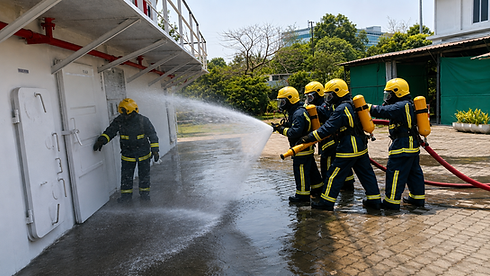
The Product requires completion of three mandatory units and specifies 32 hours of Guided Learning, with approximately one quarter theory and three quarters practical training.

From Offshore Personnel to Emergency Response Team Member
General offshore training prepares personnel to recognise alarms, follow emergency procedures and protect themselves.
The OERTM role requires another level of response. Product 4500 establishes the initial specialist training required to begin developing that capability.
An Emergency Response Team Member may be required to enter an incident area, operate firefighting systems, work in breathing apparatus, manage hoses, search for casualties, assist recovery and maintain communication with the Offshore Emergency Response Team Leader while conditions continue to change.
Practical Training Environment:
The training environment is designed for integrated, team-based emergency-response scenarios rather than isolated equipment exercises.
Facilities support practical training in:
-
Fire-hose deployment and management
-
Hydrant and branch operation
-
Portable-monitor use
-
Class A, B and C fire scenarios
-
Pressure-fed hydrocarbon fire response
-
Foam firefighting
-
Working-duration breathing apparatus
-
Multi-level firefighting and emergency response
-
Confined-space incident response
-
Restricted-access casualty recovery
-
Protection of simulated pressure vessels and associated pipework
IS 4500 Right For you?
Designed for personnel preparing to take an active role in offshore emergency response.
Product 4500 is suitable if you have been appointed, or are preparing to be appointed, as an Offshore Emergency Response Team Member and need the initial specialist training required to begin developing competence for the role.
Product 4500 may be right for you if you:
-
Are entering the OERTM role and require initial OPITO emergency-response team training.
-
Need practical emergency-response competence in firefighting, breathing apparatus, search, casualty recovery and team operations.
-
Will work under an Offshore Emergency Response Team Leader during installation or vessel emergencies.
-
Need a foundation for workplace training and offshore competence assessment before full appointment to the role.
Completing Product 4500 is one part of the wider OERTM competence pathway. Duty Holders remain responsible for workplace training, installation-specific familiarisation, competence assessment and any additional specialist training required for the role.
There are no prerequisites for OERTM Training.
Before booking, confirm your requirement with your employer, operator or mobilisation team.


ENTER

SEARCH

LOCATE

ASSESS

RECOVER
Three Mandatory Units
Initial specialist emergency-response training for personnel appointed or preparing to be appointed as members of an offshore Emergency Response Team. Develop practical competence across incident response, firefighting, breathing apparatus, team communication, search, casualty recovery and representative offshore fire and non-fire emergencies.

01
OIS-12
The Role of the Offshore Emergency Response Team Member
The Role of the Offshore Emergency Response Team Member
OIS-12 establishes the responsibilities of the OERTM and OERTL, team safety, communication hierarchy and the human factors that can influence emergency-response performance. Learners also develop an understanding of alarms, emergency procedures, incident planning, incident control and the communication methods used within the offshore emergency organisation.
The unit builds awareness of fire and non-fire hazards, dynamic risk assessment, safe access and egress, emergency-equipment locations and fixed fire-protection systems. It also reinforces the need to remain familiar with changes to an installation or vessel that may affect escape routes, access, equipment locations and emergency-response arrangements.

02
OIS-13
Incident Response
Convert knowledge into controlled emergency action.
OIS-13 develops the learner’s ability to prepare for, enter and operate safely within an offshore emergency-response environment. Learners build understanding of mobilisation, incident briefing, dynamic risk assessment, safe access and egress, communication, changing hazards and the human factors that can affect performance under pressure.
The unit also develops practical competence in search and rescue, casualty recovery, firefighting equipment selection, hose and foam operations, firefighting media and working-duration breathing apparatus. Learners practise matching the response to the incident while maintaining team control, escape routes, BA accountability and effective communication.

03
OIS-14
Practical Exercises for the OERTM
The incident is integrated. The response must be integrated too.
OIS-14 brings the previous learning together through integrated practical emergency-response scenarios. Learners operate as members of an Emergency Response Team, combining incident briefing, PPE, breathing apparatus, firefighting, hose management, communication, search, casualty recovery, hazard control and post-incident debriefing across representative fire and non-fire emergencies.
Practical exercises include multi-level response, pressure-fed hydrocarbon fires, smoke and BA operations, restricted-access casualty recovery, chemical and confined-space incidents, and use of representative firefighting and rescue equipment. Learners must demonstrate that they can work under OERTL direction, control the incident, search and recover casualties, secure the area and restore operational readiness.
Why OERTM Initial 4500 Training?
Emergency-response competence starts before the first real incident.
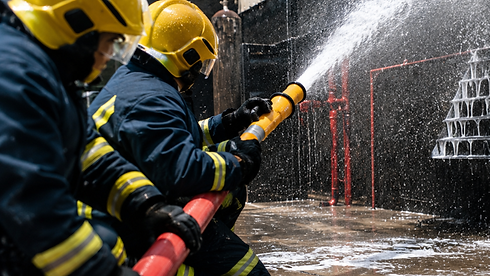
Offshore personnel may already understand alarms, muster arrangements and basic emergency procedures. The role of an Offshore Emergency Response Team Member, however, requires a different level of preparedness. An OERTM may be expected to enter an incident area, work under breathing apparatus, deploy firefighting equipment, manage hose lines, search for casualties, support recovery and remain coordinated with the Offshore Emergency Response Team Leader while conditions continue to change.
OPITO Product 4500 provides the initial specialist training required to begin developing that capability. It is designed for personnel who have been appointed, or are preparing to be appointed, to the OERTM role and equips them with the knowledge, understanding and practical skills required to perform effectively as part of an offshore emergency-response team.
Three-Level Emergency Structure
Train within the physical complexity of an offshore emergency environment.
At least one practical training structure must contain a minimum of three levels, with both open and enclosed spaces. The environment must support realistic emergency-response operations involving smoke logging, heat, fire, stairs, fixed ladders and walkways.
This creates the physical conditions required to develop controlled team movement, breathing-apparatus operations, hose management, communication, search and casualty recovery across multiple levels.
Multi-Level Fire Scenarios
Different fire conditions require different response strategies.
The training structure must support representative internal and external fire scenarios so learners can practise selecting equipment, managing hose lines and applying appropriate firefighting tactics under changing conditions.
The structure must be capable of supporting representative fires including:
Internally
-
Class A contained fires
-
Class B contained-spill fires
-
Class B pressure-fed fires
Externally
-
Class B pressure-fed fires
-
Class B contained-spill fires
-
Class B flowing fires and
-
Class C gas fires.
The purpose is to expose new OERTMs to different fuel conditions, fire behaviour and operational demands before they are expected to perform the role within the workplace.
Firewater System
Realistic firefighting depends on a reliable and controlled water supply.
The training centre must provide a firewater reservoir with sufficient capacity to complete the practical exercises and a pumping system capable of supplying the fire-training areas at full operating capacity.
The system must also provide:
-
Backup firewater capability
-
Adequate pressurised water if the primary pump fails
-
Fuel shut-off controls in the event of firewater failure
-
Low-pressure alarm or equivalent pressure monitoring
These requirements reflect the specialist nature of OERTM Initial Training. The programme is designed to develop operational emergency-response competence using representative firefighting systems and realistic team-based scenarios, rather than providing general fire-awareness training.

01
Understand the incident, hazards, team roles and immediate response objective before deployment.
RECEIVE THE BRIEF

02
Choose the firefighting, rescue, communication and protection equipment appropriate to the emergency.
SELECT THE EQUIPMENT

03
Fit and check the required emergency-response PPE and breathing apparatus before entering the incident area.
DON PPE & BA

04
Move into the response area under clear communication and coordinated direction from the OERTL.
DEPLOY AS A TEAM

05
Apply the appropriate firefighting, isolation, protection or hazard-control actions as conditions develop.
CONTROL THE INCIDENT

06
Locate casualties, assess the situation and carry out controlled search, rescue and recovery actions.
SEARCH & RECOVER

06
Confirm that immediate hazards are controlled and leave the incident area in a safe, managed condition.
SECURE THE AREA

06
Review actions, communication, equipment use and lessons from the scenario to strengthen future performance.
DEBRIEF THE RESPONSE
Why OERTM Initial Training Matters
Personnel appointed to an Offshore Emergency Response Team need more than general emergency awareness.
OERTM Initial Training develops the practical foundation required to operate as part of a coordinated offshore emergency-response team. Learners move from understanding roles, hazards and incident procedures into realistic exercises involving firefighting, breathing apparatus, search, casualty recovery and communication with the OERTL.
What Learners Must Demonstrate
-
Selecting the correct firefighting equipment and extinguishing media
-
Breathing-apparatus control-board procedures
-
Selection and donning of emergency-response PPE
-
Working-duration BA operation and wearer checks
-
Participation in an incident brief
-
Selection and use of portable firefighting equipment
-
Foam-equipment operation and flushing
-
Extinguishing representative fires and securing the area
-
Effective communication with the OERTL and response team
-
Safe entry and operation within the incident area
-
Correct search-and-rescue procedures
-
Initial casualty assessment and recovery
-
Participation in a post-incident debrief and restoration of operational readiness.
The practical progression is designed to establish the individual skills first, then integrate them into realistic team-based emergency scenarios where several response actions must be managed together.

Competence For A Safer Tomorrow
Theory builds knowledge. Practice builds confidence.


PREPARE THE PERSON. BUILD THE TEAM. DEVELOP THE RESPONSE.
Why Team Size Matters
Training as a team creates demands that cannot be reproduced through individual practical exercises alone.
OERTM competence is inherently collaborative. A realistic incident requires learners to operate within a team structure where individuals must: receive the brief, assume assigned roles, deploy equipment, communicate, maintain hose lines, search, recover casualties and report to the Team Leader (OERTL).
Practice What Offshore Drills Cannot Fully Reproduce
Build the Response Before the First Real Incident
OERTM Initial Training gives learners their first structured opportunity to bring these skills together within realistic emergency-response scenarios. Live-fire response, pressure-fed hydrocarbon fires, breathing-apparatus operations, multi-level hose deployment, restricted-access casualty recovery, chemical incidents and confined-space response all require a controlled training environment.
The purpose is to move learners beyond individual equipment familiarity and develop the ability to operate as part of a coordinated Emergency Response Team before those skills are required offshore.

REFRESH

RESCUE

BRIEF

SECURE

EQUIP

DEBRIEF
Medical Screening
OERTM practical training can be physically demanding and potentially stressful.
Learners must be capable of participating fully.
Before participating, learners must satisfy one of the specified routes:
-
valid current offshore medical
-
operator-approved medical
-
or appropriate medical screening conducted by the OPITO-approved centre.
Learners and/or sponsoring companies are responsible for declaring current or pre-existing medical conditions that could affect safe participation.
Where doubt exists, the learner must be directed to an appropriate medical professional familiar with the nature of the training.
Validity
2-Year OPITO Certificate Validity
The OPITO OERTM Initial Training certificate is valid for two years.
The Product also notes that some employers may require revalidation more frequently than OPITO's two-year period.
OERTM competence must also be maintained through workplace training, offshore drills, exercises and continuing assessment.
Why Train with Suraksha Marine?
Move beyond emergency awareness into coordinated team response.
-
Emergency Team Discipline: Develop an understanding of OERTM responsibilities, OERTL direction, communication structures and the behaviour required to operate effectively as part of an offshore Emergency Response Team.
-
Realistic Firefighting Operations: Practice hoses, branches, monitors, portable extinguishers and foam systems against representative Class A, hydrocarbon-liquid and gas-fire scenarios.
-
Breathing Apparatus Competence: Develop practical familiarity with working-duration BA, wearer checks, pressure monitoring and breathing-apparatus control-board procedures.
-
Multi-Level Emergency Response: Operate across representative multi-level structures involving smoke, heat, stairs, ladders, walkways and restricted access.
-
Search & Casualty Recovery: Practice search techniques, casualty location, initial assessment and controlled recovery using representative rescue equipment.
-
Fire & Non-Fire Incidents: Develop response capability across firefighting, gas release, chemical incident, confined-space and restricted-access scenarios.
-
Team Communication: Maintain effective communication with the OERTL and fellow team members while hazards, priorities and conditions change.
-
Integrated Practical Assessment: Bring PPE, breathing apparatus, firefighting, hose management, communication, search and rescue together within realistic emergency-response scenarios.
Build the Team Before the Emergency.
Develop the knowledge, firefighting capability, breathing-apparatus competence, search-and-rescue skills and team discipline required to begin operating as an Offshore Emergency Response Team Member.
UNDERSTAND THE INCIDENT. ENTER WITH CONTROL. RESPOND AS A TEAM.
Real Equipment.
Realistic Scenarios.
Coordinated Response.
Corporate workforce mobilisation?
Frequently Asked Questions (FAQ)


