


Case Study
The Cormorant Alpha Helicopter Tragedy, 1992
When a Short Offshore Shuttle Became a Cold-Water Survival Emergency
Case Study Analysis by Suraksha Marine
Case Study
1. Introduction — The Flight That Looked Short, but Carried Long Consequences
On 14 March 1992, an AS332L Super Puma helicopter, registration G-TIGH, crashed into the North Sea near the Cormorant ‘A’ platform in the East Shetland Basin. The helicopter was operating in the offshore oil and gas environment, close to an installation, in difficult weather, at night and over very rough water.
There were 17 people onboard. Eleven died. Six survived.
This tragedy remains one of the most important offshore helicopter survivability case studies because it sits at the intersection of aviation risk, weather decision-making, passenger escape, flotation, underwater survival, cold-water exposure and rescue coordination.
For Suraksha Marine, this case is especially relevant because it teaches a lesson that every offshore worker must understand:
A helicopter emergency does not end when the aircraft hits the water. It ends only when every survivor has escaped, surfaced, remained afloat, been located, recovered and treated.
The Cormorant Alpha tragedy was not a case of one simple failure. It was a chain. The operation was being conducted in adverse conditions. The helicopter impacted very rough seas near the platform. The aircraft rolled inverted and sank. Some occupants could not escape the cabin. Others escaped the aircraft but did not survive until rescue. Only six people were recovered alive.
This makes the case different from an accident where all occupants remain inside the aircraft. It shows that even successful underwater escape is not the end of survival. It is only the first part of a much longer emergency.
A worker may escape the fuselage and still face cold shock, darkness, waves, spray, exhaustion, injury, separation from others and difficulty being found. A lifejacket may keep the worker afloat, but it does not remove the need for airway protection, spray hood use, signalling, group survival and rapid rescue. A standby vessel may be nearby, but rough seas can make recovery extremely difficult. A helicopter may be fitted with flotation devices, but flotation is only a barrier if it activates and keeps the aircraft in a survivable attitude long enough for occupants to escape.
The Cormorant Alpha tragedy therefore teaches offshore survival as a complete chain:
Flight risk management.
Weather decision-making.
Helicopter handling and visual reference.
Water impact survivability.
Flotation.
Cabin escape.
Lifejacket discipline.
Cold-water survival.
Rescue location.
Recovery from the sea.
Investigation and industry learning.
This is why modern offshore training must be practical, repeated and realistic. HUET cannot be taught as a simple pool exercise. BOSIET cannot be treated as a one-time induction. FOET cannot be viewed as a compliance refresher. Sea survival cannot be reduced to theory. These courses exist because real offshore emergencies are fast, disorienting and unforgiving.
The strongest training message from this case is:
Offshore helicopter survival is not one skill. It is a sequence of skills, and every link must hold.

Incident Snapshot — Cormorant Alpha Helicopter Tragedy, 1992
-
Cormorant Alpha helicopter tragedy Incident
-
14 March 1992 Date
-
Near the Cormorant ‘A’ platform, East Shetland Basin, northern North Sea Location
-
AS332L Super Puma, registration G-TIGH Aircraft
-
Offshore helicopter shuttle / personnel movement near an installation Operation type
-
17 People onboard
-
11 Fatalities
-
Survivors rescued alive: 6
What Happened
During a helicopter movement near the Cormorant ‘A’ platform, the AS332L Super Puma descended into very rough seas in poor weather and night-time conditions. The helicopter rolled inverted and sank, creating a severe underwater escape and cold-water survival emergency.
Survival Lesson
The case also shows that escaping the aircraft is not the same as surviving the emergency. Some occupants reportedly escaped from the airframe, but only six people were recovered alive. This makes the accident especially important for understanding the complete survival chain: impact, inversion, underwater escape, flotation, surface survival, visibility, rescue and medical recovery.
2. Setting the Scene — Cormorant ‘A’, Rough Seas and Adverse Weather Operations
The Cormorant Alpha helicopter tragedy took place in the East Shetland Basin, a demanding offshore operating area in the northern North Sea. This region is exposed to harsh weather, rapidly changing sea states, low visibility, cold water and challenging night-time operating conditions. For offshore helicopter crews, platforms, standby vessels and passengers, this environment can reduce the safety margin very quickly.
The aircraft involved was an AS332L Super Puma, registration G-TIGH, operating near the Cormorant ‘A’ platform on 14 March 1992. The flight was connected with offshore personnel movement near the installation. Public accident summaries describe the operation as a shuttle movement in poor weather, with very rough seas and difficult conditions around the platform area.
This setting is important because it challenges one of the most dangerous assumptions in offshore travel: that a short flight is automatically a low-risk flight. In offshore operations, risk is not measured only by distance. Risk is shaped by the environment, weather, sea state, visibility, platform proximity, flight profile, passenger readiness and rescue conditions.

The Cormorant Alpha tragedy became a serious survivability case because the helicopter entered the sea, rolled inverted and sank. There were 17 people onboard. Eleven died and six were rescued alive.
Reports indicate that some occupants escaped from the airframe but were not recovered alive, which makes this case especially important for understanding the full survival chain.
The training lesson is clear: survival is not only about getting out of the helicopter. It is about staying alive after escape until rescue is completed.
2.1 The Offshore Environment — Why the East Shetland Basin Matters
The East Shetland Basin is not a forgiving place for offshore operations. Wind, darkness, spray, low cloud, rough seas and platform lighting can all affect helicopter operations near installations. In poor visibility, the sea may not provide a clear visual horizon. At night, waves and reflections can distort depth perception.
Platform lights can assist orientation, but they can also create glare, visual confusion and false references.

For a flight crew, this means the workload increases. The crew must manage altitude, speed, heading, platform position, wind, turbulence and sea state while operating close to an offshore structure. In such conditions, a small deviation can become serious because there may be limited height, limited time and limited space to recover.
For platform and emergency teams, the same environment also affects rescue. Rough seas make survivor recovery difficult. Darkness makes people in the water harder to see. Cold water reduces the time a person can remain functional.
Wind, spray and waves can separate survivors from each other and from rescue assets.
This is why offshore safety must treat the environment as an active hazard, not just background scenery. The sea, weather and darkness are not passive conditions.
They influence decision-making, aircraft handling, passenger escape and rescue success.
2.2 Why Short Offshore Shuttle Flights Still Carry Serious Risk
A short helicopter shuttle near a platform can feel routine. The flight may be brief. The route may be familiar. The passengers may have flown many times before. The aircraft type may be well known to the workforce. This familiarity can create a false sense of security.
The Cormorant Alpha accident shows why that mindset is dangerous. A short sector may still involve some of the most demanding parts of offshore aviation: low-level manoeuvring, approach, platform proximity, changing visual references, turbulence, sea spray, darkness and poor weather.
In these conditions, the aircraft may not have much time or space to recover if something goes wrong.
For passengers, the danger is that routine can weaken preparation. Workers may stop listening carefully to briefings. They may assume they already know the lifejacket.
They may not identify the nearest exit. They may not mentally rehearse what to do if the aircraft enters the water. But in a water-impact emergency, there may be no time to prepare after the event begins.
A short flight does not give a passenger a shorter emergency. Once the helicopter hits water, the same survival rules apply:
-
Hold a reference point.
-
Locate the exit.
-
Do not release too early.
-
Do not inflate inside the cabin.
-
Exit first.
-
Move clear.
-
Inflate outside.
-
Survive until rescue.

2.3 Passenger Preparedness — What Offshore Workers Can Still Control
Offshore passengers do not control the aircraft, the weather, the sea state or the decision to fly. But they do control their own readiness before boarding.
That readiness begins with the safety briefing. The briefing is not a formality. It is the passenger’s mental map for survival. Workers must know their nearest exit, secondary exit, seat harness, lifejacket, immersion suit, emergency breathing system where applicable, and the correct sequence for underwater escape.

The Cormorant Alpha tragedy is especially relevant because the helicopter rolled inverted and sank. Inversion is one of the most disorienting situations an offshore passenger can experience. The body may float upward against the restraint. The exit may feel as if it has moved. Darkness, bubbles, cold water and panic can make calm thinking difficult.
In that moment, instinct can become dangerous.
Instinct says: release immediately.
Training says: find the exit first.
Instinct says: swim upward.
Training says: follow the reference point.
Instinct says: inflate the lifejacket now.
Training says: inflate only after escape.
Instinct says: panic.
Training says: sequence.
This is why HUET and FOET must be treated as practical survival training, not certificate renewal. The aim is to build physical memory strong enough to work when visibility is gone, orientation is lost and the body is under stress.
2.4 From Escape to Survival — Why the Waterline Is Not the Finish Line
One of the most important lessons from the Cormorant Alpha accident is that escaping the helicopter is not the same as surviving the accident. Some occupants reportedly escaped from the airframe, but only six people were rescued alive. This makes the case a powerful reminder that offshore survival continues after egress.
Once a survivor reaches the surface, the emergency changes form. The worker must now deal with cold water, waves, spray, darkness, injury, exhaustion, separation, poor visibility and rescue delay.
Even with a lifejacket, a person may struggle to keep the airway clear in rough seas. Without correct use of spray hoods, locator lights, group survival and signalling methods, a survivor may remain difficult to locate and recover.
This is where HUET must connect directly with sea survival. Training must not stop at “exit the simulator.” It must teach what happens next: moving clear of the aircraft, inflating at the correct time, protecting the airway, conserving energy, staying visible, using survival equipment and preparing for rescue.
For Suraksha Marine trainees, this is one of the strongest case-study lessons: helicopter survival is not one action. It is a chain.
The worker must survive the impact.
-
Escape the cabin.
-
Reach the surface.
-
Stay afloat.
-
Remain visible.
-
Avoid exhaustion.
-
Protect the airway.
-
Survive cold exposure.
-
Be recovered safely.
-
Receive medical care.
-
If any link fails, the outcome can still be fatal.

3. The People Involved — Seventeen Lives Inside One Survival Chain
There were 17 people onboard the helicopter: flight crew and offshore personnel. They were not simply “occupants” in a report. They were workers, colleagues, family members and members of the offshore community.
In an offshore helicopter accident, the people onboard face different roles but the same emergency environment. The flight crew must control the aircraft, manage the emergency and make decisions under intense pressure. Passengers must follow instructions, brace, maintain orientation and execute escape actions if the aircraft enters water. Rescue teams must respond in difficult conditions, locate survivors and recover them from the sea. Platform teams must support emergency communication, accountability, coordination and post-incident response.
The tragedy is that the accident did not affect everyone in the same way. Some people were unable to escape the cabin. Others escaped from the airframe but did not survive to rescue. Six were rescued alive. This pattern is one of the most important learning points in the case.
It tells us that survival has stages:
First, the impact must be survivable.
Second, the occupant must remain conscious or capable enough to act.
Third, the restraint must be released at the right time.
Fourth, the exit must be found and used.
Fifth, the lifejacket must not be inflated inside the cabin.
Sixth, the person must surface safely.
Seventh, they must remain afloat and protect the airway.
Eighth, they must be visible or locatable.
Ninth, rescuers must reach and recover them in time.
If any stage fails, the outcome can still be fatal.
For training, this means we must not reduce the case to one simple message such as “wear a lifejacket” or “do HUET.” Both are vital, but the real lesson is broader. Offshore workers must understand the whole survival chain.
The people involved also include those who were not on the helicopter: helideck teams, installation management, rescue vessels, emergency response coordinators, investigators, regulators and future training providers. Their role is to learn from the event and strengthen the barriers that failed.
A respectful case study should avoid blame and focus on learning. The aim is not to judge individuals in the final seconds of a severe emergency. The aim is to ask: what barriers should have protected them before, during and after water impact?
4. Timeline of Events
4.1 Phase One: Offshore Shuttle in Adverse Weather
The helicopter was operating near the Cormorant ‘A’ platform during adverse weather and night-time conditions. Public accident summaries describe the operation as a shuttle movement connected with personnel transfer near the installation. The surrounding sea state was very rough, and the operating environment was already demanding before the accident occurred.
For trainees, this first phase is important because it shows how risk can exist before anything appears to go wrong. A helicopter may be serviceable. Passengers may be briefed. The route may be short. But weather, visibility, sea state and proximity to offshore structures can reduce safety margins.
A short flight does not mean a simple flight.
A familiar route does not mean a low-risk route.
A planned transfer does not remove environmental hazards.
Training implication:
Offshore workers and supervisors must respect weather, visibility and sea-state risk. Any helicopter movement over water should be treated as a serious operation, even when the flight is short.

This image shows the AS332L Super Puma flying a short offshore shuttle near the Cormorant A platform at night, surrounded by rough seas, low visibility, wind, spray, and platform lights in the distance. Passengers are visible inside the cabin, representing the routine movement of offshore workers in a demanding North Sea environment.
This phase highlights how a short flight can still carry serious operational risk. Night conditions, poor visibility, low altitude, platform proximity, and rough seas reduce the time available to recognise and recover from flight-path deviations.
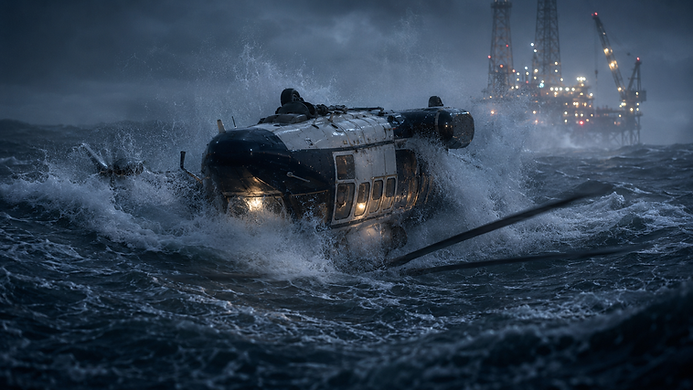
This image captures the moment the helicopter strikes the rough North Sea and begins to roll inverted. The focus is on the sudden transition from flight to survival emergency, where passengers and crew must immediately shift from normal transport posture to underwater escape readiness.
This phase represents the violent loss of orientation that can follow a helicopter water impact. Once the aircraft inverts, survival depends on restraint discipline, reference-point control, exit awareness, and the ability to act under extreme disorientation.
4.2 Phase Two: Fire Ignition During the Lowest Human-Performance Window
The helicopter was operating near the Cormorant ‘A’ platform during adverse weather and night-time conditions. Public accident summaries describe the operation as a shuttle movement connected with personnel transfer near the installation. The surrounding sea state was very rough, and the operating environment was already demanding before the accident occurred.
For trainees, this first phase is important because it shows how risk can exist before anything appears to go wrong. A helicopter may be serviceable. Passengers may be briefed. The route may be short. But weather, visibility, sea state and proximity to offshore structures can reduce safety margins.
A short flight does not mean a simple flight.
A familiar route does not mean a low-risk route.
A planned transfer does not remove environmental hazards.
Training implication:
Offshore workers and supervisors must respect weather, visibility and sea-state risk. Any helicopter movement over water should be treated as a serious operation, even when the flight is short.
4.3 Phase Three: Immediate Response, Emergency Command and Medical Evacuation
Twelve occupants are reported to have escaped from the airframe, but only six were rescued alive. This is one of the most powerful survival lessons in the entire case.
Escaping the helicopter is not the end of the emergency.
After escape, survivors were exposed to the North Sea environment. Cold water, rough waves, darkness, spray, injury, fatigue and difficulty being located all became part of the survival problem. Even a person who exits the aircraft may still drown, become separated, inhale water, lose strength or become impossible to recover quickly in severe sea conditions.
This phase is where HUET must connect with sea survival. A worker must not only know how to leave the aircraft. They must know how to remain alive after reaching the surface.
Lifejacket inflation, spray hood use, group huddling, signalling, avoiding unnecessary swimming, conserving energy and remaining visible all matter. Offshore workers must understand that survival does not end at the waterline.
Training implication:
HUET and sea survival must be integrated. The goal is not only to escape the cabin. The goal is to remain alive until rescue.

This image shows survivors escaping from an inverted submerged cabin while others float at the surface in cold, rough water. It communicates a crucial offshore safety lesson: escaping the aircraft is only the first stage of survival.
This phase highlights the importance of HUET, lifejacket use, breath control, window exits, and sea-survival discipline. In darkness, cold water, waves, and separation, survivors must manage fatigue, flotation, spray protection, signalling, and the wait for rescue

This image shows rescue teams recovering survivors from the sea under searchlights, with the offshore platform visible in the distance. The scene reflects emergency coordination, standby vessel response, search activity, and the human pressure of offshore rescue at night.
This final phase turns the incident into a learning moment. The Cormorant A case reinforces that survival is a chain: aircraft operation, weather decision-making, ditching survivability, HUET performance, lifejacket effectiveness, standby vessel readiness, and rescue coordination must all work together.
4.4 Phase Four: Fatal Consequences, Investigation and Long-Term Learning
Rescue efforts were launched, but the conditions were severe and the survival window was narrow. Six people were rescued alive. Eleven people died.
After the accident, the official investigation and industry reviews examined the operational, weather, survivability and rescue lessons. The AAIB report made several safety recommendations, and the accident contributed to wider attention on adverse weather operating policies, helicopter flotation, passenger survivability, underwater escape and offshore rescue coordination.
This phase matters because offshore safety does not stop when the wreckage is recovered. Real learning happens only when procedures, equipment, training, operating limits and emergency response systems improve.
Training implication:
A safety lesson is not complete when an investigation report is published. It is complete only when the offshore industry changes the barriers that protect workers.
5. Critical Decisions — Where the Safety Margin Was Tested
The first critical decision area was whether the flight should proceed in the prevailing conditions. Offshore aviation often involves difficult decisions about weather, visibility, sea state, installation needs and operational pressure. The Cormorant Alpha accident later became strongly associated with the need for improved management of helicopter operations in adverse weather.
This is not a simple question of “go” or “no-go.” Offshore conditions can change quickly. Weather may be acceptable at one point and marginal shortly afterward. Platform needs may create pressure. Personnel may need to be moved. Accommodation or operational arrangements may be affected. But the core safety principle remains: when weather and visibility reduce margins, operational pressure must not drive decisions.
The second decision area was visual reference and flight path management. Helicopter operations near offshore installations at night demand strong control of height, speed, attitude and position. If visual references are degraded, the crew must rely on instruments, procedures and clear limits.
The third decision area was flotation. Later survivability material notes that flotation devices were fitted but were not activated by the crew and the helicopter sank after impact. Flotation is a critical barrier in water-impact scenarios. It helps keep the aircraft afloat long enough for occupants to escape and rescuers to locate the scene. If flotation does not activate or is not activated in time, the escape problem becomes far more severe.
The fourth decision area was passenger escape. In an inverted cabin, the difference between release and entrapment may be seconds. Passengers need practical training, not just verbal briefings. They need repeated exposure to capsize, darkness, breath control, reference points and exit operation.
The fifth decision area was rescue coordination. When an aircraft enters rough water, responders face enormous difficulty. The rescue system must locate people quickly, recover them safely, manage hypothermia, and continue searching for those who are missing. In severe sea states, even a nearby survivor can be hard to recover.
The sixth decision area was industry learning. The accident demanded a shift in how offshore helicopter survivability was understood. It was not enough to focus only on preventing accidents. The industry also had to improve the chances of surviving a water impact.
The training message is direct:
Every decision before take-off affects survival after impact.
6. Technical and Survivability Failures — Not Just the Aircraft, but the Barriers Around It
This case is not best understood as a hidden mechanical-failure case like some later offshore helicopter accidents. The strongest learning lies in operational control and survivability barriers.
The first technical issue was the water-impact environment. A helicopter that enters rough water may experience rapid flooding, structural damage, violent motion and capsize. Many helicopters are top-heavy because engines, transmission and rotor systems are above the cabin. After water impact, the aircraft may roll inverted, making escape much harder.
The second issue was flotation. Emergency flotation systems are designed to help a helicopter remain afloat after ditching or water impact. If flotation is not activated, is activated too late, is damaged, or cannot keep the aircraft in a stable attitude, the time available for escape may collapse. In this accident, later survivability discussion noted that fitted flotation devices were not activated by the crew and the helicopter sank after impact.
The third issue was cabin escape. Five occupants were unable to escape the cabin. This teaches a brutal survival lesson: a person may survive the initial impact and still die if unable to exit the aircraft. Door and window operation, restraint release, reference points and physical orientation are life-critical.
The fourth issue was surface survival. Several people escaped the airframe but did not survive until rescue. That means the post-egress environment was itself deadly. The North Sea can quickly overwhelm a survivor through cold shock, wave splash, fatigue, inhaled water and loss of orientation.
The fifth issue was recovery from rough water. Rescue is not automatic. A person in the water must be located, approached and recovered. Darkness and rough sea state can make recovery slow and dangerous.
The sixth issue was equipment integration. Lifejackets, immersion suits, locator lights, spray hoods, rafts, flotation systems and rescue procedures must work together. A failure in one part can weaken the entire survival chain.
Visual Learning Section:
A useful training graphic would show a bowtie model with the centre event as “helicopter water impact and capsize.” On the left side, prevention barriers would include weather limits, flight planning, visual reference, crew procedures and operational pressure control. On the right side, mitigation barriers would include flotation, HUET, EBS or CA-EBS, lifejacket discipline, spray hood use, locator lights, rescue vessel readiness and SAR coordination.
7. Human Factors — Why Training Must Beat Instinct
Human factors are central to this accident because helicopter water impact is one of the most disorienting emergencies a worker can experience.
The first human factor is routine pressure. A shuttle movement near a platform may feel familiar. Workers may assume that because the flight is short, the risk is limited. This can reduce attention to briefings and equipment checks.
The second human factor is weather normalization. Offshore teams often operate in difficult conditions. Over time, harsh weather can become accepted as part of the job. The danger is that people may gradually accept higher levels of risk because the environment is always demanding.
The third human factor is startle response. When a helicopter impacts water, the body reacts before the mind fully understands what has happened. A person may gasp, tense, freeze, release too early or lose grip.
The fourth human factor is disorientation. Inversion changes the passenger’s world. Up becomes down. The seat may press the body in unexpected ways. The exit may no longer be where the mind expects it. Bubbles, darkness and cold water remove visual cues.
The fifth human factor is panic. Panic is not a weakness. It is a predictable human response to sudden entrapment and breath threat. Training helps by replacing panic with sequence.
The sixth human factor is memory under stress. A passenger who has only heard an explanation may not remember the correct sequence underwater. A passenger who has physically practised the sequence may have a better chance of performing it under pressure.
The seventh human factor is post-escape behaviour. Once at the surface, survivors may instinctively swim hard, separate from others, fail to deploy a spray hood or exhaust themselves. Sea survival training teaches energy conservation, group survival and signalling discipline.
The human factors lesson is simple:
In a helicopter water-impact emergency, survival depends on trained behaviour being stronger than instinct.
8. Emergency Response — Rescue in Darkness, Rough Sea and Cold Water
Emergency response after a helicopter enters the sea is complex. It requires rapid notification, accurate location, rescue vessel response, search-and-rescue coordination, recovery from rough water, casualty treatment and continued accounting for missing people.
In this accident, six people were rescued alive. That means rescue actions did succeed for some survivors. But eleven people died, showing the severity of the emergency and the limitations of rescue when people are trapped, separated, injured, submerged or overwhelmed by the sea.
A rescue team cannot save someone who cannot escape the cabin unless specialist rescue reaches them in time, which is extremely difficult in a rapidly sinking helicopter. A rescue vessel cannot recover someone it cannot locate. A lifejacket cannot protect the airway fully without correct use and suitable sea-survival actions. A fast response still may not overcome cold water, waves and darkness if the survival window is too short.
For offshore installations, emergency response planning must consider:
-
Who knows the helicopter is operating?
-
Who raises the alarm?
-
Which rescue assets are available?
-
How quickly can a standby vessel respond?
-
Can survivors be seen in darkness?
-
Do passengers have lights, beacons or reflective equipment?
-
Are immersion suits properly fitted?
-
Are lifejackets and spray hoods understood?
-
Can injured survivors be recovered from rough water?
-
Is hypothermia treatment ready?
-
Is muster and passenger accountability accurate?
Emergency response must also include support after the event. Survivors, rescuers, colleagues and families may all experience trauma. Offshore emergency planning must include communication, family liaison, counselling and workforce reassurance.
Visual Learning Section:
A strong rescue visual would show rough night seas near a platform, survivors in lifejackets, rescue vessel searchlights, a standby vessel approaching, and helicopter/SAR coordination overhead. The visual should focus on the difficulty of recovery and the importance of visibility, flotation and coordinated rescue.
9. What Went Wrong — The Survival Chain Failure Model
The accident can be understood as a survival chain failure model.
The first link was adverse weather and visibility management. The helicopter was operating in night-time adverse weather conditions near an offshore installation. Weather and visibility were later highlighted as major contributors in public safety discussion.
The second link was operational pressure. Offshore movements can carry pressure: personnel need to be transferred, accommodation arrangements may be affected, and platform operations may need continuity. Safety systems must ensure that pressure does not override margins.
The third link was water impact. Once the helicopter descended into the sea, the emergency shifted from aviation control to survivability.
The fourth link was capsize and sinking. The helicopter rolled inverted and sank. This greatly increased escape difficulty.
The fifth link was flotation. The flotation devices were reportedly fitted but not activated by the crew. Without flotation support, the aircraft did not remain as a stable escape platform.
The sixth link was cabin escape. Five occupants were unable to escape from the cabin. This highlights the importance of HUET and exit training.
The seventh link was surface survival. Some occupants escaped the airframe but were not rescued alive. This highlights the importance of sea survival, lifejacket use, spray hood use, cold-water response and signalling.
The eighth link was recovery from the sea. Rough sea conditions and darkness make rescue extremely challenging.
The ninth link was industry learning. The accident produced recommendations and later influenced adverse weather and survivability improvements. But the lesson must remain active, not historical.
The training translation is:
The accident was not only about impact. It was about every barrier before impact, every action during escape, and every survival step after reaching the surface.

10. Investigation Findings — What the Case Teaches the Offshore Industry
The official AAIB report addressed the accident to AS332L Super Puma G-TIGH near the Cormorant ‘A’ platform. Later survivability discussions note that the AAIB report made 11 safety recommendations. The accident became a key reference point for offshore helicopter survivability and adverse weather operations.
The main investigation themes relevant to training include:
-
Adverse offshore weather and visibility.
-
Night helicopter operations near installations.
-
Management of helicopter operations in poor weather.
-
Water-impact survivability.
-
Emergency flotation.
-
Passenger escape from an inverted cabin.
-
Survival after egress.
-
Rescue and recovery coordination.
-
Need for improved industry policies and training.
Later public discussion in the UK Parliament noted that the accident involved night-time, poor visibility and adverse weather as major contributors, and that operating policies were introduced afterwards to improve helicopter operations in adverse weather conditions.
For Suraksha Marine, the most important investigation lesson is not a single technical phrase. It is a safety system lesson:
The industry had to improve both prevention and survivability.
Prevention means avoiding the water impact through better weather policy, flight decision-making and operational control.
Survivability means increasing the chance that people can live if the aircraft enters the sea through flotation, HUET, lifejackets, immersion suits, rescue coordination and post-egress survival.
A mature offshore safety system must protect workers on both sides.
11. Industry Changes Afterward — From Accident Lessons to Better Barriers
The Cormorant Alpha accident influenced the direction of offshore helicopter safety in several important ways. Later safety reviews and parliamentary discussion noted that the industry introduced operating policies to improve the management of offshore helicopter operations in adverse weather. The accident also contributed to broader attention on helicopter survivability after ditching or water impact.
The industry learning can be grouped into four areas.
11.1 Weather and Operational Decision-Making
The accident reinforced the need for clear weather policies, visibility limits and decision-making discipline. Offshore helicopter operations cannot rely on informal judgement alone when weather, darkness and visibility are marginal. Procedures must help crews and operators decide when to continue, delay, divert or cancel.
11.2 Helicopter Flotation and Survivability
The sinking of the helicopter highlighted the importance of flotation systems and survivable cabin time. Helicopter flotation is not simply equipment; it is a survival barrier. It must be available, understood, maintained and capable of supporting escape.
11.3 Passenger Escape and HUET
The number of occupants unable to escape the cabin reinforced the importance of underwater escape training. HUET gives workers experience with capsize, restraint release, reference points, exit operation and escape sequence. The training environment is controlled, but the muscle memory is real.
11.4 Sea Survival and Recovery
The fact that some occupants escaped but did not survive to rescue emphasized that sea survival must be taught as part of helicopter safety. Lifejackets, spray hoods, immersion suits, group survival and rescue signalling all matter.
Industry changes after such accidents are not only technical. They are cultural. They change how workers think about helicopter travel. They remind operators that “routine” is not the same as safe. They remind training providers that survivability must be taught realistically.
12. Modern Training Lessons — What This Case Teaches Today
Lesson 1: A Short Flight Can Still Be High Risk
Offshore workers must not assume that short helicopter movements are automatically safe. Risk depends on conditions, not distance.
Lesson 2: Weather Is a Safety Barrier
Weather limits and adverse weather policies exist because poor visibility, night conditions and rough seas reduce margins.
Lesson 3: HUET Must Be Practical
A worker must practise underwater escape physically. Reading the procedure is not enough.
Lesson 4: Reference Points Save Orientation
In an inverted cabin, the hand must stay connected to a reference point. Without reference, the worker may lose orientation.
Lesson 5: Lifejackets Must Be Used Correctly
Lifejackets should not be inflated inside the aircraft. Inflation must occur after escape and when clear.
Lesson 6: Flotation Systems Matter
Helicopter flotation can create escape time. If flotation is unavailable or not activated, survivability is reduced.
Lesson 7: Escape Is Not the End
A worker who reaches the surface must still survive cold water, waves, darkness and rescue delay.
Lesson 8: Sea Survival Must Be Integrated With HUET
HUET and sea survival should not be taught as disconnected modules. They are one survival chain.
Lesson 9: Rescue Depends on Visibility
Locator lights, reflective material, PLBs where applicable, group survival and signalling improve the chance of recovery.
Lesson 10: Training Must Fight Complacency
Experienced offshore workers may become casual about briefings. This case shows why repetition matters.
13. What Today’s Offshore Workers Must Learn
Offshore workers must learn to treat helicopter travel as a serious safety exposure every time.
Before boarding, listen to the briefing. Do not assume you already know everything because you have flown offshore many times.
When seated, identify the nearest exit and an alternative exit. Count the seat rows or physical reference points if needed.
Keep the seat harness correctly fastened until the correct moment. Releasing too early in a submerged cabin can cause disorientation.
Know how your lifejacket works, but do not inflate it inside the cabin.
Understand your EBS or CA-EBS where applicable. Know where the mouthpiece is, how to deploy it and how to breathe from it.
Practice breath control. Cold shock and panic can destroy controlled breathing.
After escape, move clear of the aircraft before inflating the lifejacket.
Use the spray hood if fitted and trained. Protect the airway from waves and spray.
Stay with others if possible. Group survival improves visibility and morale.
Signal for rescue. Do not waste energy swimming unnecessarily unless required for immediate safety.
Report equipment concerns before flight. A poorly fitting immersion suit or damaged lifejacket is not a minor issue.
Take FOET seriously. Refresher training keeps survival actions current.
The personal lesson is clear:
You may not control the aircraft, the weather or the sea, but you can control your readiness to survive.
14. Suraksha Marine Courses — How They Fit This Case Study
BOSIET With EBS or CA-EBS
BOSIET gives new offshore workers their first structured understanding of helicopter safety, sea survival, emergency first aid, firefighting and offshore hazard awareness. The Cormorant Alpha case fits BOSIET because it shows why offshore helicopter travel must never be treated as routine transport.
BOSIET helps workers learn passenger discipline: listen to briefings, wear PPE correctly, understand lifejackets, identify exits, follow instructions and prepare mentally before take-off. The sea survival elements teach workers what happens after escape: flotation, group survival, signalling and rescue.
Correct training message:
BOSIET builds the foundation for the entire offshore survival chain.
HUET With EBS or CA-EBS
HUET is the most directly relevant course for this case. The helicopter rolled inverted and sank. Some occupants could not escape the cabin. This is exactly why HUET exists.
HUET teaches brace position, reference points, restraint release, exit operation, controlled escape, EBS or CA-EBS use where applicable, surface orientation and lifejacket discipline. It helps workers develop muscle memory for an environment where vision, calm thinking and orientation may be lost.
Correct training message:
HUET prepares workers for the moments when instinct may be dangerous and sequence becomes survival.
FOET With EBS or CA-EBS
FOET refreshes skills for experienced offshore workers. The Cormorant Alpha case shows why refresher training matters. A worker may fly offshore for years without an emergency, but if the emergency occurs, the escape sequence must still be available under stress.
FOET prevents skill fade, rebuilds confidence and reinforces updated equipment use.
Correct training message:
FOET keeps survival actions fresh enough to use when seconds matter.
Sea Survival Training
Sea survival is essential in this case because some occupants escaped the airframe but were not rescued alive. The sea itself became the second emergency.
Sea survival training teaches lifejacket use, spray hood use, cold-water response, hypothermia awareness, group huddling, rescue signalling, life raft boarding and energy conservation.
Correct training message:
Escaping the aircraft is only the beginning. Sea survival keeps workers alive until rescue.
Emergency First Aid
Emergency First Aid supports post-rescue care. Survivors may suffer cold exposure, shock, drowning complications, impact injuries, cuts, fractures and psychological trauma.
In offshore rescue, first aid begins once the casualty reaches a vessel, platform or rescue aircraft. Workers and emergency teams must understand airway, breathing, circulation, hypothermia and shock management.
Correct training message:
First aid extends the survival chain after recovery from the water.
OERTM — Offshore Emergency Response Team Member
OERTM prepares workers to support organized emergency response. A helicopter crash near a platform requires communication, muster, accountability, rescue support, casualty handling, coordination with vessels and SAR assets, and command discipline.
OERTM-trained personnel help prevent emergency scenes from becoming chaotic.
Correct training message:
OERTM turns rescue intention into organized emergency action.
Further OERTM
Further OERTM supports experienced responders and team leaders. This case can be used for advanced scenarios involving helicopter crash alarm, missing persons, multiple casualties in water, standby vessel coordination and cold-water casualty recovery.
Correct training message:
Advanced emergency response training prepares teams for complex, multi-agency offshore rescue.
HLO and HLA Training
Helideck teams play a critical role in offshore aviation safety. While this accident occurred during helicopter movement near the platform, the wider aviation safety chain includes passenger control, manifest accuracy, equipment checks, helideck readiness and emergency coordination.
HLO and HLA competence supports safe helicopter operations before and after flight.
Correct training message:
Helideck discipline is one layer in the offshore aviation safety system.
Travel Safely by Boat / Boat Transfer Awareness
Where personnel movement involves vessels, floatels, standby craft or recovery from water, boat transfer and marine safety awareness also matter. Workers need to understand boarding discipline, lifejacket use, recovery methods, vessel motion and rescue coordination.
Correct training message:
Marine safety and helicopter safety meet at the waterline.
Firefighting and Self-Rescue
Fire was not the central learning theme, but self-rescue discipline is relevant. Workers trained to respond calmly to alarms, follow escape routes and avoid unsafe improvisation are better prepared for multiple emergency types.
Correct training message:
Self-rescue is a transferable survival mindset.
Basic H2S Training
H2S was not involved in this accident and should not be presented as a causal lesson. However, H2S training forms part of the wider offshore safety pathway because it teaches alarm response, respiratory protection, withdrawal discipline and respect for invisible hazards.
Correct training message:
H2S is not part of this accident cause, but disciplined hazard response supports wider offshore survival culture.
15. Trainer Discussion Questions
-
Why can a short offshore helicopter flight still be high risk?
-
What weather and visibility factors made this operation more hazardous?
-
Why is night flying near an offshore platform different from daylight flying?
-
What happens to passenger orientation when a helicopter rolls inverted?
-
Why should a passenger hold a reference point before releasing the harness?
-
Why is inflating a lifejacket inside the aircraft dangerous?
-
What does this case teach about flotation systems?
-
Why is escaping the cabin only the first part of survival?
-
What threats remain after a worker reaches the surface?
-
How do cold water and rough seas reduce survival chances?
-
What equipment helps a survivor remain visible?
-
Why must HUET and sea survival be taught together?
-
How can experienced workers become complacent about helicopter briefings?
-
What should offshore workers check before boarding a helicopter?
-
What role does the helideck team play in the aviation safety chain?
-
How should emergency response teams prepare for helicopter water impact near an installation?
-
What does this accident teach about adverse weather operating policies?
-
Why should rescue drills include darkness, waves and multiple casualties?
-
What is the difference between survival to impact, escape from the aircraft and survival to rescue?
-
Which link in the survival chain is most vulnerable in your workplace?
16. Key Takeaways — Survival Is a Chain, Not a Moment
The Cormorant Alpha helicopter tragedy remains one of the most important offshore helicopter case studies because it shows that survival does not depend on one action alone.
The helicopter impacted very rough seas near the Cormorant ‘A’ platform. It rolled inverted and sank. Seventeen people were onboard. Eleven died. Six were rescued alive. Some occupants could not escape the cabin. Others escaped but did not survive to rescue.
That sequence teaches a hard truth:
-
A person can survive the impact and still lose the survival battle later.
-
For offshore workers, the lessons are practical:
-
Respect every helicopter flight.
-
Listen to the briefing.
-
Know your exit.
-
Use reference points.
-
Release the harness at the correct time.
-
Do not inflate inside the cabin.
-
Escape first, inflate later.
-
Protect the airway at the surface.
-
Stay visible.
-
Conserve energy.
-
Trust training, not instinct.
-
Refresh skills before they fade.
For offshore operators and HSE leaders, the lessons are equally clear:
Weather decisions matter.
Operational pressure must be controlled.
Flotation systems are critical barriers.
Passenger survivability must be designed, trained and tested.
Rescue coordination must be realistic.
Investigation findings must become real changes.
Training must reflect the harshness of the actual offshore environment.
For Suraksha Marine, this case strongly supports the purpose of BOSIET, HUET, FOET, sea survival, emergency first aid, OERTM and helideck training. These courses are not formalities. They are the human barrier system that helps workers respond when technology, weather and operating conditions place them in danger.
The final message for trainees is simple:
In an offshore helicopter emergency, survival begins before take-off, continues underwater, and is not complete until rescue.
.png)
Conclusion — Survival Is a Chain, Not a Single Action
The Cormorant Alpha helicopter tragedy remains one of the most powerful offshore survival case studies because it shows how quickly a familiar offshore flight can become a life-threatening emergency. The flight was short. The platform was nearby. The helicopter was operating in a known offshore environment. Yet adverse weather, darkness, rough seas and the challenges of helicopter operations near an installation created conditions where the survival margin became extremely small.
Seventeen people were onboard. Eleven died. Six were rescued alive. Those numbers tell only part of the story. The deeper lesson is that offshore helicopter survival does not depend on one moment alone. It depends on a chain of barriers before, during and after the water impact.
The first barrier is prevention: weather decisions, operational limits, flight planning, crew procedures and the willingness to delay or cancel when conditions become unsafe. The second barrier is survivability: flotation, aircraft design, passenger briefing, PPE, lifejackets, immersion suits and underwater escape readiness. The third barrier is personal action: holding a reference point, locating the exit, releasing the harness at the correct time, escaping the cabin and inflating flotation only after clearing the aircraft. The fourth barrier is survival after escape: staying afloat, protecting the airway, conserving energy, remaining visible and waiting for rescue. The final barrier is emergency response: search, recovery, first aid, hypothermia management and medical care.
The Cormorant Alpha case proves that escaping the helicopter is not the same as surviving the emergency. A worker may get out of the aircraft and still face cold water, waves, darkness, spray, injury, exhaustion and delayed recovery. That is why HUET and sea survival must be understood as connected skills, not separate training modules. The goal is not simply to exit the simulator. The goal is to escape, stay alive, stay visible and be rescued.
For offshore workers, the message is personal. Never treat helicopter travel as routine simply because you have flown many times before. Listen to every briefing. Know your nearest and secondary exits. Understand your lifejacket and survival equipment. Keep your harness secured until the correct moment. Do not inflate inside the cabin. Practise the sequence until it becomes physical memory.
For supervisors, HSE leaders and operators, the lesson is equally clear. Offshore aviation safety must be managed as a system. Weather, visibility, sea state, platform proximity, passenger readiness, rescue capability and training currency all influence survival. A short shuttle can still carry serious risk when the environment becomes unforgiving.
For Suraksha Marine trainees, this case reinforces the purpose of BOSIET, HUET, FOET, sea survival, emergency first aid, OERTM and helideck safety training. These courses are not administrative requirements. They are survival barriers. They prepare workers to respond when instinct may be dangerous and when seconds matter.
The final lesson from Cormorant Alpha is simple:
Survival begins before boarding, continues underwater, and is not complete until rescue.
That is why offshore safety training must be practical, repeated and taken seriously every time.
Take the Next Step with Suraksha Marine
If this case study raised important questions about your team’s offshore readiness, this is the moment to turn insight into action.
Learn more about our OPITO-approved HUET, BOSIET, FOET, OERTM, ERME, CA‑EBS and A‑MAST programs
VISIT: https: www.surakshaweb.com
Talk to a training specialist about the right courses for you or your crew:
📧 surakshaweb@gmail.com
📞 +91 99873 00771
📞 +91 98192 12260
Ready to enroll or request a corporate proposal?
Course & inquiry form: https://www.surakshaweb.com/contact
Your offshore team may only get one chance in a real emergency. Make sure their training is not the weak link.