


Case Study
Norwegian North Sea Emergency Rescue
Cardiac Arrest Offshore, the First Five Minutes, and Why Trained Response Saves Lives
Case Study Analysis by Suraksha Marine
Case Study
1. Introduction — When the Most Dangerous Emergency Is Not Fire, Explosion or Helicopter Ditching
Offshore workers are trained to think about major hazards: fire, gas release, explosion, helicopter ditching, man overboard, vessel collision, evacuation and survival at sea. These are real offshore threats, and they deserve serious attention. But one of the most time-critical emergencies offshore may begin quietly, without smoke, without alarm bells and without visible structural damage.
A worker collapses.
At first, it may look like fainting. It may happen in a workshop, accommodation corridor, galley, machinery space, office, deck area or below-deck access route. Someone calls the medic. Another person shouts for help. Within seconds, the situation becomes clear: the worker is unresponsive, not breathing normally, and has no signs of circulation.
This is cardiac arrest offshore.
The heart has stopped pumping effectively. The brain is no longer receiving oxygenated blood. The survival clock has started. In this kind of emergency, the offshore installation is not waiting for the helicopter to save the patient. The platform itself becomes the first hospital, the first ambulance and the first survival barrier.
That is why this Norwegian North Sea rescue case is so important for Suraksha Marine training.
The case is not a traditional disaster case study. It is not about a platform being destroyed. It is not about one dramatic explosion. It is about how an offshore emergency response system can work when every link in the chain is ready: immediate recognition, rapid CPR, early defibrillation, trained first aiders, offshore medic leadership, emergency command, clear access routes, rescue basket preparation, SAR helicopter mobilisation, onboard advanced care, hospital pre-alert and specialist treatment ashore.
In Norway’s offshore sector, medical rescue systems have developed over decades because the working environment is remote, exposed and time-sensitive. A helicopter may launch quickly, but it still needs time to reach the installation. Offshore workers cannot afford to wait passively. The first five minutes belong to the people already on the asset.
This case study teaches a central offshore safety lesson:
In a cardiac arrest offshore, survival is not decided only by the doctor, the helicopter or the hospital. It is decided by the first trained person who starts CPR and the first team that brings the AED.
For Suraksha Marine, the learning connects directly to BOSIET, FOET, Emergency First Aid, OERTM, HLO/helideck readiness, muster, communication, medevac coordination and whole-installation emergency response. It also reinforces a wider safety culture message: emergency readiness is not only for emergency teams. Every offshore worker may become the first link in the rescue chain.

Incident Snapshot
This is not a single disaster case study but a medical emergency response learning case based on Norwegian offshore rescue practice. The case focuses on observed cardiac arrest offshore, where rapid recognition, CPR, AED use, trained medics, emergency command and SAR integration can dramatically improve survival chances.
-
Human impact:
Reported offshore benchmarks describe survival probability for observed cardiac arrest offshore as over 75% in certain Norwegian offshore response contexts, compared with much lower typical out-of-hospital survival rates on land. -
Core learning theme:
The first five minutes offshore, CPR within two minutes, AED readiness, medic coordination, emergency command, helideck medevac, SAR readiness and whole-platform first response. -
Suraksha Marine training fit:
Emergency First Aid, BOSIET, FOET, OERTM, offshore medical emergency drills, medevac coordination, casualty handling, muster and emergency communication.
2. Setting the Scene — Medical Emergencies in the Norwegian Offshore Environment
2.1 The Offshore Medical Reality — Distance, Weather and Time Pressure
Norwegian offshore installations operate in one of the most demanding working environments in the energy sector. Many are located far from shore in the North Sea, where weather, distance, sea state and helicopter availability directly shape emergency response. Offshore workers live and work in isolated industrial communities surrounded by process equipment, marine hazards, moving machinery, harsh weather and cold-water exposure.
A medical emergency offshore is very different from a medical emergency in a city. Onshore, an ambulance may arrive within minutes. A hospital may be nearby. Multiple emergency services may respond quickly. Offshore, the first response must come from the installation itself.
That means the offshore medic, trained first aiders, emergency response team, control room and installation leadership must stabilise the patient until external help arrives. The platform becomes the first response point. The offshore medic becomes the immediate clinical lead. The control room becomes the coordination hub. The helideck becomes a potential medical evacuation route.
This is why medical preparedness must be treated as a core offshore safety barrier, not a secondary support function. Offshore medical evacuations are not rare administrative events.
Research from North Sea offshore operations has shown that acute illness causes far more evacuations than trauma, and cardiac problems are a major reason for medical evacuation.
For offshore safety teams, this is an important mindset shift. Many training programmes focus heavily on visible workplace injuries: falls, cuts, burns, fractures and mechanical trauma. But medical illness can be equally urgent — and in the case of cardiac arrest, even more time-critical.
A cardiac emergency offshore compresses time. Every minute without CPR and defibrillation reduces the chance of survival. Brain injury can begin quickly when circulation stops. The patient cannot wait for the helicopter. The rescue chain must begin immediately at the scene.
Training message:
In an offshore cardiac emergency, the first minutes belong to the workforce already on the installation. Recognition, CPR, AED use and rapid communication must begin before external rescue arrives.

2.2 The Response Challenge — From Collapse Location to Medevac Coordination
The offshore environment adds logistical complexity to every medical emergency. A casualty may collapse below deck, inside accommodation, in a narrow machinery area, on stairs, in a noisy workshop, near process equipment or in a congested operational zone. The location of the casualty can make response slower, more difficult and more physically demanding.
The team may need to move the patient using a stretcher, rescue basket, stairwell, lift, crane-assisted transfer route or helideck access pathway. This movement must be controlled because CPR, airway support and patient monitoring may need to continue during transfer.

A blocked corridor, unclear route, delayed stretcher team or poor radio communication can cost valuable time. The helicopter crew also needs clear information before arrival.
They may need to know the patient’s condition, exact location, access route, whether CPR is ongoing, whether shocks have been delivered, whether mechanical CPR is being used, whether oxygen is available, whether the helideck is ready and whether weather conditions allow safe landing or winching.
This makes a cardiac arrest more than a medical problem. It becomes an installation-wide coordination challenge involving people, equipment, communication, access routes, helicopter operations and command discipline.
The offshore medic may lead the clinical response, but the medic cannot manage the entire system alone. First aiders must start care. The control room must activate procedures. The emergency response team must support access and movement. Supervisors must manage the area. The helideck team must prepare for medevac. The OIM or emergency command team must coordinate the wider response.
This is why medical emergency response must be drilled like any other major offshore emergency. A cardiac arrest drill should test not only CPR technique, but also alarm activation, AED access, communication, route clearance, casualty movement, helideck readiness, handover and rescue coordination.
3. The People Involved — The Patient, the First Aiders, the Medic, the OIM and the Rescue Crew
In an offshore cardiac-arrest rescue, the people involved are not limited to the patient and the medic. The entire installation becomes part of the response.
The first person involved is the colleague who notices the collapse. This person may not be a medic, but their action can decide the direction of the emergency. Do they call for help immediately? Do they check responsiveness? Do they recognise abnormal breathing? Do they start compressions? Do they ask someone to fetch the AED? Do they stay calm enough to communicate the location clearly?
The next group is the nearby workforce. Offshore workers are often trained in basic first aid and emergency response expectations. In a cardiac arrest, they may need to clear the area, assist with CPR rotation, guide the medic, bring the AED, move obstacles, prepare a stretcher route, support communications or protect the scene.
The offshore medic becomes the clinical lead onsite. The medic assesses the patient, applies advanced first aid and resuscitation protocols, uses monitoring equipment, supports airway and breathing management, coordinates with onshore medical support and prepares for evacuation. But the medic cannot be everywhere instantly. That is why a trained first response by co-workers is essential.
The Offshore Installation Manager or emergency command team coordinates the wider response. They must ensure the correct alarm is raised, communication with shore is established, the helideck is prepared, non-essential personnel are kept clear, route access is maintained and the rescue helicopter receives accurate information.
The helideck team also becomes part of the medical chain. A medical evacuation may require rapid helideck preparation, safe landing conditions, passenger movement control, stretcher transfer, communication with the helicopter crew and readiness for unexpected changes.
The SAR or rescue helicopter crew arrives as the advanced prehospital link. In Norwegian offshore rescue practice, helicopter teams may include highly trained medical and rescue personnel capable of advanced monitoring, treatment, winching, stretcher movement and rapid transport to hospital. The hospital team forms the final emergency link by preparing specialist care before the patient arrives.
In the published Oseberg rescue example, the offshore first responders and emergency nurse were already performing uninterrupted CPR and had delivered defibrillation before the helicopter team arrived. That detail is the heart of the case. The rescue was not created by the helicopter alone. The helicopter became effective because the platform team kept the patient alive until it arrived.
The training message is clear:
A cardiac-arrest rescue offshore is a team event. The person who survives may owe their life to the worker who started compressions, the colleague who brought the AED, the medic who led the response, the OIM who coordinated evacuation, the helideck team that prepared the aircraft, and the SAR crew that delivered advanced care.
4. Timeline of Events — From Collapse to Hospital Handover
4.1 Phase One: Sudden Collapse and Immediate Recognition
The emergency begins when a worker collapses on the installation. The first minutes are critical. A colleague must recognise that this is not simply fainting or tiredness. The responder checks for response, checks breathing and calls for help.
In cardiac arrest, the patient may not breathe normally. Gasping or irregular breathing can mislead untrained people. This is why first-aid training must teach offshore workers to treat unresponsiveness and abnormal breathing as an emergency requiring immediate CPR.
At this phase, the first trained person becomes the most important person in the system. They do not need to diagnose the exact cause. They need to activate the chain: call the emergency number or control room, request the medic, start compressions and ask for the AED.
Training implication:
The first five minutes do not belong to the helicopter. They belong to the workers at the scene. Recognition, CPR and AED retrieval must begin immediately.
.

The image shows the Sikorsky S-92A departing St. John’s with offshore personnel prepared for what appeared to be a normal transport flight. Immersion suits, passenger briefings and cabin discipline form the first survival barriers before an aircraft ever leaves the ground.
Cougar Flight 91 departed on 12 March 2009 with 16 passengers and two pilots. The uneventful beginning is an important reminder that major emergencies can develop during familiar, routinely performed offshore journeys.

The image captures the moment the cockpit warning transforms a routine flight into a time-critical emergency. The pilots must interpret the warning, manage the aircraft, complete emergency actions and decide whether to continue toward land or ditch immediately.
At approximately 09:45, the main gearbox oil-pressure warning activated while the helicopter was about 54 nautical miles from St. John’s. The crew declared an emergency, descended toward 800 feet and turned back, but their understanding of the developing failure was influenced by training expectations that gearbox failure would normally be accompanied by noise and vibration.
4.2 Phase Two: CPR, AED and Offshore Medic Response
Once cardiac arrest is recognised, chest compressions must begin. The aim is to keep blood moving to the brain and vital organs. Another responder brings the AED. The medic arrives and takes clinical control, but CPR should not stop unnecessarily.
The AED analyses the heart rhythm and advises whether a shock is needed. If a shock is advised, it must be delivered safely and promptly. In the Norwegian offshore rescue example, uninterrupted chest compressions and early defibrillation before helicopter arrival were decisive parts of the survival chain.
The offshore medic may add oxygen, airway support, monitoring, IV access, medication support depending on protocols, and communication with onshore medical advice. But even advanced treatment depends on high-quality basic life support. Poor compressions cannot be fully corrected later by advanced equipment.
Training implication:
CPR quality matters. AED access matters. Team rotation matters. The medic leads the response, but survival depends on everyone maintaining the chain without delay.
4.3 Phase Three: Emergency Command, Access Route and SAR Mobilisation
While CPR continues, the control room and emergency command system must manage the wider response. The OIM or emergency leader must ensure the correct emergency notification, contact SAR or medevac resources, inform shore-based medical support, prepare the helideck and clear a route from the casualty location to the helicopter.
This phase often reveals the practical difficulty of offshore rescue. The casualty may be below deck, in a narrow area or far from the helideck. The team may need a rescue basket, stretcher, mechanical CPR device, extra oxygen, lifting support or route clearance. If the route is blocked or unclear, time is lost.
The rescue helicopter crew also needs early information. They need to know the patient’s condition, location, access challenge, whether CPR is ongoing, whether defibrillation has occurred, what equipment is needed, and where they will land or winch.
Training implication:
Medical evacuation is not only a clinical task. It is a logistics and command task. Rescue routes, helideck readiness, communication and role clarity must be drilled before the emergency.

The image shows the helicopter descending toward the North Atlantic as the margin for a controlled ditching disappears. This phase represents the point at which technical failure, flight profile, limited time and increasing control difficulty converge.
At approximately 09:55, the crew reported that they were ditching. Less than one minute later, the helicopter struck the water with a high rate of descent; the impact severely damaged the fuselage, the emergency flotation system did not deploy, and the aircraft sank rapidly in water approximately 169 metres deep.
The final image represents the struggle that continues after impact: releasing restraints, finding an exit, escaping a rapidly flooding cabin, reaching the surface and remaining alive until rescue arrives. In offshore aviation, successful ditching is only the beginning of the survival sequence.
Only one of the 18 occupants survived, despite suffering serious injuries, and was rescued approximately one hour and twenty minutes after the accident. The other 17 occupants died from drowning, reinforcing the importance of rapid underwater egress, emergency breathing capability, cold-water protection and immediate rescue coordination.
4.4 Phase Four: Helicopter Transfer, Advanced Care and Hospital Handover
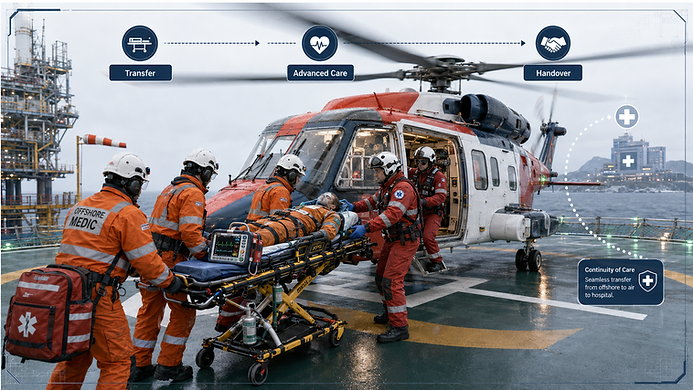
When the SAR helicopter arrives, the patient must be transferred safely and quickly. The handover should be structured: what happened, time of collapse, time CPR started, number of shocks, medication given, current rhythm, airway status, injuries or complications, and any known medical history.
The helicopter team continues treatment during transport. Depending on the patient’s condition, they may monitor ECG, support breathing, manage pain, treat shock, maintain CPR if needed or transmit information to the receiving hospital. In the published rescue example, the hospital was informed while the patient was still over the North Sea, allowing specialists to prepare before arrival.
This phase shows the importance of continuity. The rescue chain does not reset when the helicopter arrives. It continues from first aider to medic, medic to helicopter crew, helicopter crew to hospital.
Training implication:
A good handover saves time and reduces error. Offshore teams must practise concise medical communication under pressure.
5. Critical Decisions — Where Survival Was Protected
The first critical decision is whether the collapse is treated as cardiac arrest until proven otherwise. Hesitation kills. Offshore workers should not wait for the medic before starting CPR if the patient is unresponsive and not breathing normally.
The second critical decision is AED access. If the AED is too far away, locked, poorly marked, poorly maintained or unfamiliar to workers, the system loses precious minutes. AED placement and worker confidence are safety decisions, not procurement details.
The third critical decision is CPR continuity. In a real emergency, people become tired. Compressions become shallow. Team members may pause for too long while moving the patient, attaching equipment or discussing next steps. The response team must plan CPR rotation and minimise interruptions.
The fourth critical decision is medevac activation. Waiting too long to request helicopter support can increase risk. At the same time, the team must provide accurate information so the right asset and destination are selected.
The fifth critical decision is access and extraction. If the patient is in a narrow or congested area, the team must decide how to move them without compromising CPR, airway or safety. This requires drills. It cannot be improvised for the first time during cardiac arrest.
The sixth critical decision is destination. The nearest landing site may not be the best hospital. The team must consider patient condition, flight time, specialist cardiac capability and weather.
The seventh critical decision is leadership. In an emergency, many people want to help. Without command, help becomes noise. A clear medical lead and a clear emergency command structure protect the patient and the responders.
The key lesson is that survival is not one decision. It is a series of small, correct decisions made quickly by trained people.
6. Technical and Medical Failure — What Happens in Cardiac Arrest
Cardiac arrest occurs when the heart no longer pumps blood effectively. This may be caused by a heart attack, arrhythmia, electrical disturbance, severe trauma, hypoxia, drowning, electric shock, major blood loss or other medical conditions. In offshore medical cases, chest pain and cardiovascular symptoms require special attention because they can deteriorate quickly.
The most common life-saving interventions in sudden cardiac arrest are early CPR and early defibrillation where appropriate. CPR manually circulates blood. It does not restart the heart by itself in many cases, but it keeps oxygen moving to the brain and buys time. Defibrillation can correct certain shockable rhythms by delivering an electrical shock that allows the heart’s electrical system to reset.
This is why the AED is so important. It allows trained responders and even non-medical personnel to identify whether a shock is advised and deliver it safely. The AED gives voice and visual prompts, but workers must be confident enough to use it quickly.
Oxygen is also important, but oxygen without circulation is not enough. If the heart is not pumping, oxygen in the lungs will not reach the brain unless compressions move blood. This is why CPR must not be delayed while waiting for oxygen, stretcher, medic or helicopter.
A cardiac arrest offshore creates a medical and operational failure state:
The patient is clinically unstable.
The worksite may be remote or difficult to access.
The medic may need time to reach the patient.
The helicopter may need time to arrive.
The hospital is far away.
The team must create circulation manually until advanced care takes over.
This is why training must be realistic. Workers need to understand what CPR is doing, why compressions must be deep and fast enough, why interruptions are dangerous, why AED pads must be attached quickly, and why the patient must be moved only when movement is controlled.
7. Human Factors — Why People Delay, Freeze or Do the Wrong Thing
Cardiac arrest is not only a medical emergency. It is a human performance test.
The first human factor is disbelief. A colleague has collapsed, and the mind tries to explain it as something less serious: heat stress, fainting, fatigue, dizziness or a minor medical episode. This delay can cost the patient the best survival window.
The second human factor is fear of doing harm. Some workers hesitate to start CPR because they worry about breaking ribs, doing compressions incorrectly or being judged. Training must make the message clear: in cardiac arrest, doing nothing is more dangerous than imperfect compressions.
The third human factor is role confusion. Several people may gather, but no one starts. One person assumes someone else has called the medic. Another assumes the AED is already coming. Good training teaches direct communication: “You call the control room. You bring the AED. You start timing. You prepare to swap compressions.”
The fourth human factor is fatigue. CPR is physically demanding. Compression quality declines quickly if one person continues too long. Teams must rotate, but rotations must be controlled so pauses remain short.
The fifth human factor is tunnel vision. A team may focus only on compressions and forget access, helicopter preparation, route clearance or documentation. Another team may focus on medevac and interrupt CPR too often. Effective emergency response balances immediate clinical action with wider coordination.
The sixth human factor is hierarchy. A junior worker may recognise a problem but hesitate to speak up. A medic may need help but not request it clearly. A supervisor may crowd the scene. A good safety culture allows clear, direct emergency communication regardless of rank.
The seventh human factor is emotional stress. Working on a colleague in cardiac arrest is psychologically difficult. Offshore workers live together, eat together and work together. The patient may be a friend. Training cannot remove emotion, but it can provide a sequence that keeps the team functioning.
The human factors lesson is simple:
In a cardiac arrest, calm is not a personality trait. Calm is a trained system of actions.

8. Emergency Response — The Offshore Rescue Chain in Action
The emergency response begins at the point of collapse. The first aider starts CPR. The AED arrives. The medic takes clinical command. The control room activates emergency procedures. The OIM manages the installation-level response. The helideck team prepares for medevac. The rescue helicopter launches. The hospital prepares for arrival.
Each role must be clear.
-
The first aider’s job is to recognise and start.
-
The AED runner’s job is to bring and apply the defibrillator.
-
The medic’s job is to lead clinical care.
-
The control room’s job is to communicate and activate resources.
-
The OIM’s job is to coordinate priorities and preserve safety.
-
The helideck team’s job is to prepare safe aviation transfer.
-
The emergency response team’s job is to support movement and access.
-
The SAR crew’s job is to deliver advanced rescue and transport.
-
The hospital’s job is to continue specialist care without delay.
In offshore medical rescue, speed matters, but uncontrolled speed can create problems. A patient moved too early may lose CPR continuity. A helideck rushed without preparation can create aviation risk. A rescue route filled with unnecessary personnel can slow the stretcher team. Emergency response must be fast and disciplined at the same time.
The published Norwegian rescue example demonstrates how powerful the system becomes when the early links work. CPR started before helicopter arrival. Defibrillation occurred before helicopter arrival. The rescue crew received information during flight. The patient was moved to the helicopter. Advanced monitoring and treatment continued during transport. The hospital was prepared before arrival. The patient survived and returned to work.
That outcome should not be treated as luck. It should be treated as a result of preparation.
9. What Went Right — The Success Architecture
Many case studies focus on what went wrong. This one should also examine what went right, because successful rescue is built from positive barriers.
The first success barrier was immediate recognition. The emergency was identified as life-threatening, not dismissed.
The second success barrier was early CPR. Chest compressions began before external rescue arrived.
The third success barrier was early defibrillation. AED use before helicopter arrival gave the patient a critical chance.
The fourth success barrier was trained offshore first aiders. Colleagues and the emergency nurse were able to sustain response.
The fifth success barrier was emergency equipment availability. The necessary resuscitation equipment was accessible and used.
The sixth success barrier was communication. The helicopter crew received information before arrival.
The seventh success barrier was access preparation. Workers helped clear the route and prepare patient movement.
The eighth success barrier was SAR capability. The helicopter crew could deliver advanced care and rapid evacuation.
The ninth success barrier was hospital pre-alert. Specialists were ready before the patient arrived.
The tenth success barrier was training culture. Regular first-aid training and emergency exercises meant the response was not improvised from zero.
This is the failure architecture in reverse. It is the rescue architecture.
The lesson is powerful:
A successful offshore rescue is not one heroic act. It is many ordinary preparations working at the same time.
10. Investigation and Evidence-Based Findings — What the Data Tells Us
Because this case study is based on offshore medical rescue learning rather than a single accident investigation report, the most important evidence comes from offshore medevac research and documented rescue-practice examples.
A prospective observational study of North Sea offshore evacuations identified 381 evacuated persons during the study period. Most were men, with an average age in the mid-forties. Chest pain accounted for a significant portion of evacuations, trauma accounted for fewer, and acute illness caused far more evacuations than injury. The study concluded that competent SAR services are needed 24 hours a day, year-round, and that training and certification should be tailored to offshore SAR because the offshore health service and geography differ from onshore systems.
This finding matters for Suraksha Marine because it confirms that offshore emergency training cannot focus only on injuries caused by industrial work. Medical illness is a major emergency category offshore. Workers may be physically fit enough to pass offshore medicals and still develop chest pain, cardiac rhythm problems, stroke symptoms, respiratory distress, diabetic emergencies or other acute conditions offshore.
The Oseberg rescue example adds practical learning. A helicopter may launch quickly, but it may still take significant time to reach the installation. This makes the installation’s first response decisive. The same source describes a target of starting chest compressions within two minutes, regular emergency exercises, and the importance of first aiders bridging the time until rescue arrives.
The evidence points to one training conclusion:
Offshore medical survival depends on a prepared workforce, not only on professional rescuers.
11. Industry Changes and Modern Offshore Medical Preparedness
Norwegian offshore medical rescue has developed around the reality of distance. Operators cannot rely only on shore-based response. They need onboard medical competence, trained first aiders, emergency equipment, evacuation procedures, SAR readiness and hospital coordination.
Modern offshore medical preparedness includes several improvements that are relevant globally.
AED availability has become a standard expectation in many high-risk workplaces. Offshore installations should ensure AEDs are visible, accessible, maintained and included in drills.
First-aid training has become more practical and scenario-based. Workers must practise CPR, AED use, casualty movement, communication and teamwork, not only watch presentations.
Offshore medics are integrated into emergency planning. They do not work in isolation; they coordinate with control rooms, OIMs, SAR services and hospitals.
Telemedicine and remote medical support improve decision-making. ECG transmission, medical consultation and pre-alert systems can help the receiving hospital prepare.
SAR helicopters have become part of a wider medical chain rather than only transport assets. The helicopter can function as an advanced treatment platform during evacuation.
Emergency exercises increasingly test realistic barriers: difficult casualty locations, stairs, narrow access, simultaneous operations, weather delays, communication failures and fatigue.
These industry changes show the direction of modern offshore safety: medical emergency response must be treated with the same seriousness as fire, gas and evacuation response.
.png)
12. Modern Training Lessons — What This Case Teaches Today
The first lesson is that every worker is a potential first responder. Offshore installations cannot wait for the medic if the medic is several minutes away. The first colleague must start the chain.
The second lesson is that CPR must begin quickly. Training should make workers confident enough to start compressions without fear.
The third lesson is that AEDs must be used early. A defibrillator is only useful if people know where it is and are willing to use it.
The fourth lesson is that emergency command matters even in medical incidents. Cardiac arrest can require helideck activation, SAR coordination, route clearance, stretcher handling, hospital notification and family support.
The fifth lesson is that medical evacuation is a team operation. Offshore medics, first aiders, ERT members, helideck teams, control room operators and SAR crews must understand each other’s roles.
The sixth lesson is that access routes are life-safety routes. A stretcher cannot pass through blocked corridors, stored equipment or congested work areas.
The seventh lesson is that handover must be structured. Time of collapse, CPR start, shocks delivered, medications, rhythm, airway status and patient response must be communicated clearly.
The eighth lesson is that drills must be realistic. A perfect classroom CPR manikin scenario is not enough. Offshore drills should include noise, stairs, narrow spaces, radio communication, stretcher transfer and helideck coordination.
The ninth lesson is that post-incident care matters. Responders may need psychological support after resuscitating a colleague.
The tenth lesson is that prevention still matters. Health screening, fatigue management, fitness for work, chronic disease awareness and early reporting of chest pain can reduce the chance of a full cardiac arrest offshore.
13. What Today’s Offshore Workers Must Learn
Offshore workers must learn that medical readiness is part of survival culture. It is not only the medic’s responsibility.
If a colleague collapses, do not assume someone else will act. Check response. Call for help. Check breathing. Start CPR if needed. Send for the AED. Follow the AED prompts. Keep compressions going. Rotate when tired. Listen to the medic. Help clear the route. Support the team.
Workers must also report symptoms early. Chest pain, severe breathlessness, fainting, sudden weakness, one-sided facial droop, confusion, crushing pain, sweating, severe headache or unusual collapse must not be hidden to “finish the job.” Offshore culture must reject the idea that toughness means silence.
Workers must know where AEDs are located. During induction and refresher training, everyone should be able to identify the nearest AED from common work areas.
Workers must take first-aid training seriously. CPR practice can feel repetitive, but repetition builds confidence. In an emergency, confidence reduces delay.
Workers must support emergency access. Corridors, stairways, doors, muster areas and helideck routes must remain usable. Housekeeping can become a medical survival issue.
Workers must understand that medevac is not instant. Even with excellent SAR services, the platform must keep the patient alive until external help arrives.
Workers must also support colleagues after a serious event. A successful rescue can still be traumatic for responders. A fatal medical event can deeply affect the workforce. Safety culture includes care after the emergency.
The personal lesson is simple:
The life you save offshore may be the person working beside you.
14. Suraksha Marine Courses — How They Fit This Case Study
14.1 BOSIET
BOSIET provides the first offshore safety foundation. It teaches new offshore workers that emergency preparedness is part of their role from day one. In this case study, BOSIET connects through emergency first aid, alarm response, muster discipline, communication, survival mindset and offshore hazard awareness.
BOSIET helps workers understand that emergencies offshore develop differently from emergencies on land. Distance, weather, helicopter availability and isolation mean the installation must respond immediately.
The correct training message is:
BOSIET gives workers the foundation to act as part of the offshore emergency chain.
14.2 FOET
FOET refreshes essential offshore emergency skills for experienced personnel. This case is highly relevant because first-aid skills fade when not practised. A worker who once learned CPR may hesitate years later if they have not refreshed the skill.
FOET reinforces emergency first aid, response confidence, muster discipline and practical readiness. It helps experienced workers avoid complacency.
The correct training message is:
FOET keeps life-saving actions fresh enough to use when seconds matter.
14.3 Emergency First Aid
Emergency First Aid is the most directly connected course. It teaches recognition of life-threatening conditions, CPR, AED use, casualty assessment, airway management, bleeding control, shock management and handover.
In this case, Emergency First Aid is not a supporting topic. It is the centre of the rescue chain. The first trained responder may determine whether the patient reaches the helicopter alive.
The correct training message is:
First aid is not basic when the patient is in cardiac arrest. It is the first advanced barrier.
14.4 OERTM — Offshore Emergency Response Team Member
OERTM prepares team members to operate under emergency command. In a cardiac arrest medevac, OERTM-trained personnel may support stretcher movement, route control, helideck transfer, communications and casualty handling.
This case shows that emergency response teams are not only for fire. They also support medical emergencies where movement, access, manpower and coordination are critical.
The correct training message is:
OERTM turns individual helpers into an organised response team.
14.5 Further OERTM
Further OERTM strengthens experienced responders’ ability to manage complex scenarios. A realistic exercise might include a cardiac arrest below deck, CPR in progress, a blocked route, weather delay, helicopter landing preparation and hospital handover.
This builds leadership, communication and decision-making under pressure.
The correct training message is:
Advanced response training prepares teams for the messy reality of offshore emergencies.
14.6 HLO and Helideck Awareness
The helideck team plays a key role in medical evacuation. They must prepare the deck, coordinate with the helicopter, manage safe access, support stretcher transfer and ensure communication discipline.
In cardiac emergencies, helideck delay can affect survival. HLO and helideck assistants must understand that a medical flight is a time-critical operation.
The correct training message is:
Helideck readiness is a medical survival barrier during offshore medevac.
14.7 Sea Survival and Helicopter Safety
This case is medical rather than helicopter ditching, but helicopter safety remains relevant because medevac depends on safe aircraft operations. Workers may need to board or support patient transfer under pressure.
Sea survival discipline also supports wider emergency thinking: equipment readiness, calm action, communication, group coordination and survival until help arrives.
The correct training message is:
A medevac uses the same offshore discipline as every other emergency: prepare, communicate, move safely and protect life.
14.8 Firefighting and Self-Rescue
Firefighting is not the direct lesson in this case, but the response mindset is connected. Fire training teaches alarm response, role discipline, evacuation routes, PPE, communication and avoiding uncontrolled heroics.
Those same behaviours matter during medical emergencies. Workers must respond quickly but not chaotically.
The correct training message is:
Self-rescue and emergency discipline apply across all hazards, including medical emergencies.
14.9 Basic H2S Training
H2S is not part of this case, but H2S training reinforces alarm response, withdrawal discipline, respiratory protection and respect for invisible hazards. Medical emergencies also require workers to act on invisible internal hazards: cardiac rhythm problems, oxygen loss and sudden collapse.
The correct training message is:
H2S training is not a causal lesson here, but its disciplined emergency-response mindset supports wider offshore readiness.

Conclusion — The First Minutes Belong to the Offshore Team
The Norwegian North Sea emergency rescue case reminds us that offshore safety is not only tested by fire, explosion, helicopter ditching or evacuation. Sometimes the most critical offshore emergency begins with one person collapsing in an ordinary work area.
In that moment, the platform becomes the first response system. The offshore medic, first aiders, emergency response team, control room, OIM, helideck crew and rescue helicopter are no longer separate functions. They become one survival chain.
A cardiac arrest offshore is not “just a medical case.” It is a race against time, distance and logistics. The patient cannot wait passively for the helicopter. CPR, AED use, communication, route clearance, medic response and medevac preparation must begin immediately.
This case teaches a simple but powerful lesson: the rescue starts before the SAR helicopter arrives. It starts when the first worker recognises the emergency, calls for help, begins compressions and brings the AED.
For offshore workers, the message is personal. Know how to respond. Know where the AED is. Take first-aid training seriously. Support the medic. Keep access routes clear. Communicate clearly. Practise handover. Understand that the colleague beside you may one day depend on your first actions.
For HSE leaders, OIMs and training managers, the lesson is strategic. Medical emergency response must be drilled with the same seriousness as fire, gas release, muster and evacuation. A strong rescue chain is not created during the emergency. It is built through preparation, training, equipment readiness, team coordination and repeated practice.
For Suraksha Marine trainees, this case connects directly to the purpose of modern offshore safety training. BOSIET builds emergency awareness. FOET keeps skills fresh. Emergency First Aid develops CPR and AED confidence. OERTM builds team response discipline. Helideck and medevac awareness support safe casualty transfer. Together, these competencies help offshore teams respond when seconds matter.
The final message is clear:
In an offshore medical emergency, survival does not begin with the helicopter. It begins with the trained worker already on the installation.
Take the Next Step with Suraksha Marine
If this case study raised important questions about your team’s offshore readiness, this is the moment to turn insight into action.
Learn more about our OPITO-approved HUET, BOSIET, FOET, OERTM, ERME, CA‑EBS and A‑MAST programs
VISIT: https: www.surakshaweb.com
Talk to a training specialist about the right courses for you or your crew:
Training Inquiries:
-
Email: surakshaweb@gmail.com
-
Phone: +91 99873 00771 / +91 98192 12260
-
Website: www.surakshaweb.com
Ready to enroll or request a corporate proposal?
Course & inquiry form: https://www.surakshaweb.com/contact
Your offshore team may only get one chance in a real emergency. Make sure their training is not the weak link.