


Case Study
Deepwater Horizon, 2010
Blowout, Barrier Failure, Fire, Evacuation, and the Offshore Safety Lessons the Industry Can Never Afford to Forget
Case Study Analysis by Suraksha Marine
Case Study
1. Introduction — When a Well Control Problem Became a Global Disaster
On the evening of 20 April 2010, the Deepwater Horizon drilling rig was preparing to finish work on the Macondo well in the Gulf of Mexico. The job was not supposed to be dramatic. The well had been drilled. The crew was carrying out temporary abandonment activities so the well could be safely secured until a production facility returned later.
Instead, hydrocarbons entered the wellbore, travelled upward through the riser, reached the rig floor, spread across the rig, found ignition sources, exploded, and burned. Eleven workers died, 17 were seriously injured, and 115 people were evacuated from the rig. The rig sank two days later. The damaged Macondo well continued releasing oil into the Gulf for 87 days, creating what NOAA describes as the largest marine oil spill in U.S. history, with an estimated 134 million gallons of oil released.
For offshore workers, the Deepwater Horizon disaster is not just an engineering case. It is a training case. It is about barriers that were believed to be working but were not. It is about negative pressure tests that were misread. It is about how simultaneous operations can reduce visibility of risk. It is about how a blowout preventer, designed as the last line of defence, failed to seal the well. It is about alarms, gas routing, engine overspeed, emergency shutdown, evacuation, and survival.
Most importantly, it is about a lesson that every offshore worker must understand:
A major accident does not begin at the explosion. It begins much earlier, when warning signs are normalized, barriers are assumed, and teams continue work without a shared understanding of risk.

Incident snapshot
-
Date: 20 April 2010, with the rig sinking on 22 April 2010.
-
Location: Macondo well, Mississippi Canyon Block 252, Gulf of Mexico, about 40 to 50 miles off Louisiana according to official summaries.
-
Facility: Deepwater Horizon, a dynamically positioned mobile offshore drilling unit.
-
People onboard: 126 people from 13 companies were onboard at the time of the incident according to the CSB report.
-
Fatalities: 11.
-
Injuries: 16 injured in the USCG summary, 17 injured in the CSB summary.
-
Duration of uncontrolled release: 87 days before the well was capped.
-
Environmental impact: roughly 3.2 to 5 million barrels spilled according to official ranges cited by the CSB and related investigations.
2. Setting the Scene
2.1 Macondo, Deep Water, and Temporary Abandonment
The Deepwater Horizon was a dynamically positioned semi-submersible mobile offshore drilling unit. It was drilling the Macondo well, located approximately 50 miles off the coast of Louisiana in the Gulf of Mexico. The well was in deep water, with the wellhead on the seabed thousands of feet below the rig. This distance matters. In deepwater drilling, the crew does not stand above a simple wellhead. They operate through a long marine riser connected to subsea equipment, including the blowout preventer.
The crew was in the final phase before leaving the well. The objective was to temporarily abandon the well safely. Temporary abandonment means the well is secured with barriers so that hydrocarbons remain contained after the drilling rig leaves. In simple terms, the well must be left in a safe sleeping state. It should not flow. It should not be dependent on one fragile control. It should be protected by verified barriers.

The Macondo well had already been challenging. It was behind schedule and costly. The BSEE/BOEMRE investigation later noted that operations were significantly behind schedule and that decisions in the days leading up to 20 April complicated cementing and added risk. The Deepwater Horizon’s day rate at the time was reported as more than $533,000, with total daily operating costs of about $1 million. Time pressure was therefore not an abstract concept; delay had a visible financial cost.
But offshore safety training teaches a critical principle: cost pressure must never become risk blindness. When schedules tighten, the need for disciplined verification increases, not decreases.

2.2 The key technical context
The Macondo well depended on a cement barrier at the bottom of the well. Cement is placed to isolate the hydrocarbon-bearing formation and prevent oil and gas from entering the wellbore.
If the cement barrier fails, hydrocarbons can move upward. In temporary abandonment, the crew must confirm that the well is secure by performing tests, including a negative pressure test.
A negative pressure test is intended to simulate the lower pressure conditions that will exist after heavy drilling mud is displaced. If pressure builds unexpectedly, or flow continues when it should stop, that may indicate the well is not properly sealed.
The Deepwater Horizon crew carried out negative testing on the evening of 20 April.
The results were abnormal. Instead of treating the anomalies as a stop-work condition, the crew and well site leaders interpreted the test as successful.
That interpretation would become one of the central failures of the disaster.
3. The People Involved — Workers, Contractors, and Shared Responsibility
Deepwater Horizon was not operated by one group alone. Offshore drilling is a multi-party operation, and that creates complexity. BP was the lease operator and responsible for the well design and overall operation. Transocean owned and operated the Deepwater Horizon rig. Halliburton was responsible for the cement job. Sperry Sun had monitoring responsibilities. Cameron designed the blowout preventer stack. The rig crew, well site leaders, engineers, contractors, marine crew, and support vessels all formed part of the operational system.
The BSEE/BOEMRE investigation emphasized that BP, as designated operator, was ultimately responsible for conducting operations safely and protecting people, equipment, natural resources, and the environment. Transocean, as rig owner, was responsible for safe rig operations and personnel protection. Halliburton was responsible for conducting the cement job, while other contractors had monitoring and equipment responsibilities.
This division of responsibility matters because many offshore accidents occur at the boundaries between organizations. When one party designs the operation, another performs the work, another monitors data, and another owns emergency systems, the safety system depends on shared mental models. Everyone must understand what is happening, what the hazards are, and who has authority to stop the job.
On Deepwater Horizon, the CSB later identified that the operator-contractor relationship created vaguely established safety roles and responsibilities. In practical training terms, this means: when risk is distributed, accountability can become blurred.
The eleven men who did not return
The CSB dedicated its report to the eleven men killed in the explosion and fire:
Jason Anderson, Aaron Dale Burkeen, Donald Clark, Stephen Ray Curtis, Gordon Jones, Roy Wyatt Kemp, Karl Kleppinger Jr., Keith Blair Manuel, Dewey A. Revette, Shane M. Roshto, and Adam Weise.
They were not statistics. They were sons, husbands, fathers, colleagues, and trained offshore workers. Some were on the rig floor, some were in critical operational areas, and others were caught in the chain of events that followed the blowout. A case study must never lose sight of the people behind the technical terms.
Training lesson for crews
Modern offshore workers must understand that safety ownership is not limited to the person with the highest title. In complex operations, every role can become safety-critical. A mud logger watching flow, a driller seeing pressure, a bridge officer seeing gas alarms, an engine room crew hearing engine overspeed, a medic responding after the blast, or a lifeboat coxswain organizing evacuation — all of these roles matter.
4. Timeline of Events
4.1 Phase One: A Difficult Well and a Narrowing Safety Margin
Before 20 April 2010
Before the explosion, the Macondo well had already presented operational challenges. Decisions had been made regarding casing design, cementing, centralization, temporary abandonment sequence, displacement of drilling mud, and lockdown sleeve installation.
Each decision may have appeared manageable when viewed alone.
However, major offshore accidents often develop when several manageable decisions combine and reduce the margin for error. In the Macondo case, the well’s risk profile changed gradually over time. The operation became more complex, the barriers became more dependent on correct interpretation, and the room for error became smaller.
For trainees, this phase is important because disasters rarely begin at the moment of explosion. They begin earlier, when risk accumulates quietly and teams continue to operate as if the margin is still wide.

The image captures the Deepwater Horizon during a tense but routine-looking stage of deepwater drilling operations in the Gulf of Mexico. Engineers and drilling crew are shown reviewing well plans, casing decisions, cementing details, and operational data while the rig continues working under dusk lighting.
This phase represents the hidden risk that can build long before an emergency becomes visible. The danger was not obvious as fire or chaos; it existed in layered technical decisions, changing assumptions, and a well system that required clear verification before the next operational step.

This image shows the drilling-control room during the negative pressure test, with crew members studying confusing pressure readings and discussing what the data meant. The atmosphere is not panic, but uncertainty—an important reminder that major incidents often begin with signals that are unclear, abnormal, or too easily rationalised.
The Deepwater Horizon case demonstrates how pressure behaviour, test interpretation, and decision-making under operational pressure can become critical safety barriers. When warning signs are misread or normalised, the opportunity to stop work and reassess may be lost.
4.2 Phase Two: Negative Pressure Test and Misread Warning Signals
Afternoon and Evening, 20 April 2010
On 20 April, the crew performed negative pressure tests to confirm whether the cement barrier could hold back the reservoir. This test was critical because it was intended to prove that the well would remain secure after heavy drilling mud was removed.
The results were confusing and inconsistent. Pressure readings did not behave as expected. Instead of stopping the operation and fully resolving the anomaly, the test was interpreted as acceptable.
This was one of the most important decision points in the accident chain. A negative pressure test is not just a procedural step. It is a barrier verification exercise. If the test result does not make sense, the well may be warning the crew that the barrier is not secure.
Training translation:
A test that does not make sense is not a pass. It is a warning.
Training implication:
Unclear safety-critical test results must trigger stop, review, verification, and escalation. Continuing after unexplained pressure behaviour turns uncertainty into exposure.
4.3 Phase Three: Mud Displacement, Influx and Hydrocarbons Reaching the Rig
Evening, 20 April 2010
After the negative pressure test was accepted, the crew continued displacing heavy drilling mud from the riser. Drilling mud is a primary well-control barrier because its hydrostatic pressure helps keep formation fluids down. Removing mud reduces pressure against the formation.
If the cement barrier is effective, the well should remain controlled. But if the cement barrier has failed, removing mud can allow hydrocarbons to enter the wellbore.
During this stage, the well began flowing. Hydrocarbons moved upward through the well and riser. The influx was not detected in time. Oil, gas, and drilling fluids eventually reached the rig.
Gas alarms activated. Hydrocarbons were routed through the mud-gas separator, but the system was overwhelmed. Instead of being safely diverted away from the rig, gas vented onto the rig. The gas then spread into areas where ignition sources were present.
This phase marks the transition from a well-control problem to a rig-wide emergency. Once hydrocarbons reached the rig, the available response time collapsed rapidly.
Training implication:
Kick detection must be early, disciplined, and continuously monitored. Once hydrocarbons rise above the seabed blowout preventer and enter the riser, the emergency becomes much harder to control.
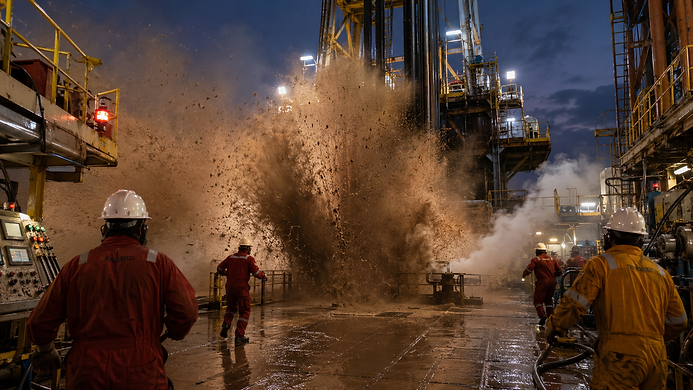
The image shows the moment the situation begins to escalate, with hydrocarbons, drilling mud, and gas surging up through the well system and process equipment. Crew members react urgently as the mud-gas separator and deck systems appear overwhelmed by a rapidly changing well-control event.
This phase represents the transition from technical uncertainty to active emergency. Once hydrocarbons reached the rig, the situation moved quickly from abnormal readings to a major process-safety failure, leaving very little time for effective intervention.

This image shows the Deepwater Horizon engulfed in flames after the explosion, with workers evacuating toward lifeboats and nearby vessels assisting in the emergency response. The scale of the fire, smoke, damaged structure, and marine rescue activity communicates the severity of the disaster without losing focus on survival and response.
This final phase is a reminder that emergency preparedness, muster discipline, evacuation routes, lifeboat readiness, and support-vessel response are vital offshore safety layers. The incident became one of the most significant offshore disasters in modern history, reinforcing the need to treat every barrier, test result, and operational decision as part of a larger life-saving system.
4.4 Phase Four: Explosion, Evacuation, Rig Loss and Long-Duration Release
20 April – 15 July 2010
The escaping hydrocarbons found an ignition source and ignited, leading to explosions and fire. The first explosion was followed by a second. Workers were killed, injured, or forced into emergency evacuation. The blast damaged critical systems and communications, making response more difficult.
Survivors moved toward muster areas and lifeboats. Some workers jumped from the rig into the sea. Support vessels, including the Damon B. Bankston, assisted in rescue and evacuation efforts. The emergency had moved beyond well control into survival, rescue, firefighting, medical response, and abandonment.
The rig burned for roughly two days and sank on 22 April 2010.
However, the disaster did not end with the loss of the rig. The Macondo well continued releasing oil into the Gulf of Mexico until a capping stack stopped the flow on 15 July 2010. NOAA reported an average release of more than 1.5 million gallons per day, with an estimated total of 134 million gallons over 87 days.
This final phase shows how one failed well-control event became a human tragedy, a rig-loss event, a major environmental disaster, and a global process safety lesson.
Training implication:
Emergency response can save lives after barriers fail, but prevention remains the strongest protection. Once hydrocarbons reach ignition sources, the situation can escalate beyond the ability of people onboard to fully control it.
5. Critical Decisions — Where the Margin Was Lost
Deepwater Horizon teaches that major accidents are not created by one bad decision. They are created by a series of decisions that reduce resilience.
Decision 1: Relying on a single cement barrier
Investigators concluded that the cement barrier at the bottom of the well failed. The BSEE/BOEMRE report noted that BP used only one cement barrier and did not set additional cement or mechanical barriers despite well conditions that created difficulty for the production casing cement job. For offshore trainees, this is a fundamental barrier-management lesson: a safety-critical activity should not depend on one unverified control.
Decision 2: Accepting an abnormal negative pressure test
The negative test was the key opportunity to identify that the well was not secure. The results were anomalous, yet they were accepted. This is one of the most important learning points in the case. A test is not a ritual. A test is a decision gate. If the result is ambiguous, the operation should stop until the ambiguity is resolved.
Decision 3: Continuing displacement after accepting the test
Once heavy drilling mud was displaced, the well lost a major hydrostatic barrier. If the cement was not competent, hydrocarbons could flow. Continuing displacement after misreading the test allowed the influx to develop.
Decision 4: Simultaneous operations and monitoring difficulty
During the critical phase, multiple activities were taking place. Simultaneous operations can distract crews, complicate pit-volume monitoring, and mask well-flow indicators. The BSEE/BOEMRE investigation identified the inability to accurately monitor pit levels during simultaneous operations as a contributing factor in kick detection failure.
Decision 5: Routing flow to the mud-gas separator
When hydrocarbons arrived at the rig, routing to the mud-gas separator allowed gas to vent onto the rig. The BSEE/BOEMRE report identified ambiguity in Transocean’s well control manual regarding when to use the diverter rather than the mud-gas separator. Training lesson: emergency response procedures must be clear before the emergency. Ambiguous procedures become dangerous under stress.
Decision 6: Delayed engine emergency shutdown
Gas alarms activated, but engine room crews were not effectively warned to shut down engines. The BSEE/BOEMRE investigation identified the failure to notify engine room personnel after high gas alarms as a contributing cause of the explosion. Air intakes for engine rooms were located close enough to the gas plume for gas to be drawn in, creating engine overspeed and ignition risks.
Decision 7: Not stopping work after multiple warning signs
The BSEE/BOEMRE investigation concluded that the failure to stop work after encountering multiple hazards and warnings was a contributing cause of the blowout. This statement is central to modern offshore safety training. Stop Work Authority is not an inspirational slogan. It is a life-saving control.
6. Technical Failures — Barrier Breakdown in Plain Language
Cement barrier failure
The cement job was intended to isolate hydrocarbons below the seafloor. It did not. Once the cement barrier failed, hydrocarbons could enter the wellbore. Investigations pointed to cement design, execution, testing, and interpretation issues. Foam cement stability and centralization were among the technical concerns discussed in investigations.
In training terms, cement is not just construction material. It is a well control barrier. If the barrier is not verified, the well is not secure.
Negative pressure test failure
A negative test should demonstrate whether the well will remain stable under reduced hydrostatic pressure. On Deepwater Horizon, the test results were not properly interpreted. The team effectively treated a failed or inconclusive test as a successful test.
For trainees, the lesson is simple: test integrity depends on interpretation integrity. The test itself does not save anyone if the team rationalizes abnormal readings.
Kick detection failure
A kick occurs when formation fluids enter the wellbore. Early kick detection depends on monitoring flow, pit volumes, pressures, and other indicators. The BSEE/BOEMRE report identified that hydrocarbons were not detected until they were above the BOP stack. Once hydrocarbons pass the BOP and rise rapidly through the riser, response time collapses.
Blowout preventer failure
The BOP was a massive subsea safety device designed to close around pipe, shear pipe if necessary, and seal the well. It failed to seal the Macondo well. Later analysis showed that drill pipe position and buckling contributed to failure of the blind shear ram to cut and seal effectively. CSB findings also highlighted limitations in industry testing that masked latent BOP failures.
A BOP should be considered a critical barrier, not a magic barrier. It requires verification, maintenance, testing under credible conditions, and clear activation rules.
Mud-gas separator and gas venting
A mud-gas separator is used to separate gas from drilling fluid. It is not intended to safely handle every possible high-rate blowout flow. On Deepwater Horizon, the system was overwhelmed and gas vented onto the rig. The “gooseneck” vent configuration increased the risk of gas being released back onto the rig.
Gas detection and ignition controls
Before the explosion, multiple gas alarms activated. The BSEE/BOEMRE report noted that approximately 20 gas alarms went off before the explosions. Gas reached engine room air intakes. Engine overspeed shutdown systems did not prevent ignition. The rig had areas classified as non-hazardous that were not required to be explosion-proof, yet gas entered those areas.
Emergency disconnect and evacuation systems
The emergency disconnect system was intended to separate the rig from the well in extreme circumstances. But response was delayed until hydrocarbons had already risen above the BOP. Once explosions occurred, systems were damaged, and the response became survival rather than prevention.
7. Human Factors — The Psychology of a Developing Major Accident
Technical failures explain what failed. Human factors help explain why intelligent, experienced people continued into danger.
Normalization of abnormal signals
When crews work with complex systems every day, they can become used to nuisance alarms, pressure fluctuations, and operational difficulties. Familiarity can reduce sensitivity. If unusual readings are repeatedly explained away, the team may stop treating them as warnings.
The negative test anomalies were not simply numbers on a screen. They were the well trying to tell the crew something. Training should teach workers to listen to abnormal data.
Confirmation bias
Confirmation bias occurs when people interpret evidence in a way that supports what they already expect. The crew expected the well to be secure. When the test produced confusing results, the explanation that allowed work to continue became attractive. In high-pressure environments, the mind often looks for the interpretation that supports the plan.
Work-as-imagined vs work-as-done
The CSB emphasized the gap between work-as-imagined by designers, managers, and regulators and work-as-done by the crew. On paper, barriers existed. In reality, barrier verification was incomplete, monitoring was complicated, procedures were ambiguous, and roles across companies were not fully aligned.
Production and schedule pressure
Deepwater work is expensive. Delays can cost millions. However, the danger is not that someone says, “Ignore safety.” The danger is subtler: pressure changes the threshold for doubt. Teams become more likely to accept uncertainty, continue with incomplete information, and treat unresolved questions as manageable.
Authority gradients and multi-company complexity
On a rig, authority is distributed across operator representatives, drilling contractors, subcontractors, and marine leadership. When responsibilities are unclear, people may hesitate to challenge decisions. A junior worker may see something troubling but assume someone else has already evaluated it.
Process safety vs personal safety
The Deepwater Horizon reportedly had a strong focus on personal safety indicators. But process safety indicators — barrier condition, well control risk, safety-critical equipment health, alarm response, abnormal test interpretation — are different. A rig can have good personal safety statistics and still be exposed to major accident risk.
8. Emergency Response — Survival After Prevention Failed
When prevention failed, the event became an emergency response and survival scenario. The rig crew, marine crew, and support vessels had to act in darkness, fire, noise, injury, confusion, and fear.
Gas alarms and bridge response
Gas alarms activated, but communication to engine room personnel did not result in timely shutdown. Once gas reached engine intakes, ignition risk became severe. Emergency bridge response training was later identified as an issue in the BSEE/BOEMRE investigation. This is highly relevant to offshore survival training: bridge teams must understand that gas alarms are not only process alarms; they can be vessel survival alarms.
Explosion and immediate evacuation
The explosions damaged equipment, injured personnel, and created chaos. Survivors had to make rapid decisions: where to muster, whether to assist others, how to move through smoke, when to board lifeboats, and when to abandon the rig.
Muster and lifeboats
The Deepwater Horizon had lifeboats and emergency procedures. The majority of personnel escaped the rig, but the evacuation occurred under extreme conditions. Some personnel jumped from the rig into the sea. Survival depended on training, instinct, leadership, and the ability to move despite fear.
Support vessel response
The Damon B. Bankston and other response vessels assisted with survivors. Offshore response is never just onboard response; it involves standby vessels, rescue craft, emergency communications, medevac, shore response, coast guard coordination, and incident command.
Firefighting and rig loss
The rig burned for roughly two days and then sank. Firefighting support vessels sprayed water on the rig, but once the well was flowing and the rig was structurally compromised, the emergency exceeded onboard control capability.
Oil spill response
The response then became a prolonged environmental emergency. Responders used vessels, aircraft, dispersants, booming, skimming, controlled burns, subsea intervention, and eventually a capping stack. NOAA reports that responders initially recovered around 16% of the oil, while the remainder spread through the Gulf environment in different forms.

9. What Went Wrong — The Failure Pattern
The disaster can be understood as a pattern of barrier failure.
Well integrity was not assured
The cement barrier failed, and the negative pressure test did not correctly identify that failure. Without verified well integrity, the well was not ready for temporary abandonment.
Warning signs were not acted upon
Abnormal pressure data, flow indications, gas alarms, and operational uncertainty were not escalated effectively. Major accidents often show repeated warning signs before disaster; Deepwater Horizon was no exception.
Monitoring was compromised by complexity
Simultaneous operations made it difficult to monitor pit volumes and flow accurately. When operations are complex, the monitoring system must be simplified, strengthened, or paused — not overloaded.
Procedures were ambiguous
The decision whether to route flow through the mud-gas separator or diverter was not clear enough for emergency conditions. Procedures that are understandable only in calm discussion may fail under pressure.
Emergency systems were not enough
Gas detection, engine shutdown, BOP activation, and emergency disconnect did not prevent the explosion. This reinforces the hierarchy of controls: mitigation systems are vital, but they should not be the first time a hazard is controlled.
Safety responsibilities were blurred
Multiple companies were involved, each with responsibilities. However, the CSB found that BP and Transocean did not have a sufficiently common, integrated approach to well control and major accident risk.
Process safety indicators were underdeveloped
Personal safety performance can be good while process safety risk is rising. The CSB specifically highlighted the need for equal focus on process safety performance indicators, not only personal safety statistics.
10. Investigation Findings — What Official Investigations Revealed
Multiple investigations examined the Deepwater Horizon disaster, including the U.S. Chemical Safety and Hazard Investigation Board (CSB), the BSEE/BOEMRE Joint Investigation Team, the National Commission, the National Academy of Engineering, BP, and Transocean.
Core technical findings
The investigations found that the disaster involved failure of the cement barrier, misinterpretation of the negative pressure test, delayed kick detection, ineffective well control response, and BOP failure. The BSEE/BOEMRE report concluded that the crew failed to detect hydrocarbon influx until hydrocarbons had risen above the BOP stack and that collective misinterpretation of the negative tests caused the well control failure.
BOP findings
The BOP failed to shear the drill pipe and seal the wellbore. The BSEE/BOEMRE report concluded that the drill pipe’s physical location near the wall of the wellbore placed it outside the blind shear ram cutting surface during activation. Elastic buckling forced the pipe to the side of the wellbore, contributing to BOP failure. The CSB further highlighted that BOP testing practices did not adequately reveal latent failures.
Explosion findings
Hydrocarbons reached the rig and were routed through systems that allowed gas to vent onto the rig. Gas alarms activated. Engine room air intakes were exposed to the gas plume, and overspeed devices did not shut down engines in time. The BSEE/BOEMRE investigation identified the failure of overspeed devices, gas alarm response failures, engine room classification, and air intake location as contributing or possible contributing causes.
Human and organizational findings
The CSB emphasized human factors, process safety indicators, operator-contractor boundaries, safety culture, and regulatory oversight. It found that complex multi-party risk management requires explicit roles and responsibilities. It also emphasized cognitive and social skills training alongside technical competence.
Regulatory findings
The disaster revealed gaps in U.S. offshore oversight and safety-critical equipment management. After the disaster, regulatory reforms addressed well design, casing and cementing, blowout preventers, Safety and Environmental Management Systems, and oversight structure.
11. Industry Changes Afterward — How Standards Were Revolutionized
Deepwater Horizon changed offshore drilling. Some reforms were technical, some regulatory, and some cultural.
Reorganization of U.S. offshore oversight
After the disaster, the former Minerals Management Service structure was reorganized. The final stage occurred on 1 October 2011, when BOEMRE split into the Bureau of Safety and Environmental Enforcement (BSEE) and the Bureau of Ocean Energy Management (BOEM). The purpose was to separate safety and environmental enforcement from resource leasing and development functions.
Drilling Safety Rule
The 2010 Drilling Safety Rule introduced heightened standards for well design, casing, cementing, and well control equipment, including blowout preventers. This directly addressed weaknesses revealed by Macondo.
Safety and Environmental Management Systems (SEMS)
The SEMS rule strengthened requirements for offshore operators to identify, manage, and audit safety risks. SEMS emphasizes systematic management of hazards, operating procedures, safe work practices, training, mechanical integrity, management of change, incident investigation, and emergency response.
Well Control Rule and BOP expectations
Post-Macondo well control reforms improved requirements for BOP systems, testing, maintenance, and real-time risk management. The core lesson is that a BOP must be managed as a safety-critical element throughout its lifecycle — design, maintenance, testing, deployment, and operation.
Process safety indicators
The CSB emphasized that the offshore industry must improve process safety metrics. Instead of focusing only on slips, trips, and falls, operators must track barrier health, unresolved anomalies, safety-critical equipment status, well control events, alarm management, and stop-work effectiveness.
Emergency preparedness and spill response
The industry strengthened spill response capability, subsea containment systems, capping stack availability, well intervention planning, and emergency coordination. The 87-day Macondo spill demonstrated that offshore emergency preparedness must include worst-case discharge planning, not only platform evacuation.
Safety culture changes
The disaster reinforced the need for leaders to treat major accident risk as real even when personal injury statistics look good. Safety culture must ask: Are barriers healthy? Are teams challenging assumptions? Are contractors aligned? Are we listening to weak signals?

12. Modern Training Lessons — Turning Investigation Findings into Worker Competence
Lesson 1: Barrier thinking must be practical
Every offshore worker should understand barriers. A barrier is not a word in a risk assessment. It is something that physically, procedurally, or behaviorally prevents harm. In Deepwater Horizon, barriers included cement, drilling mud, negative testing, monitoring, BOP functions, gas detection, engine shutdown, diverter systems, emergency disconnect, muster, lifeboats, and rescue vessels.
Training must teach workers to ask: Which barriers are protecting us right now? How do we know they are working? What happens if this barrier fails?
Lesson 2: Tests are decision gates
Negative pressure testing was treated as a step in the job rather than a true decision gate. Modern training should teach personnel to treat tests as go/no-go controls. If test results are abnormal, unclear, or inconsistent, the correct action is to stop and verify.
Lesson 3: Simultaneous operations need disciplined control
SIMOPS can hide warning signs. Training should include scenarios where multiple tasks compete for attention. Trainees should practise simplifying operations, pausing non-essential tasks, assigning dedicated monitors, and confirming communication channels during critical operations.
Lesson 4: Stop Work Authority must be rehearsed
Workers may know they have Stop Work Authority, but they also need the confidence and language to use it. Training should include role-play: “I am stopping this job because the negative test is not understood,” or “We are not displacing until the pressure anomaly is resolved.”
Lesson 5: Emergency response starts before the alarm
Emergency response is not only lifeboat boarding. It includes early recognition, alarm response, gas detection, engine shutdown, ESD activation, communications, muster discipline, fire response, rescue craft readiness, and medevac planning.
Lesson 6: Contractor interfaces are safety-critical
Modern offshore work is delivered by multiple companies. Training must include contractor interface management: who owns the hazard, who owns the barrier, who has authority to stop, and how information moves across boundaries.
Lesson 7: Process safety is different from personal safety
A clean injury record does not prove that the well is safe. Trainees must learn to distinguish personal safety metrics from process safety health. A rig can have strong PPE compliance and still have a failing barrier.
13. What Today’s Offshore Workers Must Learn — Practical Competence Checklist
-
Do not normalize abnormal pressure. Pressure anomalies are messages from the well. Treat them seriously.
-
Verify barriers before removing another barrier. Never remove heavy mud, mechanical barriers, or procedural barriers unless the next barrier is proven.
-
Understand the purpose of every test. A test is not paperwork. It is evidence. If the evidence is unclear, stop.
-
Watch for SIMOPS distraction. During critical operations, simplify the work environment.
-
Use Stop Work Authority early. It is easier to restart a paused job than recover a lost well.
-
Communicate across roles and companies. The driller, company man, cementer, mud logger, marine crew, bridge team, and engine room need a shared picture.
-
Know emergency routing decisions. Understand when flow should go to a mud-gas separator and when diversion is required.
-
Respect gas alarms. Gas alarms are urgent safety information, not background noise.
-
Know muster and evacuation routes. In smoke, heat, and darkness, memory and muscle practice matter.
-
Train for leadership, not only compliance. Offshore safety depends on people speaking up, challenging assumptions, and acting decisively.
14. Suraksha Marine Courses — How Training Fits the Deepwater Horizon Lessons
Suraksha Marine’s offshore safety training portfolio can translate the Deepwater Horizon lessons into practical worker competence. The event was a drilling and well-control catastrophe, but the survival and emergency lessons apply across offshore oil and gas, marine logistics, offshore wind support, and energy operations.
BOSIET with EBS / CA-EBS — The foundation for offshore emergency readiness
BOSIET introduces offshore workers to the survival mindset required before travelling offshore. While Deepwater Horizon did not involve a helicopter ditching, BOSIET matters because it builds core emergency behaviours: muster discipline, lifejacket use, sea survival, firefighting awareness, first aid, emergency communication, and response under stress.
How it fits this case:
-
Workers must know how to respond when alarms activate.
-
They must understand muster procedures and abandonment routes.
-
They must be able to enter the water safely if evacuation by lifeboat is not possible.
-
They must understand how survival equipment works before they need it.
-
They must be psychologically prepared for a rapidly escalating offshore emergency.
Training emphasis for instructors: Use Deepwater Horizon to explain that survival training is not only for helicopter accidents. It is for any situation where an offshore worker must survive smoke, fire, explosion, water entry, rescue delay, and trauma.
HUET — Calm action under extreme stress
HUET teaches workers how to escape a submerged helicopter. The direct technical event in Deepwater Horizon was not a helicopter accident, but HUET builds transferable survival skills: breath control, orientation in disorientation, controlled escape, reference-point discipline, and managing panic.
How it fits this case:
-
Emergencies create sensory overload.
-
Panic narrows thinking.
-
Muscle memory helps workers act when conscious reasoning slows down.
-
Water entry and rescue survival skills may be needed when abandoning offshore installations.
Training emphasis for instructors: Link HUET psychology to platform escape. The body’s stress response is similar whether the worker is underwater in a HUET simulator, escaping smoke-filled accommodation, or jumping into the sea from a burning installation.
FOET — Refresher training prevents skill decay
FOET refreshes critical survival and emergency response competence. Deepwater Horizon demonstrates that emergency competence cannot be assumed because a worker has been offshore for years.
How it fits this case:
-
Alarm response must remain sharp.
-
Escape routes must be remembered under stress.
-
Firefighting and self-rescue skills must be rehearsed.
-
First aid and casualty response must be current.
Training emphasis for instructors: Ask trainees what they remember from their initial training and what they may have forgotten. Skill decay is real; refresher training rebuilds response speed.
Basic H2S Training — Gas hazard awareness and alarm discipline
Deepwater Horizon involved hydrocarbons and natural gas rather than a classic H2S incident. However, gas hazard awareness is directly relevant. Basic H2S training teaches workers to respect invisible hazards, understand detector alarms, don respiratory protection when required, muster upwind, and avoid assuming that “no smell” means “no danger.”
How it fits this case:
-
Gas alarms must be treated as life-critical.
-
Workers must understand gas migration and ignition risk.
-
Emergency response depends on immediate recognition and disciplined action.
-
Alarm fatigue can kill.
Training emphasis for instructors: Compare H2S gas response with hydrocarbon gas response. Different gas, same discipline: detect, alarm, communicate, isolate, evacuate, and do not improvise in a contaminated zone.
Firefighting and Self-Rescue — From small response to survival judgement
Deepwater Horizon escalated beyond onboard firefighting capacity. However, firefighting training still matters because early response, fire classification, boundary cooling, smoke movement, and self-rescue knowledge influence survival.
How it fits this case:
-
Workers must know when to fight and when to escape.
-
Fire and gas emergencies can compromise power, lighting, communications, and routes.
-
Smoke inhalation and disorientation are major survival threats.
-
Safe approach, wind direction, and evacuation routes matter.
Training emphasis for instructors: Teach that firefighting is not heroism. It is controlled response within limits. When limits are exceeded, survival and evacuation become the priority.
Emergency First Aid — Saving lives after explosion and evacuation
After the Deepwater Horizon explosions, injured workers needed immediate assistance. Offshore first aid is essential because professional medical care may be delayed by distance, weather, and evacuation complexity.
How it fits this case:
-
Burns, blast injuries, fractures, smoke inhalation, and hypothermia can occur together.
-
Workers may need to assist colleagues before medics arrive.
-
Casualty triage and calm communication improve survival.
Training emphasis for instructors: Use a scenario: a worker reaches muster with burns and breathing difficulty after a blast. Ask trainees to prioritise care, communicate with medics, and prepare for evacuation.
OERTM / Emergency Response Team Training — Coordinated response to major accident escalation
Offshore Emergency Response Team Member training is highly relevant to major accident events. The Deepwater Horizon case shows why emergency teams must understand command, communication, search and rescue, fire response, casualty management, and abandonment.
How it fits this case:
-
Emergency teams must respond to multiple simultaneous hazards.
-
Gas alarms, fire, explosion, structural damage, and casualties may occur together.
-
Teams must work when communications fail.
-
Leaders must decide when to continue response and when to abandon.
Training emphasis for instructors: Create a tabletop exercise: hydrocarbon influx, gas alarms, explosion, missing personnel, lifeboat muster, injured workers, and loss of communications. Ask trainees to manage priorities.
Travel Safely by Boat — Marine evacuation and rescue support
Deepwater Horizon evacuation involved support vessels and water survival. Travel Safely by Boat reinforces boarding discipline, lifejackets, vessel transfer safety, man overboard awareness, and survival at sea.
How it fits this case:
-
Support vessels are crucial in offshore rescue.
-
Survivors may enter the sea before rescue.
-
Vessel crews must coordinate with installation emergency response.
-
Marine transfer and rescue skills save lives.
Training emphasis for instructors: Show how standby and support vessels can become lifelines during platform abandonment.
Dry CA-EBS and Shallow Water CA-EBS — Breathing discipline and progression-based confidence
CA-EBS training develops familiarity with compressed air emergency breathing equipment. While Macondo did not involve CA-EBS, the training methodology is relevant: controlled progression, equipment confidence, and breathing discipline under stress.
How it fits this case:
-
Workers need calm equipment handling during emergency events.
-
Confidence is built through gradual exposure, not theory alone.
-
Emergency breathing competence supports survival in aviation and marine incidents.
Training emphasis for instructors: Emphasise that good training builds controlled behaviour under pressure. This same principle applies to gas alarms, firefighting, evacuation, and well control response.
15. Trainer Discussion Questions — Turning the Case into Learning
-
At which point should the Macondo operation have stopped? Why?
-
How would you explain the negative pressure test failure to a new offshore worker without using complex drilling language?
-
What is the difference between a personal safety indicator and a process safety indicator?
-
Why can good injury statistics create false confidence in major accident risk management?
-
What barriers were supposed to prevent hydrocarbons from reaching the rig? Which ones failed?
-
What communication failures occurred across the operator-contractor boundary?
-
How can a worker use Stop Work Authority when senior personnel believe the job is acceptable?
-
How should crews respond when gas alarms activate in multiple zones?
-
What survival skills from BOSIET, HUET, FOET, Basic H2S, and firefighting are relevant to this case?
-
If you were designing a training simulation based on Deepwater Horizon, what decisions would you force learners to make?
16. Key Takeaways — What Deepwater Horizon Must Teach Every Offshore Worker
-
Eleven workers died because a well control failure escalated into explosion, fire, evacuation, rig loss, and a long-duration oil spill.
-
The disaster began before the explosion. It began with barrier weaknesses, risk decisions, ambiguous test interpretation, and missed warning signs.
-
The cement barrier failed, and the negative pressure test was misinterpreted. The team believed the well was secure when it was not.
-
Drilling mud was removed before the well was truly safe. Removing one barrier before verifying another created the conditions for flow.
-
Kick detection was delayed. Hydrocarbons were not recognized and controlled before they rose above the BOP.
-
The BOP failed to seal the well. Safety-critical equipment must be tested, maintained, and managed for real conditions, not only checklist compliance.
-
Gas alarms require immediate action. Alarm fatigue and unclear response can turn a well control event into an explosion.
-
Process safety needs equal attention. Personal injury statistics cannot reveal whether cement, BOP, ESD, gas detection, or well control barriers are healthy.
-
Stop Work Authority must be real. Workers must be trained to pause operations when test results are confusing or hazards are unresolved.
-
Modern training prevents repetition. BOSIET, HUET, FOET, Basic H2S, firefighting, first aid, OERTM, boat transfer, and CA-EBS training each build part of the emergency competence needed offshore.

Conclusion:
How Suraksha Marine’s Training Helps
Deepwater Horizon is remembered for the scale of the oil spill, but for offshore safety training it must first be remembered as a worker-safety tragedy. Eleven people went to work and did not return. Their loss should not become a distant historical statistic.
For Suraksha Marine trainees, the lesson is direct: safety is not what the procedure says should happen. Safety is what trained, alert, and disciplined people make happen when conditions are uncertain. Offshore workers must recognize weak signals, respect barriers, challenge assumptions, communicate clearly, and act decisively before a developing hazard becomes irreversible.
The future of offshore safety is built in training rooms, simulators, pools, firefighting grounds, vessel drills, and emergency response exercises. Every trainee who learns from Deepwater Horizon becomes part of the industry’s promise: never again through ignorance, complacency, or silence.
Take the Next Step with Suraksha Marine
If this case study raised important questions about your team’s offshore readiness, this is the moment to turn insight into action.
Learn more about our OPITO-approved HUET, BOSIET, FOET, OERTM, ERME, CA‑EBS and A‑MAST programs
VISIT: https: www.surakshaweb.com
Talk to a training specialist about the right courses for you or your crew:
📧 surakshaweb@gmail.com
📞 +91 99873 00771
📞 +91 98192 12260
Ready to enroll or request a corporate proposal?
Course & inquiry form: https://www.surakshaweb.com/contact
Your offshore team may only get one chance in a real emergency. Make sure their training is not the weak link.