


The Sumburgh Helicopter Incident: A Lesson in Survival
- Suraksha Marine
- Dec 4, 2025
- 13 min read

Updated: 5 days ago
The 52 Seconds That Changed Everything: Lessons from the Sumburgh Accident
The Approach
The Super Puma helicopter had just departed from the Borgsten Dolphin drilling rig, carrying offshore workers back to Aberdeen. As the weather at Sumburgh worsened, visibility dropped to 2,800 meters, with broken clouds at 300 feet. These conditions required an instrument approach, meaning the pilots had to rely solely on cockpit instruments without any external visual references.
During the final approach, the flight crew failed to monitor the helicopter's instruments effectively. Insufficient collective pitch control input caused the helicopter's airspeed to decrease continuously, leading to a dangerously high rate of descent. By the time the pilots recognized the critically low energy state, recovery was impossible.
Impact and Capsize
At 17:17 hours, the Super Puma struck the North Sea approximately 1.7 nautical miles west of Sumburgh Airport. The helicopter rapidly filled with water and rolled inverted within seconds—confirming the grim reality that helicopters capsize almost every time after water impact.
Survivors described the violent transition: the jarring impact, the rush of icy seawater mixed with jet fuel and hydraulic fluid, the complete disorientation as the cabin inverted, and the near-total darkness as the helicopter settled upside-down. Emergency flotation bags deployed, keeping the fuselage from sinking immediately. However, occupants faced the classic underwater escape challenge: breath-hold time versus escape time in a race measured in seconds.
What Training Taught Them: The Techniques That Worked
The Reflexive Response
Post-accident analysis and survivor testimony revealed that HUET training did not merely provide knowledge—it created muscle memory that functioned when conscious thought became overwhelmed. Survivors described executing learned procedures automatically rather than deliberating on each action.
The EASA research report analyzing the Sumburgh accident documented specific survivor accounts:
"Survivors from this accident repeatedly commented that their experience of escaping from the helicopter cabin was very different from that simulated in training."
Yet despite these differences, the foundational sequence practiced in HUET courses—wait for motion to stop, orient to solid references, release harness, locate exit by memory and feel, egress toward lighter water—remained effective.

One survivor captured the essence: "I wasn't thinking; I was just doing what we practiced." This automaticity is the hallmark of effective procedural training: skills ingrained so deeply through repeated practice that they execute without conscious deliberation. When 17 seconds of breath-hold time confronts 29-92 seconds of escape requirement, this reflexive response eliminates the cognitive delay that could prove fatal.
The Exit Challenge: Harder Than Training
The Sumburgh escape revealed a critical gap between training and reality. Four emergency exit windows were opened by passengers during the escape. The majority of passengers who removed windows reported that "this was not easy and was significantly harder than they experienced during training."
Research confirmed this disparity: the force required to jettison push-out underwater emergency exits in actual helicopters significantly exceeds that encountered in training simulators. In the cold, dark, disoriented conditions of actual capsize, this increased force requirement translated to precious seconds—seconds that determined who escaped and who didn't.
Yet survivors persevered. Those sitting adjacent to exit windows used those exits when possible. Remarkably, four passengers executed cross-cabin escapes—releasing their harnesses, orienting in the inverted cabin, and navigating across the helicopter interior to exits that weren't their nearest option. This adaptation demonstrates how training provides not just a single procedure but a cognitive framework for problem-solving under extreme stress.
Finding Exits by Feel Alone
Problems due to darkness and poor visibility were consistently reported by survivors. One passenger described finding the exit window by feel alone after discovering that vision provided no useful information in the fuel-contaminated, sediment-filled water. This matches research showing underwater visibility should not be relied upon for distances greater than 1.5 meters—and actual accident conditions often reduce this further to near-zero.
Training versus reality comparison for helicopter underwater escape
HUET training prepares participants for this sensory deprivation through simulations that replicate low-light and zero-visibility scenarios. At facilities like Suraksha Marine, state-of-the-art simulators incorporate exact aircraft exit configurations, enabling trainees to build tactile reference maps of exit locations, handle positions, and release mechanisms. When vision failed Sumburgh survivors, these tactile memories guided hands to exits and enabled escape.
Breath Management and Timing
Few Sumburgh survivors reported having time to take a breath before becoming submerged. This reflects the speed of capsize and cabin flooding—events that unfold in seconds rather than minutes. The mismatch between the 17.2-second average breath-hold time in cold North Sea water and the actual time required for escape explains why none of the survivors successfully deployed their emergency breathing systems (EBS).
The accident report noted that many passengers were unaware that their hybrid rebreather EBS had an automatically released air supply, believing it required manual inflation. This knowledge gap—combined with the speed of events and the cognitive overload of emergency—meant the technology intended to bridge the breath-hold deficit went unused.
This finding catalyzed industry changes. Post-Sumburgh recommendations led to enhanced CA-EBS training that emphasizes rapid deployment procedures, pre-donning checks, and reflexive activation techniques. Modern OPITO-approved CA-EBS courses at advanced facilities specifically address deployment speed, achieving the 8-10 second activation times that make the technology effective in actual emergencies.
The Anatomy of Survival: Why 14 Lived and 4 Died
The Statistics of Escape
The Sumburgh accident provided tragic but valuable data on what determines survival in helicopter water impacts. Of the four passengers who did not survive, one was found still secured by the seat harness after sustaining a head injury during impact. A second passenger had released their seat harness but did not escape from the cabin, drowning before successfully egressing.
Evidence suggested that the remaining two non-survivors who initially escaped may have succumbed to the combination of cold water exposure, physical exhaustion, and the challenges of sea survival in the North Sea. This underscores that successful cabin escape marks only the beginning of the survival challenge—hypothermia, sea state hazards, and rescue coordination remain critical factors.
Among the 14 survivors, the 12 passengers who escaped (75% passenger survival rate) and both crew members (100% crew survival rate) demonstrated the effectiveness of training combined with appropriate equipment. Both crew members had problems locating door emergency jettison handles and resorted to using normal door handles to escape—highlighting that even experienced aviators face disorientation and equipment challenges in actual ditching scenarios.
The Training Differential
Comparing the Sumburgh survival rate to broader industry data reveals training impact. The UK Civil Aviation Authority's CAP1145 comprehensive review found that between 1976 and 2012, potentially survivable offshore helicopter accidents led to 38 fatalities, with 31 of those 38 failing to escape the crashed helicopter. This represents a baseline 43% survival rate in survivable water impacts without optimized training and equipment.
The Sumburgh incident's 77.8% overall survival rate—and 75% passenger survival rate—represents a 34.8 percentage point improvement over this historical baseline.
This improvement corresponds directly to the post-2012 implementation of enhanced emergency breathing systems, more realistic HUET training, and improved safety equipment mandated by CAP1145 recommendations.
Controlled research provides additional context. Studies tracking 8,902 students through 59,245 underwater escapes during HUET training documented 100% successful escape rates in simulator environments that closely replicate actual ditching conditions. While simulator escapes occur in warmer, clearer water than the North Sea, the consistency of training success demonstrates that properly trained individuals possess the necessary skills—the Sumburgh survivors proved these skills transfer to actual emergencies.
Building Muscle Memory: How CA-EBS Training Creates Survival Reflexes
The OPITO Standard: Consistency and Excellence
OPITO's Helicopter Underwater Escape Training standards ensure that regardless of geographic location, offshore workers receive consistent, high-quality preparation for helicopter emergencies. The standards framework encompasses HUET with Emergency Breathing System (rebreather-based), HUET with Compressed Air Emergency Breathing System (CA-EBS), and specialized variants for different operational environments.
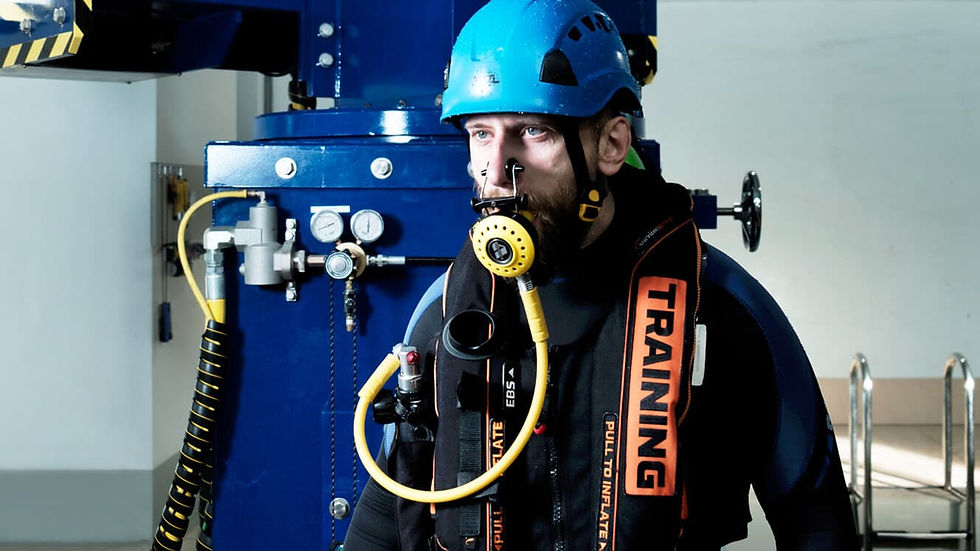
Each OPITO-approved HUET course follows a carefully sequenced progression from theoretical knowledge to practical skill demonstration. The theoretical component addresses previous ditching events like Sumburgh, helicopter safety equipment, emergency procedures, and the specific properties of breathing systems. Critically, survivors' testimonies from actual accidents are incorporated, providing trainees with realistic expectations rather than sanitized scenarios.
The practical component progresses through water confidence exercises before advancing to actual underwater egress scenarios. Initial exercises build comfort with face submersion, breathing equipment use, and underwater orientation. Subsequent scenarios increase in complexity: vertical sinking simulations where the helicopter descends upright, and capsized escapes where the simulator rolls inverted during descent—replicating the Sumburgh experience.
CA-EBS: Bridging the Breath-Hold Gap
The integration of Compressed Air Emergency Breathing Systems into HUET training addresses the fundamental survival equation: extending underwater time from 17 seconds to 60-90 seconds or more. CA-EBS devices provide pressurized atmospheric air through miniature SCUBA-style cylinders, delivering approximately two minutes of breathing air at the surface.
Comparative testing demonstrates clear performance advantages. Hybrid CA-EBS systems achieved underwater stay times of 90.0 seconds compared to 68.3 seconds for rebreathers, while dyspnea (breathing difficulty) ratings were significantly lower—2.4 cm for compressed air systems versus 6.5 cm for rebreathers. This combination of extended time and reduced breathing stress creates the window needed for trained escape.
However, deployment speed matters critically. Research identified that hybrid CA-EBS systems require 17.7 seconds to deploy compared to 8-10 seconds for standard compressed gas systems. OPITO-approved CA-EBS training at advanced facilities like Suraksha Marine specifically addresses this challenge through repeated practice of pre-donning checks and deployment sequences.
Trainees practice donning life jackets complete with CA-EBS, executing buddy checks, and deploying systems both on the surface and underwater at shallow depths initially, progressing to deeper water as skills develop. The safety record validates this approach.
The comprehensive study tracking 59,245 underwater escapes documented only three serious injuries and zero problems with Emergency Breathing System use across all escapes—an injury rate of 0.74 per 1,000 ascents that compares extraordinarily favorably to other high-risk training activities.
Simulator Fidelity: Realism That Prepares
State-of-the-art HUET simulators at facilities like Suraksha Marine replicate specific helicopter models using interchangeable exterior panels. These panels match actual escape exit configurations for aircraft including the AS332 Super Puma—the exact model involved in the Sumburgh accident—ensuring trainees practice with exits matching those they'll encounter in operational flights.
Advanced simulators incorporate variable sea states, smoke effects, deluge systems simulating heavy rain or spray, and day/night lighting conditions.
The ability to practice in degraded visibility conditions—matching the 1.5-meter maximum effective range of emergency lighting and the near-zero visibility reported by Sumburgh survivors—prepares trainees for the sensory deprivation described in accident reports.
The modular design allows rapid reconfiguration between training sessions, enabling facilities to accommodate multiple helicopter types and emergency scenarios within single training days. This flexibility supports the diverse offshore energy sector, where personnel may rotate between different helicopter types depending on contract assignments and platform locations.
The Psychology of Survival: Mental Preparation Equals Physical Capability
Overcoming Panic Through Familiarization
Survivor accounts emphasize that HUET training provided more than just physical skills—it built psychological resilience through repeated exposure to underwater disorientation and controlled stress. This familiarization reduces the panic response that can override rational thought during actual emergencies.
Research on training effectiveness demonstrates that realistic training scenarios significantly increased self-assessed competence and reduced anxiety about actual emergencies.
This psychological preparation may be as important as physical skill development in determining survival outcomes. When the alternative is paralysis through fear, training-induced confidence enables action.

The Australian Transport Safety Bureau documented a parallel case: a Sikorsky S-64E helicopter crew who survived a 2019 water impact specifically credited their HUET training for their survival. The crew recalled that despite being unable to see anything underwater and facing jet fuel contamination, they executed the rehearsed drills from their training—identifying harnesses and nearest exits to orient themselves, waiting until the last moment to draw a breath, and not unbuckling until motion had ceased.
Reflex Conditioning: When Thinking Stops, Training Takes Over
The UK Air Accident Investigation Branch's analysis concluded that "interviews with survivors from helicopter accidents requiring underwater escape frequently mention they considered that HUET had been very important in their survival." The training provided "reflex conditioning, a behavior pattern to follow, reduced confusion, and reduced panic"—all critical factors when cognitive processing is overwhelmed by emergency stress.
This phenomenon—where trained procedures execute automatically under conditions that would otherwise overwhelm decision-making capacity—represents the ultimate value proposition of HUET training. The Sumburgh survivors who described executing escapes that felt "significantly harder than training" yet succeeded anyway demonstrated that muscle memory functions even when conditions exceed training parameters.
Lessons Learned: Post-Sumburgh Safety Evolution
Regulatory Response
The Sumburgh accident generated extensive safety recommendations that reshaped offshore helicopter operations. The UK AAIB issued Safety Recommendation 2016-016 calling for EASA to "instigate a research programme to provide realistic data to better support regulations relating to evacuation and survivability of occupants in commercial helicopters operating offshore."
EASA's response led to comprehensive research into underwater escape, addressing gaps in understanding about passenger demographics, realistic escape conditions, and equipment effectiveness. The 266-page accident report and subsequent research identified specific areas where improvements could save lives: exit window jettison forces, emergency breathing system training, pre-flight safety briefings, and life raft deployment procedures.
Industry Action
CHC Scotia, the helicopter operator, and offshore operators including Total E&P UK, implemented immediate safety actions following the accident. These included enhanced pre-flight safety briefings emphasizing emergency equipment functionality, revised training curricula incorporating lessons from Sumburgh survivor testimony, and improved emergency breathing system familiarization.
The offshore industry's adoption of advanced CA-EBS technology accelerated post-Sumburgh. Facilities like Suraksha Marine—India's first and only advanced CA-EBS training center—emerged to meet growing demand for training that incorporates compressed air breathing systems alongside traditional HUET scenarios.
Suraksha Marine: Where Training Meets Global Standards
India's Advanced CA-EBS Center
Founded in 1999 and achieving OPITO approval in 2001, Suraksha Marine has established itself as India's premier offshore safety training provider over more than two decades. The center's unique distinction as India's first and only advanced CA-EBS training facility positions it at the forefront of offshore helicopter safety training in the Asia-Pacific region.
The significance of this capability cannot be overstated. Prior to Suraksha Marine's advanced CA-EBS approval, Indian offshore personnel requiring this specialized training faced international travel to facilities in Europe, Southeast Asia, or the Middle East—adding cost, complexity, and time away from operations. By bringing OPITO-approved CA-EBS training to India, Suraksha Marine enables domestic training delivery while maintaining the global standards that saved lives at Sumburgh.
Comprehensive Training Portfolio
Suraksha Marine's portfolio encompasses 25 distinct OPITO-approved training courses, ranging from Basic Offshore Safety Induction and Emergency Training (BOSIET) through specialized modules including HUET with CA-EBS, FOET with CA-EBS, Helicopter Landing Officer (HLO), and Offshore Emergency Response Team Member (OERTM) training.
The CA-EBS-specific courses include both shallow water initial deployment training and full HUET with CA-EBS integration, accommodating learners at various stages of offshore career development. The progression pathway—from basic BOSIET establishing foundational skills, through CA-EBS introduction in shallow water, to full HUET with CA-EBS in deep water capsized scenarios—mirrors international best practice while meeting India's growing offshore energy sector demands.
State-of-the-Art Infrastructure
Suraksha Marine's training infrastructure incorporates the advanced simulators and support systems necessary for realistic emergency training matching the challenges Sumburgh survivors faced. The facility's Helicopter Underwater Escape Trainer (HUET) simulators can be rapidly reconfigured with modular panels replicating different helicopter models—including the AS332 Super Puma configuration involved in the Sumburgh accident.
Variable sea state simulation, smoke effects, and lighting controls create the sensory environment of actual ditching events—preparing trainees for the darkness, disorientation, and poor visibility that Sumburgh survivors reported. The compressed air emergency breathing system training infrastructure includes both shallow-water and deep-water configurations, allowing progressive skill development as learners advance through certification levels.
Industry Validation
Suraksha Marine's client roster demonstrates industry confidence in the facility's capabilities. Major international operators including Transocean (over 1,000 personnel trained), Saipem India (over 1,500 personnel), GE Oil & Gas India (over 150 personnel), and OCS Services India (over 200 personnel) have selected Suraksha Marine for workforce safety certification.
The training center's certifications compound this validation:
ISO 9001 quality management certification, Director General of Shipping (DGS) approval, Directorate General of Civil Aviation (DGCA) approval, and OPITO approval—
representing recognition from international quality standards bodies, Indian maritime authorities, Indian aviation regulators, and the global offshore safety training standard-setter.
The Investment That Measures in Lives
The Survival Dividend
The value proposition of OPITO-approved HUET training with CA-EBS extends beyond compliance requirements. The Sumburgh crash survival rate—77.8% versus historical 43% baselines—demonstrates that comprehensive training and modern equipment can improve survival outcomes by 34.8 percentage points in actual emergencies.
For offshore operators, this translates to preserved workforce, avoided tragedy, and demonstrated duty of care. The cost of training—measured in thousands of rupees per person—pales against the value of lives saved and families kept whole. Every operator that deployed personnel on the Borgsten Dolphin rig that August day learned this equation: 14 people came home because training converted panic into procedure.
Individual Empowerment
At the individual level, the investment in HUET with CA-EBS training buys confidence, competence, and preparedness for low-probability but high-consequence events. Offshore workers trained at facilities like Suraksha Marine carry knowledge that their international peers possess—the skills that Sumburgh survivors credited with saving their lives when seconds determined outcomes.
This psychological security enables personnel to board helicopters with appropriate respect for risk but without paralyzing fear. Research measuring trainee confidence in future helicopter underwater egress found that realistic training scenarios significantly increased self-assessed competence. This confidence is not bravado—it is the justified assurance that comes from proven preparation.
Strategic Capability for India's Offshore Future
For India's expanding offshore energy sector—encompassing not only traditional oil and gas but growing offshore wind, subsea telecommunications, and maritime logistics operations—domestic access to world-class HUET training represents strategic capability. As helicopter transport becomes increasingly integral to offshore operations across energy sectors, Suraksha Marine's advanced CA-EBS center ensures Indian personnel and operations meet global safety standards without compromise.
The facility's capacity to deliver training matching the standards that saved lives at Sumburgh—using simulators that replicate actual aircraft configurations, breathing systems that extend underwater survival time by a factor of 2x or more, and instructors with operational offshore experience—positions India's offshore workforce at the forefront of safety preparedness.

Conclusion: Muscle Memory That Saves Lives
The Sumburgh Super Puma accident of August 23, 2013 stands as both tragedy and testament. Four lives were lost—each an irreplaceable individual whose absence leaves permanent voids in families and communities. But 14 people survived conditions that historically claimed far more lives. Their survival was not chance—it was the direct result of training that converted knowledge into muscle memory.
When survivors described "I wasn't thinking; I was just doing what we practiced," they captured the essence of effective HUET training with CA-EBS. In the cold, dark, disoriented seconds after the Super Puma capsized, conscious thought gave way to reflexive action—releasing harnesses, locating exits by feel, navigating across inverted cabins, removing windows despite forces greater than training, and egressing to the surface against breath-hold time constraints.
The scientific evidence supports survivor testimony. Research tracking nearly 60,000 training escapes demonstrates that OPITO-approved HUET training achieves 100% success rates with injury rates of just 0.74 per 1,000 ascents.
Comparative testing proves that CA-EBS technology extends underwater survival time from 17 seconds to 60-90 seconds or more—the margin between drowning and escape. Statistical analysis confirms that comprehensive training improves survival outcomes by 34.8 percentage points compared to historical baselines.
But beyond statistics lies human reality: 14 families who welcomed loved ones home instead of mourning their loss. Twelve offshore workers who returned to careers and communities. Two crew members who survived to fly again. Each represents the tangible value of training that works when it matters most.
Your Path to Readiness Starts Here
At Suraksha Marine, India's first and only advanced CA-EBS training center, we deliver the preparation that saved lives at Sumburgh. Our OPITO-approved HUET with CA-EBS courses combine:
State-of-the-art simulators matching actual aircraft configurations including AS332 Super Puma
Advanced CA-EBS technology extending underwater survival time by 2x minimum
Progressive training from shallow water introduction to deep water capsized scenarios
Zero-visibility simulations preparing you for the darkness Sumburgh survivors faced
Expert instructors with offshore operational experience
Global recognition through ISO 9001, DGS, DGCA, and OPITO approvals.
We've trained over 1,000 Transocean personnel, 1,500 Saipem teams, 150 GE Oil & Gas professionals, and 200 OCS Services personnel. Your team deserves the same world-class preparation.
Don't wait for an emergency to discover whether your team is prepared. Invest in training that builds survival muscle memory today.
Suraksha Marine
Schedule your OPITO-approved HUET with CA-EBS training today.
Because when 77.8% survival comes down to muscle memory built through training, every second of preparation counts.
The Sumburgh survivors came home because training became reflex. Your people deserve the same chance.


Comments