


OPITO Product 5905
Tropical BOSIET with Emergency Breathing System (EBS)
Tropical BOSIET with EBS course focuses on initial offshore safety and emergency-response training for personnel travelling by helicopter to tropical offshore installations where a rebreather Emergency Breathing System is provided.
21
4
EBS
4 Year
Guided learning hours
Mandatory units
Rebreather Pathways
Validity
Develop practical competence in EBS use, helicopter emergency response, sea survival, first aid, firefighting and self-rescue through a structured OPITO training pathway.

Validity
4 years
Product Type
OPITO Approved Course
Trainers
OPITO Certified and years of experience
Progression
Tropical FOET with EBS
Course Objectives
One programme. Connected offshore emergency competence.
By the end of Product 5905, learners are required to develop competence in:
-
Recognising offshore hazards and controls;
-
Understanding key offshore safety-management principles;
-
Correctly using rebreather EBS;
-
Preparing for helicopter emergency landing and ditching;
-
Completing simulated helicopter underwater escape;
-
Applying sea-survival and first-aid techniques;
-
Using basic firefighting equipment;
-
And completing self-rescue exercises in reduced visibility.
The Safety Induction is delivered as theory while OPITO indicates an approximate 40% theory / 60% practical balance for the remaining unit

IS 5905 Right For you?
Choose Product 5905 when your offshore journey uses rebreather EBS.
This programme is intended for personnel who are new to, or returning to, the offshore industry and are required to travel by helicopter to a tropical offshore asset where a rebreather Emergency Breathing System will be supplied.
Training requirements can vary by operator, region and aviation arrangement.
Before booking, confirm your requirement with your employer, operator or mobilisation team.

Helicopter Travel
Required for Personnel travelling by Helicopter to offshore installations.
Tropical Environment
Designed for tropical offshore conditions and operating challenges.
New or Returning
Ideal for those new to, or returning to, offshore industry operations.
Foundation for Safety
Build essential offshore safety skills confident and competent travel.
Four Mandatory Units
01 — OIS-01
Safety Induction
3 hours 20 minutes
Build the knowledge foundation required before practical offshore emergency-response training begins.
Learners are introduced to the structure of offshore oil and gas operations, including drilling, production, construction, accommodation and specialist-support activities. The unit develops awareness of major offshore hazards such as pressure, machinery, chemicals, electrical systems, suspended loads, hazardous atmospheres and confined spaces, and explains how risk is reduced through Safe Systems of Work, the hierarchy of controls, isolation, Permit to Work, personal responsibility and multiple safety barriers.
The training also introduces the regulatory and management framework behind offshore safety, including legal responsibilities, Safety Case principles, safety-critical systems, performance standards and ALARP. It then connects these systems with day-to-day offshore behaviour through PPE, work authorisation, toolbox talks, drills, safety communication, incident reporting, medical fitness and offshore welfare.
.png)
UNDERSTAND
.png)
IDENTIFY

CONTROL
.png)
WORK SAFELY

Understand offshore operations, hazards, risk controls, safety-management systems and individual responsibilities.

Understand the EBS, prepare for the emergency, maintain orientation and perform the escape sequence under controlled simulated conditions.
02 — OIS-443
Helicopter Safety & Escape — Tropical EBS
6 hours 40 minutes
Develop competence for offshore helicopter travel, rebreather EBS use and underwater escape following ditching.
Training begins with routine helicopter travel: pre-flight briefings, boarding procedures, correct dress, documentation, prohibited articles and in-flight safety. Learners then progress into emergency preparation, including seatbelt and lifejacket security, aircraft flotation, escape routes, brace positions, nominated exits, push-out windows and aviation liferaft procedures.
The EBS element develops understanding of the principles, duration, flotation effects, donning and operation of the rebreather system. Practical training then progresses from dry deployment and breathing to pool familiarisation, where learners experience how body orientation affects breathing-system pressure. HUET exercises build progressively from partial submersion to capsize, with and without EBS, and with push-out-window operation. The unit concludes with aviation-lifejacket inflation, spray-visor deployment and boarding an aviation liferaft from the water.
.png)
PREPARE

RELEASE
.png)
BREATHE
.png)
EGRESS

ORIENT
03 — OIS-03
Sea Survival & First Aid
6 hours 20 minutes
Develop the survival and immediate-response skills required after evacuation from an offshore installation or helicopter.
Learners are introduced to offshore evacuation arrangements, station bills, escape routes, muster locations, alarms, PPE and survival craft. The unit also covers offshore search-and-rescue systems, helicopter recovery, standby vessels, FRCs, MRRDs and TEMPSC operations, including mustering, boarding and securing as a passenger.
Practical training includes controlled water entry, helicopter rescue-device use, individual survival techniques such as HELP and wave-slap protection, group survival techniques including towing, chain, huddle and circle formations, and boarding a marine liferaft from the water. First-aid training covers immediate response to bleeding, burns, chemical exposure and heat or cold exposure, together with raising the alarm, assessing the casualty and making the area safe until further medical help is available.

EVACUATE
.png)
SURVIVE
.png)
FLOAT

RESCUE
.png)
GROUP

RESPOND

Move from evacuation into flotation, survival craft, rescue and immediate first aid as one connected emergency-response sequence.
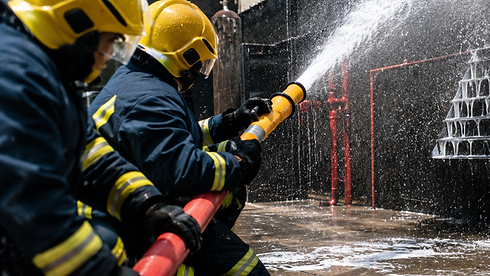
Recognise the fire, raise the alarm, use basic firefighting equipment correctly and escape safely when visibility deteriorates.
04 — OIS-04
Firefighting & Self Rescue
3 hours
Develop basic firefighting capability and the ability to escape safely when smoke or heat removes normal visibility.
Learners examine common offshore fire causes, the triangle of combustion, heat transfer through conduction, convection and radiation, and the use of firefighting media including water, foam, dry chemical and CO₂. The unit also covers fixed fire and gas detection systems and the actions required when a fire is discovered, with particular emphasis on raising the alarm, selecting the appropriate response and evacuating when required.
Practical exercises require learners to operate portable extinguishers against appropriate Class A or Class B fire scenarios and then move into self-rescue training. Learners practise smoke-hood use, individual escape in reduced and completely obscured visibility, and small-group escape techniques that conclude with muster.
.png)
RECOGNISE

ESCAPE

ALARM

MUSTER

RESPOND
Why the Rebreather EBS Pathway Matters
Train for the breathing system you may actually use offshore.
Product 5905 is built around the rebreather EBS pathway.Learners develop an understanding of the system, its operating duration, flotation dynamics and correct donning and operation before integrating EBS into helicopter emergency and underwater escape exercises.
Unlike the CA-EBS pathway, OPITO specifically states that compressed-air cylinders are not used during Product 5905 EBS training.


System
Understanding

Operating
Duration

Flotation
Dynamics

Integrated
Egress
EBS Technical Focus
Understand the system before you depend on it.
The EBS element develops an understanding of:
EBS operating principles
How the system provides emergency breathing capability.
Duration
Why the available breathing period must be understood.
Flotation Dynamics
How body orientation and the equipment interact in water.
Donning & Operation
How the EBS is correctly fitted, checked and operated.
The learner then progresses into practical use.
Experience how EBS behaves in the water.
Learners deploy, operate and breathe from the EBS in a controlled pool environment.The exercise specifically requires the learner to experience the positive and negative pressure effects created by body orientation in water.
This establishes familiarity before EBS is integrated into more demanding underwater helicopter escape exercises.

01
Know the system and how it works.
Understand

02
Wear it correctly and Securely.
Don

03
Complete allpre-use checks.
Check

04
Deploy in the exercise.
Deploy

05
Breathe correctly and stay calm.
Breathe

06
Escape safely and follow instructions.
Escape
Suraksha Marine HUET Simulator
Train the escape in a controlled helicopter environment.
At Suraksha Marine, HUET practical training is delivered using a purpose-built helicopter underwater escape simulator designed to support controlled submersion, inversion and emergency egress exercises.
Product 5905 requires HUET systems to include representative helicopter seating and restraints, push-out windows, controlled lowering, at least 180° rotation, emergency stopping capability and rapid retrieval.
.png)
6 Training Positions
.png)
4 Passengers +
2 Cockpit Positions
.png)
Multiple Push-Out Emergency Windows
.png)
Representative Restraint Systems
.png)
Controlled 180° Inversion
.png)
Dedicated Lowering
& Recovery System

.png)
Controlled Environment
Safe, repeateble conditions for effective learning.
.png)
Progressive Escape Training
Build skills and confidence through structure scenarios
.png)
Operational Realism
Realistic systems and motions that mirror field conditions

What HUET is Really Training
FOUR SKILLS.
One Outcome.
.png)
Reference
Maintain a physical point of orientation
>>>
.png)
Orientation
Recognise body and cabin position after movement
>>>
.png)
Release
Release restraint at the appropriate stage
>>>
.png)
Egress
Locate and pass through the nominated exit
These variations form part of the practical Product 5905 HUET sequence.
HUET Escape Progression
Build the escape sequence progressively.
HUET training increases in complexity as learners develop confidence and competence.
The minimum HUET team includes:
Lead Instructor
Crane/Hoist Operator or Dive Supervisor
OPITO HUET Divers
Pool Safety Person
01
Partial
Submersion
Escape without EBS.
04
Capsize
Escape from the inverted helicopter.
02
Partial
Submersion + EBS
Deploy, operate and breathe from EBS during escape.
05
Capsize + EBS
Breathe correctly and stay calm.
03
Partial Submersion + EBS + Push-Out Window
Integrate breathing-system operation with exit removal.
06
Capsize + EBS + Push-Out Window
Escape safely and follow instructions.
Push-Out Window Competence
Establish the exit skill before the final capsize exercise.
An important assessment detail within the Product Standard is that although push-out windows are fitted for the final capsize exercise, the learner's ability to push out the window is assessed during the partial-submersion exercise.
Demonstrate the exit action before adding the full inversion sequence.

Aviation Liferaft
The emergency continues after leaving the cabin.
Product 5996 includes both dry evacuation into an aviation liferaft and liferaft boarding from the water.
Learners understand the location, operation and use of aviation liferafts.
.png)
Secure mooring lines
.png)
Deploying the sea anchor
.png)
Raising the canopy
.png)
Raft maintenance
Medical Requirements
Be fit for the practical demands of training.
The programme contains physically demanding and potentially stressful activities.
Learners must satisfy an acceptable
medical-entry route, which may include:
-
valid offshore medical;
-
employer-approved equivalent;
-
fitness-to-work-at-sea certificate;
-
medical fitness for diving at work;
-
or appropriate screening through the OPITO-approved centre.
Medical eligibility should be confirmed before booking.
Swimming Ability
You do not need to hide your swimming ability.
These groups must be clearly
identified during pool exercises.
The standard recognises: swimmers, weak swimmers and designated non-swimmers.
A maximum of two designated non-swimmer learners may participate in any one HUET pool exercise.
Inform Suraksha Marine of your swimming ability before practical training.
Shoulder Breadth Measurement
Where required locally, learners should hold a valid Shoulder Breadth Measurement before offshore helicopter travel.
Shoulder Breadth Measurement may be required depending on the applicable offshore aviation regime. Confirm your mobilisation requirement before booking.
Why Suraksha Marine
Practical competence built around real equipment and controlled simulation.
-
Advanced HUET Simulation: Train in a dedicated underwater helicopter escape environment with controlled inversion and representative exits.
-
EBS-Specific Training: Move from EBS understanding and operation into practical pool use and helicopter escape.
-
Progressive Learning: Build competence through theory, demonstration, controlled practice, simulation and assessment.
-
Structured Safety Systems: HUET activities are supported by defined instructor, dive and pool-safety resources.
-
Integrated Offshore Emergency Response: Helicopter escape, survival, rescue, first aid, firefighting and self-rescue are developed as connected competencies.
-
Training Pathway Support: Suraksha Marine can help learners and corporate clients distinguish between the EBS and CA-EBS pathways.
Offshore Preparedness Begins Before the Flight
Product 5905 connects offshore safety knowledge, rebreather EBS operation, helicopter escape, survival and emergency response into one structured training pathway.
Breathing. Orientation. Escape. Survival.
Train the system.
Practice the sequence.
Demonstrate competence.
Corporate workforce mobilisation?
Check related Courses:
01
Tropical BOSIET with CA-EBS
Initial tropical offshore safety training integrating CA-EBS use, HUET, sea survival, first aid, firefighting and self-rescue.
04
Tropical HUET with EBS
Focused tropical HUET training integrating rebreather EBS use, underwater helicopter escape, inversion response and survival actions.
02
Tropical FOET with EBS
Further offshore emergency training to refresh and demonstrate rebreather EBS use, helicopter escape, firefighting, self-rescue and first aid.
05
Tropical HUET with CA-EBS
Focused tropical helicopter emergency training combining CA-EBS competence, underwater escape, capsize response and post-egress survival.


