


BOSIET vs Tropical BOSIET: The Complete Comparison Guide

Every year, thousands of workers preparing for their first — or next — offshore assignment face the same question at the booking stage: BOSIET or Tropical BOSIET? It sounds like a small administrative detail. In practice, it's one of the most common sources of mobilisation delay across the offshore training industry, and it's almost entirely preventable once the distinction is properly understood.
This article breaks down exactly what separates the two courses, what they share, how the equipment layer (EBS vs CA-EBS) fits into the decision, and how the refresher pathways — FOET and Tropical FOET — keep certification current over a career. Every fact below is checked against verifiable OPITO course specifications and industry sources, because in offshore safety training, approximate information isn't good enough.
The Core Distinction, Stated Plainly
BOSIET (Basic Offshore Safety Induction and Emergency Training) and Tropical BOSIET (T-BOSIET) are both OPITO-approved offshore safety courses aimed at personnel who are new to, or returning after a gap from, offshore oil and gas, energy, or renewables work. They share the same four foundational training modules.
The difference between them is the operating environment each course is designed around: BOSIET is built for standard operating conditions, while Tropical BOSIET is specifically adapted for personnel travelling to offshore installations by helicopter in tropical, warm-water regions.
That single distinction — environment, not difficulty — is the one point of confusion this article exists to resolve. Neither course is a "lighter" version of the other. Both are full, rigorous training products, and the correct one depends on where a worker is actually going to be operating, not on personal preference or convenience.
Why the Distinction Has Become More Important
Offshore careers today rarely stay within a single region or a single climate. A worker might begin on a standard-environment platform, move into a tropical offshore wind project, then support an FPSO campaign somewhere entirely different — sometimes within the same decade, occasionally within the same year. Each move can carry a different training requirement, and operators have become increasingly specific about exactly which course variant they expect before mobilisation.
This isn't bureaucratic tightening for its own sake. It reflects a genuine safety principle: training should match actual risk exposure. A worker prepared for cold-water hypothermia scenarios isn't automatically prepared for the heat stress and tropical storm considerations relevant to a warm-water posting, and the reverse is equally true. As the workforce becomes more mobile across regions, the industry's insistence on environment-specific training has, if anything, become more rigorous rather than less.
What BOSIET Covers
BOSIET is the foundational offshore safety course used across standard operating environments. It runs over three days, with OPITO structuring the course around approximately 21 hours of guided instruction, divided between classroom theory and hands-on practical exercises, including pool-based "dunker" simulator drills.
The course is built around four mandatory units:
Safety induction introduces offshore hazards, safety management systems, and the practical realities of alarm response and muster procedures — the foundational awareness every offshore worker needs before setting foot on an installation.
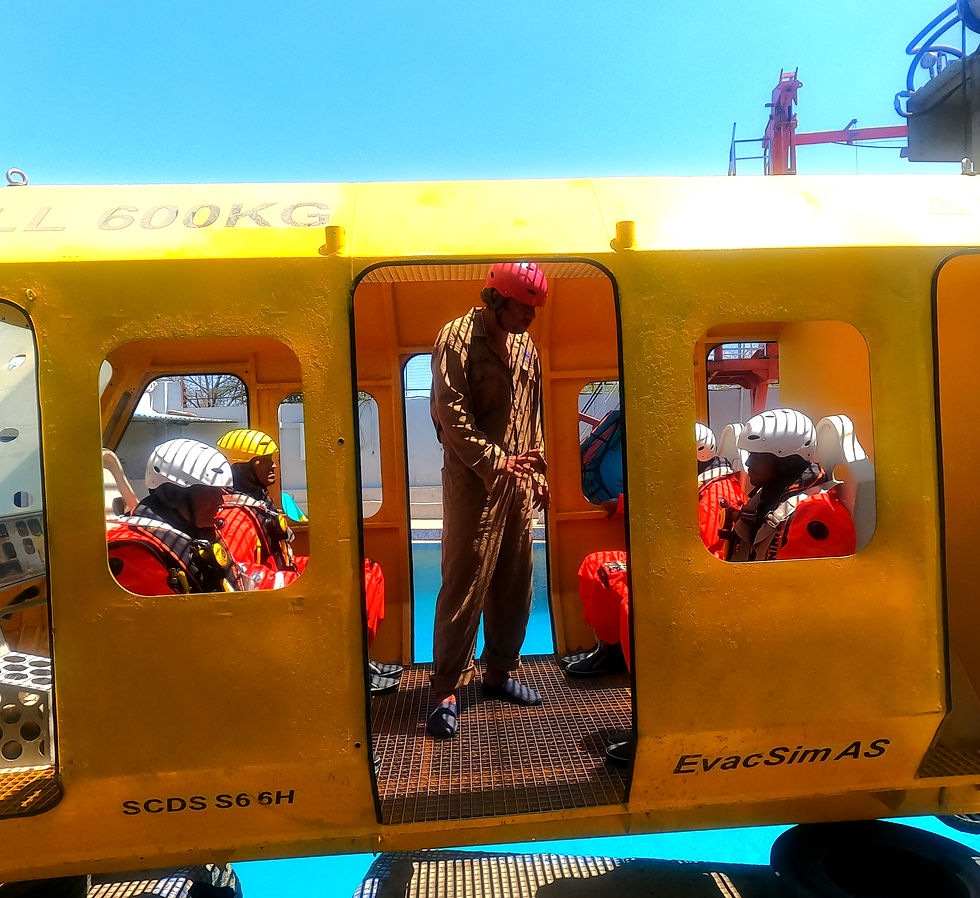
Helicopter safety and escape is the module most widely recognised, since it incorporates HUET (Helicopter Underwater Escape Training). This portion uses pool-based dunker simulators to train workers through the physical experience of escaping a submerged or inverted helicopter cabin, including breathing system deployment where applicable.
Sea survival with first aid covers what happens after evacuation into open water — liferaft boarding, group survival techniques, and emergency first aid delivered without immediate access to medical facilities.
Firefighting and self-rescue trains workers in basic firefighting equipment use and, critically, self-evacuation through smoke and low-visibility conditions.
BOSIET is commonly required for production technicians, drilling crew, maintenance personnel, subsea support teams, rope access workers, HSE staff, and new entrants heading into standard-environment offshore assignments, though the exact requirement always depends on the specific employer and operator.

What Tropical BOSIET Covers
Tropical BOSIET runs the identical four-module structure — safety induction, helicopter safety and escape, sea survival with first aid, and firefighting and self-rescue — but recontextualises the survival content for tropical, warm-water operating conditions.
The practical difference lies in what the training assumes about the operating environment. Standard BOSIET's sea survival content is built heavily around cold-water physiology, where hypothermia dominates the survival timeline and urgency calculation. Tropical BOSIET shifts that emphasis: hypothermia risk drops substantially in warm water, but heat stress, dehydration, tropical storm exposure, and often more remote rescue logistics become the relevant considerations instead.
This is worth stating clearly, because it's the single most common misconception around the course: tropical does not mean reduced seriousness. The underlying emergency-response skills — escaping a ditched helicopter, fighting a fire, evacuating through smoke — remain exactly as demanding as they are in the standard course. What changes is the environmental context those skills are applied within.
On delivery format, Tropical BOSIET offers a digital-delivery pathway that some training providers use alongside the traditional classroom format. OPITO's digital delivery specification for T-BOSIET calls for 8 guided learning hours of online theory instruction, delivered to groups of up to 8 learners, followed by mandatory in-person practical assessment at an OPITO-approved training centre. Some centres running the classroom-format version cite closer to 19 total instructional hours, so exact scheduling does vary by delivery method and provider — this is worth confirming directly at the point of booking rather than assuming a single fixed figure applies everywhere.
Certificate validity for Tropical BOSIET matches standard BOSIET exactly: four years, after which renewal happens through a refresher course rather than repeating the full induction.
A Direct Comparison
Feature | BOSIET | Tropical BOSIET |
Full name | Basic Offshore Safety Induction and Emergency Training | Tropical Basic Offshore Safety Induction and Emergency Training |
Built for | Standard operating environments | Tropical, warm-water regions |
Duration | 3 days, ~21 guided hours | 3 days classroom, or 8 guided hours digital plus practical assessment |
Core modules | Safety induction, helicopter escape, sea survival, firefighting | Same four modules, tropical-adapted |
Certificate validity | 4 years | 4 years |
Refresher pathway | FOET | Tropical FOET |
Relative difficulty | Full, rigorous course | Full, rigorous course — not reduced |
Offered by Suraksha Marine | Yes, including BOSIET with EBS (course code 5700) | Yes, dedicated Tropical BOSIET pathway |
Neither column in this table ranks above the other. They answer different operational questions, and choosing between them is a matter of matching training to environment, not comparing quality.
The Equipment Question That Sits Above Both Courses
Regardless of whether a worker is booking BOSIET or Tropical BOSIET, a second and equally consequential decision needs resolving: which emergency breathing system the training will cover, because this needs to match precisely what the operator supplies during actual helicopter travel.
EBS (Emergency Breathing System) is a rebreather-type device that recycles a limited air supply, providing breathing capacity during underwater helicopter escape.
CA-EBS (Compressed Air Emergency Breathing System) operates on an entirely different mechanism, supplying compressed air rather than recycled breath. Industry adoption of CA-EBS increased significantly following the UK Civil Aviation Authority's 2014 offshore helicopter safety review, known as CAP 1145, which prompted a broader industry shift away from rebreather-type EBS for many offshore helicopter passengers .
OPITO responded by building dedicated CA-EBS training directly into both BOSIET and FOET product lines, and this same distinction carries through to the tropical pathway.
This is not a minor technical footnote. A worker trained on EBS who is subsequently issued CA-EBS equipment at the point of travel — or the reverse — has a genuine competence gap at exactly the moment competence matters most. The correction is simple and available to anyone before they book: confirm with the employer or operator which specific breathing system will be supplied during travel, and select the matching course variant accordingly.
Historical Context: Why Two Separate Pathways Exist
Offshore safety training standards were originally shaped almost entirely around North Sea operating conditions — harsh weather, cold water, and survival scenarios structured around hypothermia risk. As offshore operations expanded into West Africa, Southeast Asia, the Gulf of Mexico, and South Asian waters, it became clear that applying cold-water survival assumptions uniformly across every region didn't reflect the operational reality those workers actually faced.
Rather than forcing a mismatch between training content and real conditions, OPITO developed Tropical BOSIET as a parallel, purpose-built product. This mirrors a consistent pattern across the evolution of offshore safety standards more broadly: as real-world operating conditions expose a gap between training assumptions and actual risk, the standard gets refined to close that gap.
The same logic that produced the EBS-to-CA-EBS transition after CAP 1145 produced the BOSIET-to-Tropical-BOSIET split earlier in the industry's development — training standards evolving in response to demonstrated operational need rather than being handed down as a fixed template.
Common Booking Mistakes and Why They Happen
A recurring pattern shows up across mobilisation delays tied to course selection, and understanding why these mistakes happen helps prevent them.
Booking based on price or scheduling convenience rather than actual requirement. This is understandable — workers are often eager to get certified and mobilised quickly, and a cheaper or sooner-available course is tempting. But if it doesn't match the operator's specified requirement, the time and cost invested doesn't translate into an accepted certificate.
Assuming BOSIET and Tropical BOSIET are automatically interchangeable. They are not. Acceptance of one course in place of the other depends entirely on the specific employer, operator, and regional requirement, and should never be assumed without direct confirmation.
Overlooking the EBS versus CA-EBS decision entirely. This is arguably the single most frequent cause of course-equipment mismatch across both the standard and tropical pathways, precisely because it's easy to focus on the base course name and forget the equipment layer sitting underneath it.
Treating "tropical" as a signal that the training will be less demanding. This misconception can subtly affect how seriously trainees engage with practical exercises, even though the underlying escape and survival skills carry identical stakes regardless of water temperature.
Delaying certificate expiry checks until close to mobilisation. A four-year validity window feels distant until the final weeks before a crew change arrive and a lapsed certificate suddenly becomes an urgent problem.
Conflating HUET with the full induction course. HUET is the helicopter-escape module embedded within both BOSIET and Tropical BOSIET — useful as a standalone course in specific circumstances, but not a substitute for the full induction where that broader course is required.
What Effective Training Planning Looks Like
For HSE managers and operations teams coordinating multi-region workforces, a few practices consistently prevent the mismatches described above.
Sorting personnel by project region at the point of assignment — before any training booking takes place — removes ambiguity early. A worker assigned to a tropical-region project gets flagged for Tropical BOSIET consideration from day one; a worker assigned to a standard-environment project gets flagged for BOSIET. Handling this at the assignment stage, rather than leaving it to the individual worker to figure out at booking time, closes off most of the confusion at its source.
Confirming equipment type alongside the base course decision — rather than treating EBS/CA-EBS as a separate, later step — prevents the gap where assumptions creep in. Both decisions, environment and equipment, should be resolved together.
Building refresher timelines into a proper workforce management system, rather than tracking expiry manually, matters more as workforce size grows. FOET and Tropical FOET renewal windows need the same proactive attention as initial course bookings, and a four-year interval is long enough that manual tracking reliably breaks down across a workforce of any meaningful size.
Extending this same rigor to contractors and vendor personnel, not just direct employees, closes a gap that shows up repeatedly in incident and near-miss reviews. Training requirements don't discriminate by employment status — everyone boarding the same helicopter needs the same verified competence.
Refresher Pathways: FOET and Tropical FOET
Certification from either course doesn't need to be repeated in full every renewal cycle. Workers holding a valid BOSIET certificate approaching its four-year expiry typically renew through FOET (Further Offshore Emergency Training), a considerably shorter one-day refresher course designed to rebuild practical sharpness rather than reteach foundational content. Workers holding a valid Tropical BOSIET certificate follow the equivalent Tropical FOET pathway.
These refresher courses exist because emergency response skills are perishable in a specific way: a worker can retain the theoretical knowledge of an escape sequence indefinitely while losing the practical fluency that comes only from recent, hands-on practice. Most offshore careers never require executing an actual helicopter escape or liferaft evacuation for real — which is precisely why deliberate, periodic refresher training matters. Waiting until skills have fully faded before addressing them defeats the purpose of the four-year cycle in the first place.
Confirming which specific refresher applies — FOET versus Tropical FOET — depends on which prerequisite certificate a worker currently holds, and this should be checked well ahead of the next mobilisation window rather than discovered under time pressure.

Getting the Decision Right the First Time
The distinction between BOSIET and Tropical BOSIET is not a technicality buried in course paperwork — it reflects a genuine difference in operational risk profile, environmental hazard, and survival methodology. Choosing correctly protects three things simultaneously: the worker's actual safety readiness, the employer's mobilisation timeline, and the operator's competence assurance process.
Neither course should be selected on the basis of price, convenience, or assumption. The correct choice depends on where the work is actually happening, what breathing system will actually be supplied, and what the specific operator has specified — information that takes a single confirming conversation to establish before booking, and considerably more time and cost to correct afterward if the wrong course has already been completed.
Suraksha Marine delivers both pathways as OPITO-approved training products — BOSIET with EBS, Tropical BOSIET, and their respective FOET and Tropical FOET refresher courses, alongside standalone HUET and CA-EBS training where required . For workers and companies uncertain which combination applies to a specific project, region, or equipment requirement, Suraksha Marine's training team is available to confirm the correct pathway before any booking is made — because in offshore safety training, the right course chosen the first time is always faster, and always safer, than correcting the wrong one under mobilisation pressure.
Training Inquiries:
Email: surakshaweb@gmail.com
Phone: +91 99873 00771 / +91 98192 12260
Website: www.surakshaweb.com
Frequently Asked Questions
What is the main difference between BOSIET and Tropical BOSIET?
BOSIET is the offshore safety induction course used for standard operating environments; Tropical BOSIET is the same category of training adapted specifically for tropical, warm-water regions. Both cover safety induction, helicopter escape, sea survival, and firefighting.
Is Tropical BOSIET a shorter or easier version of BOSIET?
No. It is a full, rigorous course adapted for a different operating environment, not a reduced version. Duration is broadly comparable, running three days in classroom format or 8 guided hours online plus mandatory practical assessment in the digital-delivery format.
How long does a BOSIET or Tropical BOSIET certificate remain valid?
Both certifications carry a four-year validity period, after which renewal happens through the respective one-day refresher course — FOET or Tropical FOET — rather than repeating the full induction.
Does BOSIET or Tropical BOSIET training include EBS or CA-EBS?
Both course pathways offer variants covering either EBS or CA-EBS, depending on which breathing system an operator supplies during actual helicopter travel. This should always be confirmed before booking, since the two systems are not interchangeable.
Can a standard BOSIET certificate be used where Tropical BOSIET is required, or vice versa?
Not automatically. Acceptance depends entirely on the specific employer, operator, and regional requirement, and should never be assumed without direct confirmation.
What is the difference between FOET and Tropical FOET?
FOET is the refresher course for workers renewing a valid standard BOSIET certificate. Tropical FOET is the equivalent one-day refresher for workers renewing a valid Tropical BOSIET certificate.


Comments