


USD 3.3 Trillion in Energy Investment: Why Safety Training Must Scale Globally

How BOSIET, HUET, FOET, H₂S and OERTM Prepare Workers for the Next Era of Energy
The Investment Boom Has a Human Side
The number USD 3.3 trillion sounds like a boardroom headline. It conjures capital allocation, megaprojects, FPSOs, offshore wind farms, LNG terminals, subsea infrastructure and drilling campaigns.
But behind every billion-dollar energy project is something more immediate.
A worker boarding a helicopter before sunrise. A technician transferring from a vessel to an offshore asset in three-metre swells. A process operator responding to a gas alarm at two in the morning. An emergency response team activating for a fire scenario on a platform with forty people on board.

Energy investment builds infrastructure. Training builds the people who must operate it safely. That distinction is not semantic — it is the difference between a project that performs and one that fails catastrophically.
A platform does not become safe because it is expensive. An offshore wind farm does not become safe because it is modern. An LNG terminal does not become safe because it is strategic. Safety is built through competence, systems, discipline and repeated practice.
That is why the global energy investment cycle must be matched by a deliberate, global scale-up in safety training.
Why This Moment Is Different
The energy sector is expanding in multiple directions simultaneously, and the workforce is changing with it.
Oil and gas remain essential to global supply and will do so for years. LNG infrastructure is growing rapidly. Offshore wind is moving from policy ambition to industrial deployment. Hydrogen is progressing from pilot projects toward commercial-scale operations. Maritime decarbonisation is shifting fuel types and changing the risk profile of vessel operations.
Existing offshore assets — platforms, FPSOs, subsea systems — still require skilled crews, maintenance teams and emergency-ready supervisors.
The workforce serving all of this is becoming more mobile. A single worker today may move from an oil and gas production role into offshore construction, then support an LNG project, then join an offshore wind campaign. That worker may need helicopter travel awareness, vessel-transfer competence, emergency breathing systems knowledge, sea survival capability, toxic gas response, firefighting basics and emergency team awareness — sometimes within a single career arc.
This convergence is why recognised competence standards matter more than ever.
The Numbers Behind the Training Need
Global energy investment is at a historic level
The IEA's World Energy Investment 2025 report projects global energy investment reaching USD 3.3 trillion in 2025. Approximately USD 2.2 trillion is directed toward clean energy technologies, grids and storage, while around USD 1.1 trillion continues to flow into fossil fuel supply.
Both streams create offshore and industrial workforces exposed to serious hazards. The energy transition does not eliminate risk — it redistributes and, in some cases, introduces new forms of it.
Offshore wind is creating a large new workforce
Global offshore wind capacity is forecast to approach 420 GW by 2035. More than 50 GW of offshore wind projects are currently under construction worldwide. That means more offshore construction activity, more vessel transfers, more working-at-height operations, more marine coordination and more emergency response requirements — all in a genuinely offshore environment.
The sea does not become less dangerous because the energy source is renewable.
Wind alone will need hundreds of thousands of technicians
The Global Wind Energy Council projects that the global wind sector will need approximately 628,000 technicians by 2030. Training cannot be an afterthought in workforce plans of that scale. It must be integrated from the start.
LNG export capacity is expanding significantly
The IEA's Gas 2025 outlook projects approximately 300 billion cubic metres per year of new LNG export capacity coming online globally by 2030, with the United States and Qatar as the primary contributors. LNG growth creates more gas-processing risk, marine export infrastructure, cryogenic systems management, emergency planning requirements and port-interface hazards.
Hydrogen is growing, but the risk profile is emerging
Global hydrogen demand reached approximately 97 million tonnes in 2024, but demand from new hydrogen applications remained below 1% of total consumption, according to the IEA's Global Hydrogen Review 2024.
Hydrogen as an industrial gas is not new — but the future hydrogen economy, with wider distribution, maritime bunkering and power applications, will require workers who understand hydrogen's distinct behaviour: wide flammability range, invisible flame, high diffusivity and rapid pressure buildup in confined spaces.
Offshore safety performance data reinforces the case
IOGP's most recently published annual safety performance report recorded 32 fatalities across member companies' submitted data, with offshore fatal accident rates remaining higher than onshore. The lesson is not that offshore work is inherently dangerous by design. The lesson is that it is high-consequence — and
high-consequence environments require people who have been properly prepared.
OPITO standards already operate at global scale
OPITO reports over 500,000 training registrations annually, across more than 50 countries and approximately 240 approved training centres. When energy workers cross borders and sectors, recognised standards create a consistent language of competence.
Suraksha Marine, as an OPITO-approved provider in India, is part of that global safety ecosystem.

How Offshore Safety Training Became Non-Negotiable
Offshore safety training did not emerge from regulatory paperwork. It emerged from industry incidents that demonstrated, repeatedly and at great cost, that technical systems alone are insufficient.
Platforms may have fire detection, gas alarms, emergency shutdowns, lifeboats, breathing apparatus and written procedures. But in a real emergency — during smoke, disorientation, noise, heat or structural damage — workers must act from trained habit, not from memory of a document they read during induction.
The offshore industry learned that competence must be practised, not just explained. It also learned that competence fades when not refreshed. A worker who completed training three years ago may understand the principles but hesitate during execution. Hesitation in an offshore emergency is itself a risk.
This is the foundation of BOSIET, HUET, FOET, Basic H₂S and OERTM — not compliance overhead, but conversion of safety knowledge into reliable emergency behaviour.
The Training Courses and Why They Exist
BOSIET — Foundation for Every New Offshore Worker
Basic Offshore Safety Induction and Emergency Training is the entry-level requirement for most personnel deploying to offshore oil and gas, offshore construction and related marine energy environments.

BOSIET covers offshore safety orientation, alarm and muster awareness, helicopter safety, sea survival, liferaft procedures, basic firefighting, self-rescue, first aid awareness and emergency response discipline.
Its purpose is specific: a technically skilled worker — a welder, a technician, an engineer — may know their trade completely but still be unprepared for the offshore emergency environment. BOSIET closes that gap before they board a helicopter or step onto an asset for the first time.
As new energy projects create new waves of first-time offshore workers, BOSIET becomes the first layer of a functioning safety culture.
HUET — Helicopter Safety for Offshore Travel
Helicopter Underwater Escape Training prepares personnel for emergency scenarios involving helicopter ditching or water impact. Training covers pre-flight safety briefing comprehension, brace positions, exit identification and approach, restraint release, underwater orientation, emergency breathing system use and post-escape surface survival.

Offshore helicopter travel carries a statistically distinct risk profile compared to commercial aviation, due to the operating environment, sea-state conditions, approach profiles and landing-area constraints. HUET ensures that workers are not encountering the sensory experience of helicopter inversion and water entry for the first time during an actual emergency.
As offshore wind projects — many of which use helicopter transfer to access distant assets — expand, helicopter safety competence remains relevant well beyond the traditional oil and gas sector.
FOET — Refresher Training for Skills That Fade
Further Offshore Emergency Training is the periodic refresher for personnel who already hold BOSIET or equivalent certification.
Emergency skills have a documented decay curve. A worker who completed BOSIET certification several years ago may have the correct theoretical understanding but reduced practical confidence and slower response under pressure. FOET re-establishes that confidence through practical drills in helicopter escape, sea survival, fire response and first aid.
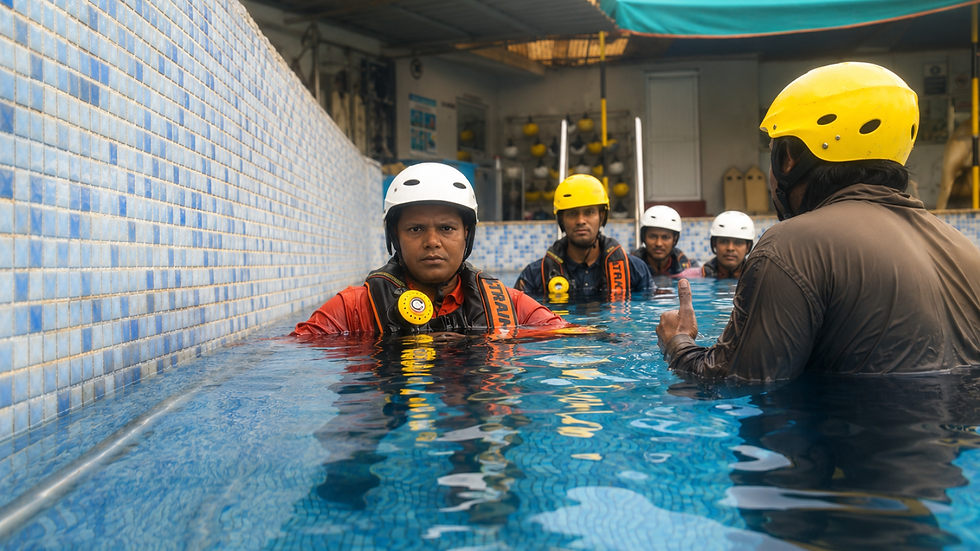
During periods of rapid project growth, there is a consistent industry tendency to prioritise getting experienced workers offshore quickly over ensuring their training is current. FOET is the control against that tendency — and against the overconfidence that experience alone can generate.
Basic H₂S — Toxic Gas Awareness for Oil, Gas and Beyond
Hydrogen sulphide remains one of the most serious chemical hazards in oil and gas operations. It is colourless, has a detectable odour only at low concentrations — with olfactory fatigue reducing detection at dangerous levels — and is toxic at surprisingly low thresholds.

Basic H₂S training prepares workers to understand gas properties and behaviour, recognise detection systems and alarm sequences, execute proper escape and respiratory protection procedures, and avoid the instinctive rescue response that turns single-casualty incidents into multi-casualty events.
H₂S exposure risk exists in drilling, production, sour gas processing, confined space entry and maintenance on hydrocarbon systems. As oil and gas operations continue throughout and beyond the energy transition, this training remains essential for workers exposed to gas-risk environments.
OERTM — Emergency Response Team Competence
Offshore Emergency Response Team Member training prepares designated personnel to take an active role in emergency operations — not simply to survive and muster, but to act as part of a coordinated response.
OERTM covers team-based firefighting, search and rescue under reduced visibility, casualty handling, breathing apparatus discipline, communication protocols and command structure awareness.
The distinction between BOSIET and OERTM is role-based: BOSIET is the standard for every offshore worker; OERTM is for those assigned to emergency response duties. Both are necessary. An emergency response team without OERTM-level competence is equipment without trained operators.
As new assets come online — platforms, FPSOs, offshore wind substations, LNG facilities — each requires a trained emergency response team, not just the equipment to support one.

Five Scenarios That Illustrate the Risk
The first-time offshore technician.
A mechanical engineer joins his first offshore assignment. He is technically competent. But he has never mustered during a gas alarm, never boarded a liferaft, never been briefed on helicopter egress. BOSIET converts his general industrial experience into offshore emergency readiness.
The offshore wind technician.
He is not working on a hydrocarbon platform — but he transfers to a substation by vessel in deteriorating weather, works at height above open water and is more than 80 kilometres from shore. Sea survival awareness, vessel-transfer safety and emergency response planning are directly relevant to his safety.
The HSE manager building a training matrix.
She is preparing workers for simultaneous deployments to oil and gas, offshore wind and marine logistics roles. The challenge is not booking courses — it is identifying the correct training pathway for each role, asset type and operator requirement, tracking expiry dates and managing refresher cycles across a mobile workforce.
The emergency response team.
The platform has breathing apparatus, firewater systems and hose stations. But equipment only functions when trained people activate and operate it correctly, under the stress of heat, smoke, noise and time pressure. OERTM is what converts the equipment investment into actual emergency capability.
What Good Training Actually Looks Like
Effective offshore safety training does more than transfer information. It builds responses that hold under stress.

Role-based pathways.
Not every worker needs identical training. A new offshore entrant needs BOSIET. A helicopter passenger may need HUET and CA-EBS. A returning worker may need FOET. A sour-gas environment worker needs Basic H₂S. An emergency response team member needs OERTM. Role-matched training prevents both gaps and unnecessary confusion.
Practical simulation.
Adult learners in safety-critical roles need to experience equipment under realistic conditions — what a restraint feels like under water pressure, how stress affects decision speed, how smoke changes spatial orientation, how team communication breaks down under noise. Simulation creates the procedural memory that classroom instruction cannot.
Incident-linked learning.
Procedures are more durable when learners understand the incidents that created them. Case studies, near-miss reviews and scenario discussions help workers connect the training to real consequences — which is the most effective form of motivation.
Human factors content.
Fatigue, overconfidence, confirmation bias, task fixation and communication failure all affect emergency performance. Competent training does not only teach procedures — it teaches workers how human behaviour changes under pressure and what to do about it.
Quality at scale.
As demand increases, there will be pressure to reduce training time, increase group sizes or simplify practical components. Standards exist precisely to prevent this. Scaling training must mean wider access and better planning — not compressed delivery and weakened assessment.
Practical Guidance
For Offshore Workers
Understand why each course matters to your specific role and exposure, not just what certificate it produces
Keep all certifications current — certificate expiry is a mobilisation blocker that affects you, not only your employer
Take helicopter and vessel briefings seriously every time, even on familiar routes
Practise emergency procedures actively during drills rather than treating them as administrative events
Report hazards early — you are part of the safety system on every asset you enter
For HSE Managers
Build training matrices by role, asset type and operator requirement before project mobilisation begins
Build certificate expiry tracking into your workforce management system, not a spreadsheet reviewed before crew change
Use FOET proactively to manage skill decay — do not wait for certificates to expire before scheduling refreshers
Ensure H₂S training is assigned to workers whose actual job tasks involve gas-risk environments, not applied universally or avoided selectively
Review incident and near-miss data from your sector annually and assess whether your training pathways reflect current hazard profiles
For Operations Managers
Treat training planning as part of project readiness, at the same level as equipment procurement and logistics
Budget training into project costs from the start — late identification creates schedule risk and reduced training quality
Avoid the pattern of approving training in principle but creating schedule pressure that compresses preparation time
Recognise that competence gaps are operational risk, not just HR administration
For Those Entering Offshore Careers
BOSIET is your foundation — the course that introduces you to how offshore environments manage emergencies and how you are expected to contribute. HUET prepares you for the specific experience of helicopter egress. Basic H₂S gives you the awareness to work safely in gas-risk environments without panic or incorrect response. FOET is how you maintain that competence over a career. OERTM is how you take on a more active role in protecting the people around you.
Offshore work rewards those who treat safety with the same professionalism they bring to their technical role. Training is not the obstacle to getting on a project. It is the foundation on which a professional offshore career is built.
Conclusion: Investment Builds Infrastructure.
Training Builds the People Who Protect It.
The global energy sector is expanding on multiple fronts simultaneously. Oil and
gas continue to operate at scale. LNG infrastructure is growing. Offshore wind is accelerating. Hydrogen is transitioning from policy to project. Marine operations are evolving under decarbonisation pressure.
Every one of these trajectories creates workers in high-consequence environments — people who need to recognise hazards, travel safely to assets, respond correctly to alarms, survive offshore emergencies, manage gas risks, support emergency response teams and return home after every rotation.
BOSIET builds the foundation. HUET prepares workers for helicopter escape. FOET keeps competence current. Basic H₂S prepares workers for toxic gas environments. OERTM develops the emergency response capability that every offshore asset needs.
The energy investment story is ultimately a people story. And prepared people are the most important safety control in any offshore operation.
Planning offshore mobilisation, building a corporate training matrix, managing refresher certification cycles or developing emergency response readiness for oil and gas, offshore wind, LNG or future energy projects?
Contact Suraksha Marine to enquire about OPITO-approved BOSIET, HUET, FOET, Basic H₂S, OERTM, CA-EBS, sea survival, firefighting and offshore emergency response training in India.
Training Inquiries:
Email: surakshaweb@gmail.com
Phone: +91 99873 00771 / +91 98192 12260
Website: www.surakshaweb.com
Would you like me to adjust the tone further — for instance, making the client-facing sections more formal/proposal-style, or the trainee sections slightly warmer and more encouraging? I can also create a condensed version optimised purely for web readability.
Frequently Asked Questions
Why does global energy investment increase training demand?
More investment means more projects, more worksites and more workers deployed to offshore and hazardous industrial environments. Each new deployment creates new exposure. Exposure without training preparation is risk without control.
Does offshore wind require the same safety training as oil and gas?
Not identically, but substantially. The hazard profiles differ — offshore wind does not involve hydrocarbon processing — but marine transfer, remote location, working at height, weather exposure, emergency evacuation and sea survival remain directly relevant. Some offshore wind operations also involve helicopter transfer.
Why is FOET required if a worker is already experienced?
Because emergency response skills decay over time, and experience can create overconfidence. FOET is not a reassessment of basic competence — it is a practical refresher that re-establishes the muscle memory and decision speed that emergency response requires.
What makes H₂S particularly dangerous compared to other industrial gases?
H₂S causes olfactory fatigue — at moderate concentrations, workers may lose their ability to smell it before reaching dangerous exposure levels. It is also acutely toxic at concentrations well below what many workers intuitively treat as serious, and it creates a strong instinctive rescue response that frequently turns single-casualty events into multi-casualty incidents.
What is the difference between BOSIET and OERTM?
BOSIET prepares every offshore worker for self-survival and basic emergency response. OERTM prepares designated team members to actively support emergency operations — firefighting, search and rescue, casualty handling, breathing apparatus use and team coordination. Both are necessary on any offshore asset.
When should training be booked relative to deployment?
Training should be part of project workforce planning from the earliest mobilisation phase. Last-minute booking creates certification timing issues, reduces preparation time and often results in poorer learning outcomes.


Comments