


OERTM Offshore Training: Ensuring Offshore Safety

When Seconds Matter, Emergency Teams Need More Than Basic Survival Skills
Offshore environments do not forgive hesitation, weak coordination, or half-learned emergency procedures. That is why OERTM offshore training matters: it prepares designated emergency responders to act with control, clarity, and discipline when fire, smoke, injury, equipment failure, or evacuation risk threatens an installation and everyone on it.

The Offshore Emergency Response Team Member standard is intended for personnel appointed, or about to be appointed, to an offshore emergency response role, and OPITO makes clear that onshore training is only one part of the full competence picture. The duty holder is still responsible for workplace training, offshore drills, competence assessment, and any additional specialist modules such as confined-space or working-at-height training before a person is fully appointed to the role.
Why OERTM matters
The case for OERTM is simple: offshore emergencies escalate fast, and poorly prepared teams lose precious time at the exact moment when time matters most. U.S. offshore regulators require immediate reporting of fatalities, evacuation injuries, loss of well control, fires, explosions, structural damage, crane incidents, and damage to safety systems, which shows how wide the emergency-risk profile remains in offshore oil and gas operations.
The statistics underline the point. Between 2012 and 2020, U.S. offshore operations recorded 4,474 incidents, 1,654 injuries, and 23 fatalities, while a separate long-term study found that oil and gas extraction workers faced a fatality rate seven times higher than the average for all U.S. workers during 2003 to 2010.
Even in more recent global upstream reporting, IOGP’s 2023 safety data showed an offshore fatal accident rate of 0.59, confirming that high-hazard exposure has not disappeared just because systems and standards have improved.
That is where OERTM becomes more than a regulatory box to tick. It builds a response capability inside the installation itself, so the first people confronting a fire, casualty, smoke-filled area, or controlled evacuation are not improvising under stress but working from trained roles, practiced communications, and repeatable actions.
What OERTM training actually covers
At its core, OERTM training prepares offshore personnel to operate as part of a structured emergency team rather than as isolated individuals. OPITO’s standard frames the role around knowledge, understanding, and practical performance for those who may need to respond to incidents offshore, while further training exists specifically to refresh abilities that cannot be fully practised offshore during normal drills.
In practical terms, strong OERTM programmes develop competence in:
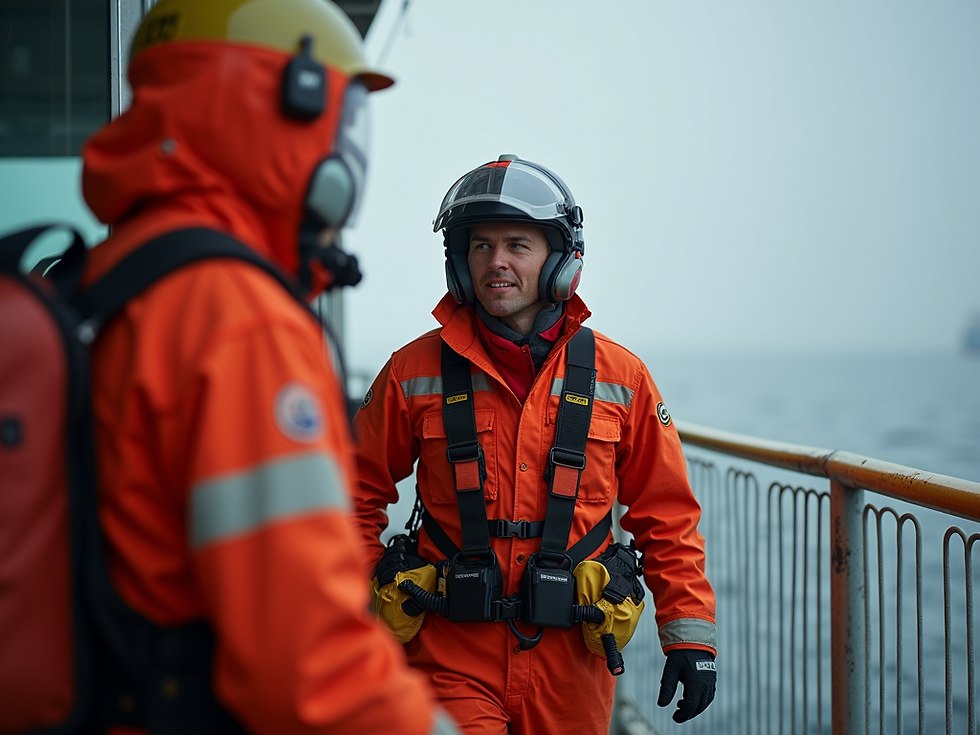
Emergency-response PPE selection and safe use during offshore incidents.
Controlled approach to an incident area under the direction of the Offshore Emergency Response Team Leader.
Communication hierarchy, radio discipline, and understanding the limits of communication methods during an emergency.
Team-based response in conditions where smoke, heat, noise, confined access, and changing hazards can affect both mission success and responder safety.
This is why OERTM should not be described as generic firefighting alone. It is a role-specific emergency-response framework designed for offshore settings where responders must control their own exposure, receive direction, support the wider command structure, and still protect colleagues, assets, and the environment.
The safety impact offshore
Well-run offshore emergency response depends on something deeper than courage. It depends on trained people who can recognize changing conditions, work inside a chain of command, and keep functioning when heat, noise, stress, and uncertainty all rise together.
That need is not theoretical. The 2023 SafeOCS annual report identified 194 known oil and gas production safety system failure events, a 26.8 percent increase from 2022, showing that safety-critical failures remain an active operational concern even in modern offshore systems.
When wells, process equipment, or safety systems fail, emergency teams must bridge the gap between the first abnormal event and the arrival of full incident control, which is exactly why response readiness matters so much.
OERTM also strengthens the wider safety culture on board. Personnel trained for emergency roles tend to improve hazard awareness, role clarity, and drill discipline across the installation, because they understand not just what to do in an emergency but why sequence, communication, and containment matter. In other words, OERTM improves both incident response and everyday preparedness.

Where BOSIET fits in
Many offshore workers first encounter emergency training through BOSIET, while OERTM sits at a more specialized point in the competence pathway. OPITO’s OERTM standard does not present onshore training as a standalone endpoint; instead, it places OERTM inside a broader programme that includes workplace practice, offshore exercises, and competence assessment by the duty holder.
That distinction matters for career planning. Basic offshore induction and emergency training builds personal survival awareness, but OERTM develops the response capability expected from people who may be called forward during an actual incident rather than simply follow muster and evacuation instructions.
For employers, that makes OERTM-certified personnel especially valuable in crews where emergency-team readiness is part of the installation’s core barrier system.
Why it matters for careers
OERTM improves employability because it signals something very specific: this worker is prepared not only to protect themselves, but to support the emergency capability of the entire installation.
Since the standard is issued through OPITO’s industry framework and linked to duty-holder competence expectations, it carries clear relevance for offshore employers working to recognized training systems.
It also positions candidates for progression. Offshore installations need reliable team members, team leaders, helideck support personnel, and emergency-response specialists who can function in structured drills and real incidents, and OERTM helps form that pipeline by building disciplined team behaviour before leadership responsibilities are added.
In a sector still managing high consequence risks, specialist safety competence is not peripheral to career growth; it is often one of the clearest ways to stand out.
Why Suraksha Marine’s approach fits this need
Suraksha Marine positions itself as an OPITO-approved offshore safety training provider and highlights programmes including BOSIET, HUET, FOET, Basic H2S, CA-EBS, and OERTM-related offshore emergency training in its broader offshore training portfolio.
That alignment matters because OERTM works best when it is delivered as part of a realistic training ecosystem where survival, escape, firefighting awareness, gas safety, and team response are treated as connected skills rather than isolated certificates.
OERTM Offshore Training is not just about responding to emergencies. It is about building the kind of offshore team that can contain chaos, protect life, and preserve critical minutes when every decision carries consequences.
At Suraksha Marine, offshore emergency training supports that exact goal by helping personnel move from awareness to readiness, and from readiness to dependable action under pressure.
Training Inquiries:
Email: surakshaweb@gmail.com
Phone: +91 99873 00771 / +91 98192 12260
Website: www.surakshaweb.com
Suraksha Marine is committed to delivering world-class offshore safety and technical training, helping professionals meet and exceed international standards while fostering sustainable careers in the energy sector.

Comments